

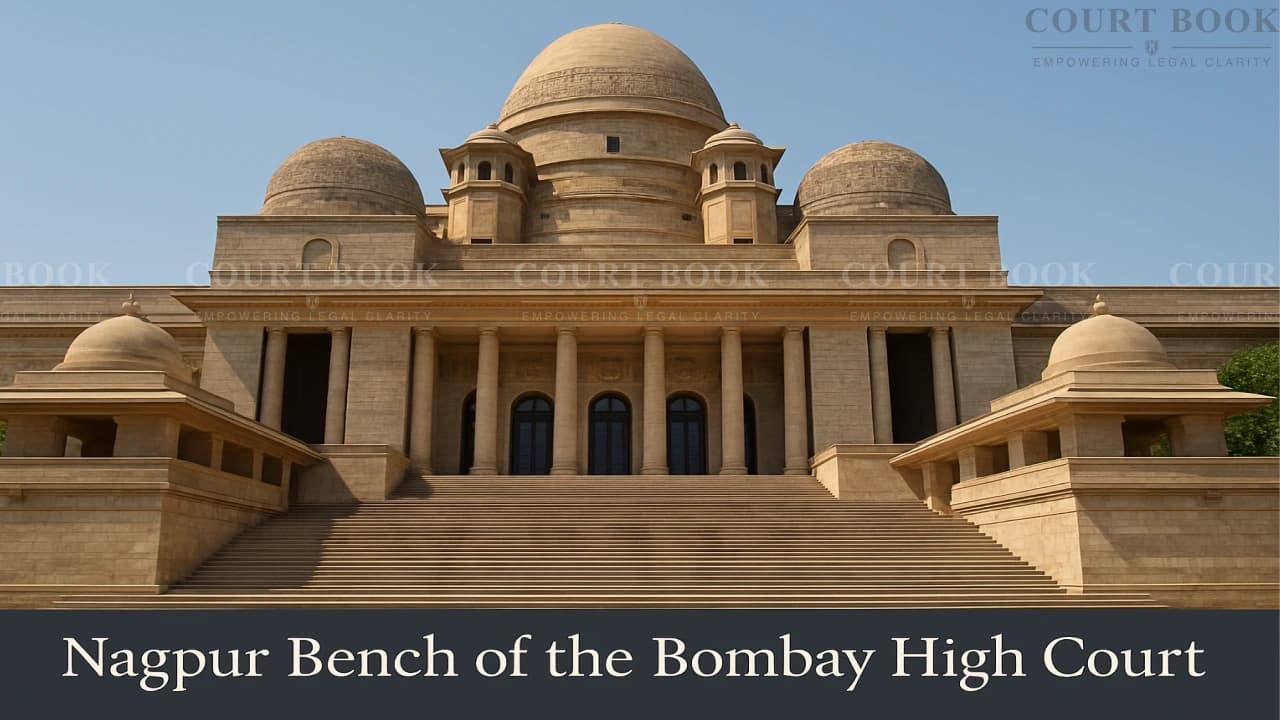
The Nagpur Bench of the Bombay High Court has stepped in to resolve a long-running dispute over a mining lease timeline, granting relief to Dalmia Cement (Bharat) Limited. The court ruled that the State of Maharashtra wrongly curtailed the statutory extension period available to the company for executing a mining lease, despite delays that were beyond its control.
The judgment was delivered on December 23, 2025, by a Division Bench comprising Justice Anil S. Kilor and Justice Rajnish R. Vyas.
Background of the Case
Dalmia Cement had emerged as the preferred bidder for a limestone mining lease in the Gojoli Mineral Block in Chandrapur district after a competitive auction process. A Letter of Intent (LoI) was issued in September 2020, giving the company three years to complete statutory compliances and execute the mining lease deed.
Read also:- Calcutta High Court Flags Delay in Murder Trial, Seeks Change of Public Prosecutor in Long-Pending Bail Case


Under the applicable rules, this three-year period could be extended by another two years if delays occurred for reasons beyond the bidder’s control.
According to the company, several unexpected developments slowed the process. These included an increase in the identified forest land requiring diversion, fresh wildlife-related restrictions following the notification of the Kanhargaon Wildlife Sanctuary, and the need for multiple environmental and forest clearances from different authorities.
Before the initial three-year period expired in September 2023, Dalmia Cement formally applied for a two-year extension. However, the State government did not decide the request for nearly two years.
Dispute Over the Extension
When the State finally responded in April 2025, it granted an extension only up to September 9, 2025. In effect, the company received barely a few months of additional time instead of the full two years permitted under the rules.
Dalmia Cement challenged this decision, arguing that the law did not allow the State to shorten the extension period once it accepted that the delay was not the company’s fault.
The State, on the other hand, maintained that the total life of a Letter of Intent could not exceed five consecutive years from the original date, and that it had acted within its powers.
Court’s Observations
After examining the relevant provisions, the Bench focused on the purpose behind the extension clause. It noted that the law clearly provides a three-year period, extendable by a further two years, to enable bidders to complete mandatory compliances and execute the mining lease deed.
“The court found that once the authority is satisfied that the delay was beyond the control of the preferred bidder, the extension cannot be cut short,” the Bench observed.
Importantly, the judges rejected the State’s interpretation that the two-year extension must always be counted from the end of the initial three-year period, even if the decision on extension itself was delayed by the authorities.
The Bench underlined that the rule does not use the words “up to two years”. Instead, it speaks of “a further period of two years,” leaving no discretion to grant anything less.
Adopting a purposive interpretation, the court said a narrower reading would defeat the very object of the provision and lead to an unfair result.
Decision
Setting aside the State’s communications dated April 4, 2025, and September 1, 2025, the High Court directed Maharashtra to grant Dalmia Cement a full two-year extension from the date on which the extension was actually granted.
The Bench ordered that the period between April 4, 2025, and September 9, 2025, should not be counted against the company while calculating the two-year extension for completing compliances and executing the mining lease deed.
With this direction, the writ petition was allowed, and the rule was made absolute, with no order as to costs.
Case Title: Dalmia Cement (Bharat) Limited v. Union of India & Others
Case Number: Writ Petition No. 5113 of 2025
Download Order


