

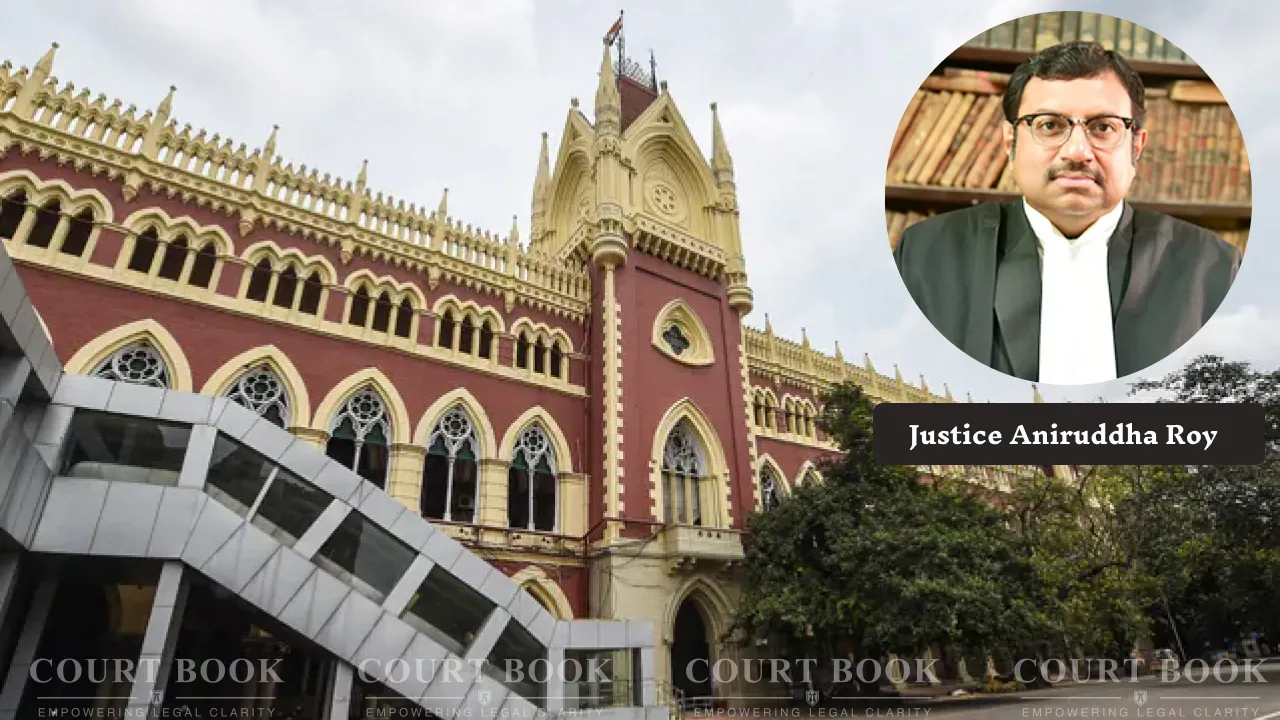
The Calcutta High Court has reinstated an SSB constable whose services were terminated years after he had already been punished in a departmental proceeding for allegedly suppressing information about a criminal case at the time of recruitment. The Court held that the authorities acted without jurisdiction when they later annulled the earlier punishment and ordered his removal from service.
Background of the Case
Petitioner Mukesh Kumar Pandey was appointed as a Constable (General Duty) in the Sashastra Seema Bal (SSB) in 2006. During a departmental inquiry, authorities alleged that he had not disclosed the existence of a criminal case while filling out his verification form during recruitment.
Following the inquiry, the disciplinary authority passed an order on March 5, 2013, imposing a minor penalty of seven days’ pay fine. The authority observed that the petitioner was young at the time of the incident and appeared to have omitted the information out of fear or inadvertence.
Several years later, senior authorities reviewed the matter and concluded that the punishment was too lenient. Fresh show-cause notices were issued, and in October 2019 the petitioner’s services were terminated. His statutory appeals were subsequently rejected.
Justice Aniruddha Roy examined the scope of Rule 29 of the CRPF Rules, which was relied upon by the authorities to reopen the matter and annul the earlier punishment.
The Court noted that Rule 29 primarily provides a revisional remedy to a member of the force whose appeal has been rejected. According to the Court, the revisional powers under Rule 29(d) cannot be exercised independently unless a revision petition has first been filed by the concerned employee.
The bench observed that,
“in absence of any revision having been preferred by the petitioner, in the instant case, there was no scope for exercising revisional power by the Superior Authority.”
The Court further held that Rule 29(d) was not an independent source of power and had to be read together with Rule 29(a). Since no revision petition had been filed by the petitioner, the authorities lacked jurisdiction to invoke Rule 29(d) and annul the earlier punishment.
Rejecting the argument that the petitioner had waived his rights by participating in the later proceedings, the Court stated that principles such as waiver, acquiescence, or estoppel cannot validate an action that is fundamentally without jurisdiction.
Allowing the writ petition, the Calcutta High Court quashed the decision annulling the earlier punishment, the subsequent termination order dated October 25, 2019, and the appellate orders that had upheld the termination.
The Court directed that the petitioner be treated as continuing in valid service after the original punishment imposed in March 2013 and held that his service should be regarded as continuous.
It further ordered that the period during which he remained out of service due to the impugned termination should not be treated as unauthorized absence for the purpose of calculating service and retirement benefits.
Case Details
Case Title: Mukesh Kumar Pandey vs The Union of India and Others
Case Number: WPA 340 of 2021
Judge: Justice Aniruddha Roy
Decision Date: June 11, 2026


