The Supreme Court has referred to a Larger Bench the question of whether a Civil Judge (Senior Division) notified as a Commercial Court can hear suits concerning trade mark infringement under Section 134 of the Trade Marks Act, 1999.
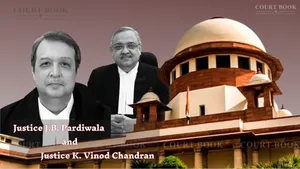
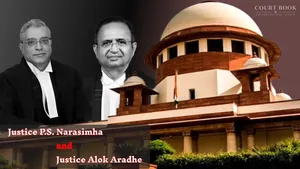
The issue arose in a dispute concerning the interaction between Section 134 of the Trade Marks Act and the Commercial Courts Act, 2015. The order was passed by a Bench comprising Justice J.B. Pardiwala and Justice K. Vinod Chandran on September 21, 2026.
The appeal concerned proceedings in Jharkhand, where the Civil Judge (Senior Division) had been notified as a Commercial Court. Section 134 of the Trade Marks Act restricts suits for infringement and related reliefs from being instituted before a court below the level of a District Court having jurisdiction to try the suit.
The appellants argued that allowing such matters to be filed before a Civil Judge (Senior Division) could affect the appellate remedy available to litigants. They submitted that an appeal would lie to the District Court, while the High Court's jurisdiction would largely remain confined to revision or proceedings under Article 227.
The respondents relied on the Commercial Courts Act, particularly its provisions covering intellectual property disputes and Section 21, which gives the Act overriding effect where there is an inconsistency with another law.
The Court examined earlier decisions dealing with conflicts between special statutes and the Commercial Courts Act. It considered, among others, Kandla Export Corporation v. OCI Corporation, Fun N. Fud v. GLK Associates and Jaycee Housing Private Limited v. Registrar (General), Orissa High Court.
The Bench observed that intellectual property rights, including trade marks, form part of the broader category of commercial disputes under the Commercial Courts Act. However, Section 134 of the Trade Marks Act specifically requires certain suits to be instituted before a District Court.
"Further, intellectual property rights including that of trade marks is only a species [2(c)(xvii)] of the larger genus of commercial disputes."
The Court noted that the difficulty arises when a notification under the Commercial Courts Act designates a Civil Judge as a Commercial Court. It observed that permitting such a court to entertain trade mark suits may create an apparent conflict with the specific jurisdiction prescribed under Section 134.
The Bench also highlighted the practical anomaly in Jharkhand. Civil Judges (Senior Division) notified as Commercial Courts have pecuniary jurisdiction between ₹3 lakh and ₹1 crore. Consequently, a trade mark suit valued below ₹3 lakh would still have to be filed before the District Court under Section 134, while a suit above that threshold could be placed before the Civil Judge (Senior Division).
The Court also referred to the position in Kerala, where later notifications designated District Courts and Additional District Courts as Commercial Courts for disputes involving statutes including the Trade Marks Act.
The Supreme Court held that the apparent conflict between the earlier decisions required consideration by a Larger Bench. It said the issue should be settled uniformly across States rather than being dependent on different notifications issued by High Courts.
"The matter shall be placed before the Hon’ble the Chief Justice of India for appropriate orders."
The Commercial Suit No. 11 of 2023 pending before the Civil Judge (Senior Division)-I, Jamshedpur, was stayed.




-300x169.webp)
-300x169.webp)



-300x169.webp)