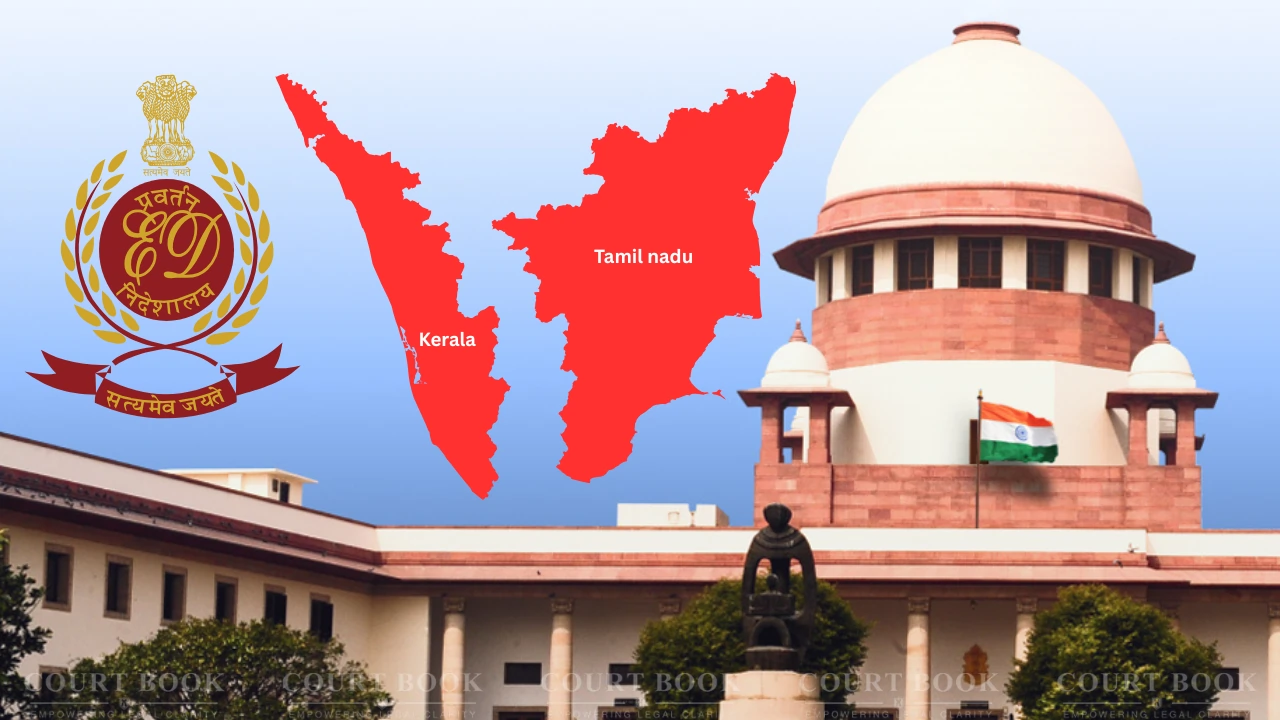
A sharp constitutional question landed before the Supreme Court on Monday: can the Enforcement Directorate (ED) itself file a writ petition under Article 226 before High Courts?
A Bench of Justice Dipankar Datta and Justice Satish Chandra Sharma issued notice on petitions filed by the States of Kerala and Tamil Nadu, which have challenged a Kerala High Court view that the ED, being a statutory authority, has the right to approach a High Court under Article 226.
The notice has been made returnable within four weeks. No stay was granted at this stage.
Background of the case
The dispute traces back to the UAE gold smuggling case, in which 30 kilograms of gold worth about ₹14.82 crore was seized at Thiruvananthapuram International Airport on July 6, 2020.
The gold was allegedly sent to the UAE Consulate and marked as “Diplomatic Baggage”, triggering investigations by multiple central agencies. During the probe, offences under the Unlawful Activities (Prevention) Act, 1967 (UAPA) and the Prevention of Money Laundering Act, 2002 (PMLA) were also flagged, following which the NIA and ED registered cases.
Kerala later constituted a Commission of Inquiry to examine allegations that central agencies were falsely implicating political leaders, including Chief Minister Pinarayi Vijayan, in the case. The Commission was headed by retired High Court judge Justice V.K. Mohanan.
The ED then moved the Kerala High Court, challenging the State’s notification setting up the inquiry commission.
Read also:-Bombay High Court Sets Aside ₹20,000 Maintenance Order, Flags Gaps in Wife’s Income Disclosure
What Kerala and Tamil Nadu told the Supreme Court
In the Supreme Court hearing, Senior Advocate Kapil Sibal appeared for Kerala, while Tamil Nadu was represented through counsel, including senior advocates.
At the start, Justice Sharma noted that the Kerala High Court order was interim in nature. Sibal, however, disagreed on the impact, telling the Bench that for Kerala, the order effectively settles a core legal issue.
He said the Supreme Court would now have to decide a larger question: whether the ED has the competence to invoke Article 226 at all.
As Sibal put it in court:
“Because of this final order, the issue that mylords have to… adjudicate is the competence of this department to file a writ petition in Article 226.”
He also flagged the constitutional angle involving the relationship between Article 131 (which deals with disputes between the Union and States) and Article 226 (writ powers of High Courts).
Read also:- Jharkhand High Court Upholds Divorce, Grants ₹35,000 Monthly Maintenance to Wife and Daughter
Tamil Nadu, in its separate plea, argued that the Kerala High Court’s view could have a wider ripple effect because the ED has also invoked writ jurisdiction in matters involving Tamil Nadu, including a mining-related dispute.
Kerala High Court’s view: ED is a statutory authority
The States are challenging the Kerala High Court’s September 26, 2025 order, which upheld a single judge’s interim order staying the inquiry commission.
Kerala had argued that the ED is only a department under the Central Government and therefore cannot independently file a writ petition.
But the High Court rejected that argument, holding that the ED is a statutory body and can approach the High Court under Article 226.
The High Court had observed:
“Insofar as the Directorate of Enforcement is a statutory body, the contention that it is only a Department of the Central Government is only to be rejected.”
Read also:- General Allegations Can’t Prove Cruelty Where In-Laws Never Lived With Complainant: Patna High
It further stated:
“The proposition that a statutory body is entitled to file a writ petition invoking Article 226 of the Constitution cannot be doubted.”
The High Court also noted that even if the ED’s ability to file a petition in its own name is questioned, the Deputy Director of Enforcement, being a statutory authority under the PMLA, would still have the legal standing to do so.
After hearing the initial submissions, the Supreme Court Bench issued notice to the ED on the petitions filed by Kerala and Tamil Nadu.
The Bench ordered that the notice is returnable within four weeks. Importantly, the Court did not grant any stay on the High Court order at this stage.
Court’s decision
The Supreme Court has issued notice and will examine the question of whether the Enforcement Directorate can file writ petitions under Article 226 before High Courts. The matter will now proceed after responses are filed.
Case Title: State of Kerala & Ors. v. Enforcement Directorate & Anr.
Case No.: SLP(C) No. 1479/2026Case Title: The State of Tamil Nadu & Ors. v. Directorate of Enforcement
Case No.: T.P.(Crl.) No. 34/2026Case Title: State of Tamil Nadu v. Enforcement Directorate & Ors.
Case No.: Diary No. 1263/2026Decision Date: January 20, 2026






 chief. Eknath Shinde – Shiv Sena leader-300x169.webp)
-300x169.webp)