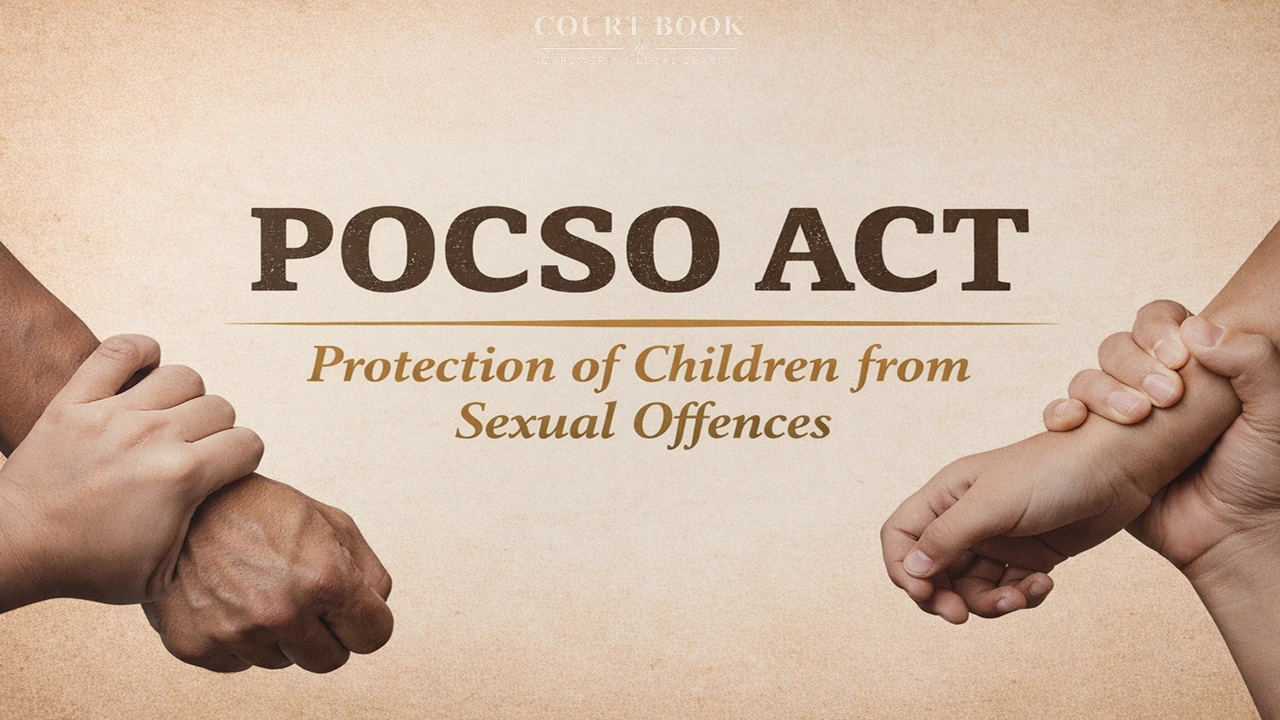
The Madurai Bench of the Madras High Court has set aside the conviction of a young man in a case registered under the Protection of Children from Sexual Offences (POCSO) Act, holding that the prosecution failed to properly prove the age of the victim — a crucial element required to sustain the charges.
Justice N. Mala allowed the criminal appeal filed by the accused and ordered his immediate release, observing that the trial court had relied on inadmissible secondary evidence while determining the victim’s age.
Read also:-Gym Review Row Reaches Court: Orissa High Court Refuses Relief in Police Harassment Allegations Case
Background of the Case
According to the prosecution, the victim girl, aged around 16 at the time of the incident, had become acquainted with the accused, a friend of her elder brother. Over time, the two developed a relationship and communicated regularly over the phone.
The prosecution alleged that in March 2018, the accused expressed his intention to marry the girl. Around the same time, the girl’s parents were reportedly planning her marriage against her wishes.
On 4 March 2018, the girl left her parental home early in the morning and joined the accused. The prosecution claimed that the accused took her to his uncle’s house where they married and later engaged in sexual relations.
About a month later, officials from the District Child Protection Unit reached the accused’s relative’s house after receiving a call on the Child Helpline. Both the girl and the accused were taken to the All Women Police Station, where a complaint was lodged and a case was registered under the POCSO Act.
Following investigation, a charge sheet was filed and the Special Court for POCSO cases at Nagercoil convicted the accused. The trial court sentenced him to five years’ rigorous imprisonment under Section 366 of the Indian Penal Code and 20 years’ rigorous imprisonment under Section 5(l) read with Section 6 of the POCSO Act.
Arguments Before the High Court
Counsel for the appellant argued that the girl had voluntarily joined the accused and that the relationship between them was consensual. It was also contended that the victim’s statements contained contradictions and that the trial court had relied heavily on unreliable testimony.
The defence further argued that the prosecution had failed to produce reliable evidence to prove the victim’s age, which was essential for invoking the POCSO Act.
On the other hand, the State contended that the trial court had properly evaluated the evidence, including the victim’s testimony and medical records, and that the conviction was justified.
Read also:- Karnataka High Court Allows Minor to Use Mother’s Surname in Birth Certificate, Orders Fresh Record
Court’s Observations
After examining the records and evidence, the High Court focused on the issue of proof of age. The prosecution had relied on photocopies of the victim’s birth certificate and school transfer certificate to establish that she was a minor.
However, the Court noted that these documents were only xerox copies and that the originals were not produced during the trial.
“The originals of the birth certificate and transfer certificate were admittedly available. Yet the prosecution failed to produce them,” the Court observed.
Justice Mala emphasised that under the law of evidence, original documents are considered primary evidence, while copies are treated as secondary evidence and can be admitted only when a valid reason for the absence of the originals is provided.
“The trial court ought to have examined the admissibility of these documents before relying upon them to determine the age of the victim,” the Court said.
Since the prosecution had not explained why the original documents were not produced, the High Court held that the photocopies could not be accepted as valid proof.
Once those documents were discarded, the prosecution’s case collapsed because the age of the victim - the foundation for applying the POCSO Act - remained unproven.
Read also:-Supreme Court Withdraws 3 Criminal Revisions from Allahabad HC Over Delay in 1994 Murder Case Trial
The Decision
Allowing the appeal, the High Court set aside the conviction and sentence imposed by the Special POCSO Court.
“The Criminal Appeal is allowed and the judgment of conviction and sentence is set aside,” the Court held.
The appellant was acquitted of all charges and the Court directed that he be released from custody immediately unless required in connection with any other case.
Case Title: Mahesh v. State represented by Inspector of Police
Case No.: Crl.A.(MD) No.1300 of 2025
Decision Date: 16 February 2026
Download Judgment















 chief. Eknath Shinde – Shiv Sena leader-300x169.webp)