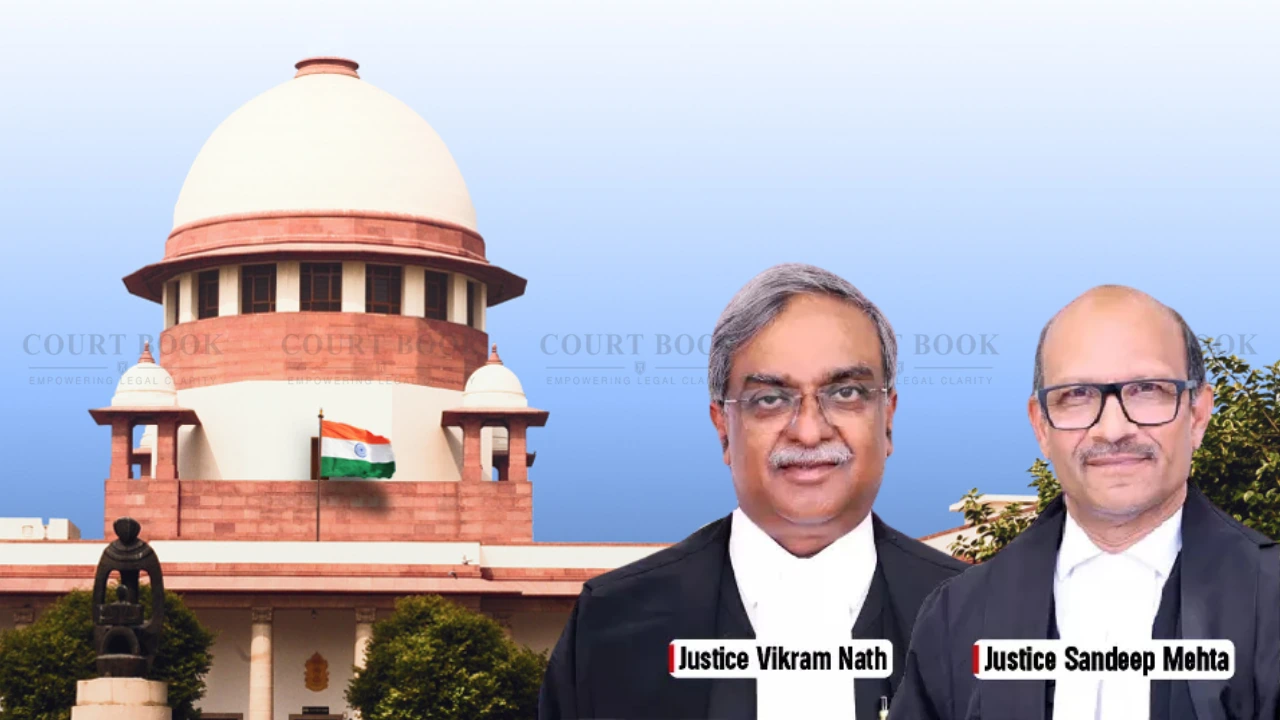
The Supreme Court has stepped in to address a decades-long delay in a criminal case linked to a 1994 incident in Uttar Pradesh. A bench of Justice Vikram Nath and Justice Sandeep Mehta ordered that three criminal revision petitions pending before the Allahabad High Court be withdrawn to the Supreme Court for final adjudication.
The Court acted after noting that the High Court had reserved judgment in the matters in February 2020 but had not delivered its decision, leaving the related criminal trial stalled.
Background of the Case
The case originates from Case Crime No. 68 of 1994, registered at Charkhi Police Station in Jalaun district. The FIR invoked serious charges under Sections 147, 148, 149, 302, and 307 of the Indian Penal Code relating to rioting, murder, and attempted murder. The incident reportedly led to the death of two people and injuries to several others.
The matter was committed to the Sessions Court in 1995. Another accused who had allegedly been absconding was later brought into proceedings in 2004, and both trials were eventually taken up together.
During the trial, the Uttar Pradesh government issued orders proposing withdrawal of prosecution against some accused persons. Applications under Section 321 of the Criminal Procedure Code were filed in 2012 seeking permission from the trial court to withdraw the prosecution.
In May 2012, the trial court allowed withdrawal of prosecution for one accused but rejected similar requests for the remaining accused. This order triggered multiple criminal revision petitions before the Allahabad High Court.
Three criminal revision petitions filed by the accused were heard together by the Allahabad High Court, which reserved judgment on 5 February 2020.
However, the verdict was not delivered for several years. According to the petitioner who claims to be a legal heir of one of the victims the continued pendency of these revisions and the stay on trial proceedings effectively brought the trial to a halt.
Meanwhile, related proceedings reached the Supreme Court earlier. In July 2024, the apex court set aside the trial court’s decision allowing withdrawal of prosecution against one accused and directed the High Court to reconsider the remaining revisions in light of its observations.
Despite this direction, the revisions remained pending and continued to be adjourned, with the last listing recorded on 4 February 2026.
The Supreme Court noted that petitions under Article 32 are ordinarily not entertained to manage listing or hearing of cases pending before High Courts. The bench emphasized that the Supreme Court does not function as a supervisory authority over the daily administration of justice in High Courts.
However, the Court said intervention may become necessary in rare and exceptional situations where continued inaction results in a violation of fundamental rights.
“The extraordinary jurisdiction of this Court is to be exercised with great circumspection,” the bench observed, adding that intervention is justified when prolonged delay affects constitutional guarantees such as the right to speedy justice.
The Court further noted that the prolonged pendency of the revisions combined with the stay on trial had prevented the trial court from proceeding with the criminal case arising from the 1994 incident.
Invoking its powers under Article 139A(1) of the Constitution, the Supreme Court ordered that the three pending criminal revisions be withdrawn from the Allahabad High Court to the Supreme Court for final disposal.
The Court also directed the Registrar General of the Allahabad High Court to send the complete records of the revisions including all applications and orders to the Supreme Court registry within three weeks.
Additionally, if the original trial records are currently with the High Court, they must be returned to the trial court within the same period.
Once the records are received, the Supreme Court registry will place the matters before an appropriate bench after obtaining directions from the Chief Justice of India.
Case Title:- Jaideep Kumar Srivastava v. State of Uttar Pradesh & Others
Case Number:- Writ Petition (Criminal) No. 56 of 2026
Date of Order:- 13 February 2026
Download Order


 chief. Eknath Shinde – Shiv Sena leader-300x169.webp)
-300x169.webp)
-300x169.webp)
-300x169.webp)