

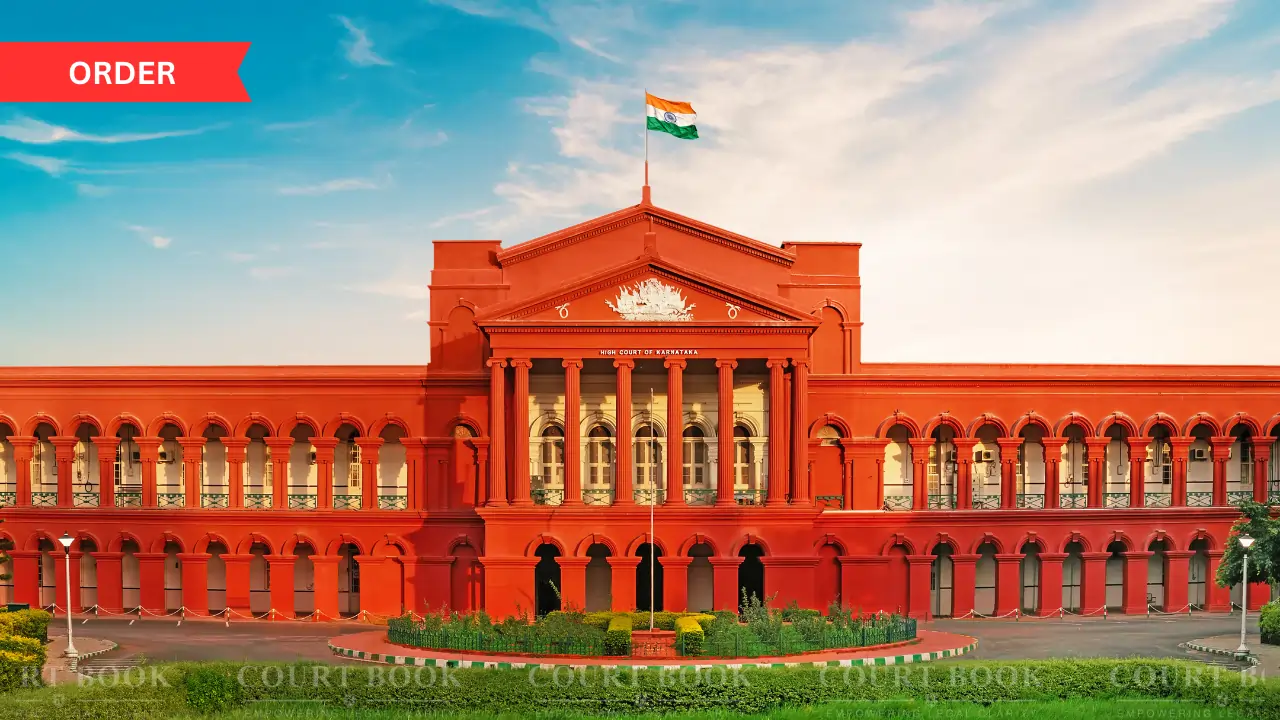
In a significant ruling on marital disputes, the High Court of Karnataka has refused to grant divorce to a husband who alleged that his wife deserted him. The division bench made it clear that simply living apart for years does not automatically amount to “desertion” under law.
The appeal was decided on February 10, 2026, by a bench comprising Justice Jayant Banerji and Justice T.M. Nadaf in MFA No. 918 of 2021 .
Read also:-Gujarat HC Clears Way for Police Recruit, Says Minor, Quashed FIR Can’t Block Appointment
Background of the Case
The couple married on December 4, 2011, at Chitradurga according to Hindu customs. They have a daughter from the marriage.
The husband claimed that after a few years of marriage, his wife frequently went to her parental home and eventually left the matrimonial house in April 2015. He alleged that she was involved in an extra-marital relationship and that, after he confronted her, she moved out.
He further stated that a criminal case under Section 498A of the Indian Penal Code and Sections 3 and 4 of the Dowry Prohibition Act was filed against him, but he was later acquitted. According to him, there had been no cohabitation since 2015, and the marriage had broken down completely.
On these grounds, he approached the Family Court under Section 13(1)(b) of the Hindu Marriage Act, seeking divorce for desertion. The Family Court dismissed his petition. He then filed an appeal before the High Court.
Read also:-Madras High Court Orders Removal of Shops from Kanyakumari Temple Mandapam, Slams HR&CE
Notably, the wife did not appear in the appeal proceedings. The High Court appointed an amicus curiae (court-appointed lawyer), Advocate Archana K.M., to represent her side.
Arguments Before the High Court
The husband’s counsel argued that there had been no marital relationship for nearly a decade and that reunion was impossible. He contended that the wife’s long absence clearly amounted to desertion.
He also relied on his acquittal in the criminal case, submitting that the allegations against him were false and that this strengthened his claim.
On the other hand, the amicus curiae argued that the husband had failed to prove the legal requirements of desertion. She pointed out that mere acquittal in a criminal case does not automatically establish desertion.
She emphasized that the husband’s allegation of an extra-marital relationship was not supported by any solid evidence. In fact, she argued, making such unproven allegations could itself amount to mental cruelty toward the wife.
Court’s Observations
The bench examined whether the husband had proved “desertion” as defined under Section 13(1)(b) of the Hindu Marriage Act.
The court noted that desertion is not just about physical separation. It must be shown that the spouse left without reasonable cause, without consent, and with the intention to permanently end the marital relationship.
The judges observed that the burden of proof lies on the person seeking divorce.
“Mere living separately for a considerable period may not amount to desertion,” the bench said. It added that what matters is the intention behind the separation.
The court also addressed the allegation of an extra-marital relationship. It found that the husband had not produced convincing evidence to prove the claim. The trial court had earlier remarked that making such accusations without proof could itself be mental cruelty.
The High Court agreed with this reasoning. “The party who approaches the Court has to establish his case on his own,” the bench observed, stressing that relief cannot be granted on self-serving statements alone, even if the other spouse does not contest the case.
The court further noted that the husband had previously filed a divorce petition but later withdrew it. No convincing explanation was offered for this withdrawal.
Importantly, the bench said there was nothing on record to show that the wife had the intention (animus) to permanently abandon the marriage without reasonable cause.
Decision
After reviewing the evidence and arguments, the High Court found no reason to interfere with the Family Court’s order.
The bench concluded that the husband had failed to prove the essential ingredients of desertion. As a result, the appeal was dismissed.
The court also placed on record its appreciation for the assistance rendered by Advocate Archana K.M. as amicus curiae and directed the Karnataka State Legal Services Authority to pay her ₹10,000 as remuneration.
With this, the husband’s plea for divorce stands rejected.
Case Title: Husband vs Wife (Name Withheld)
Case No.: MFA No. 918 of 2021
Decision Date: 10 February 2026


