

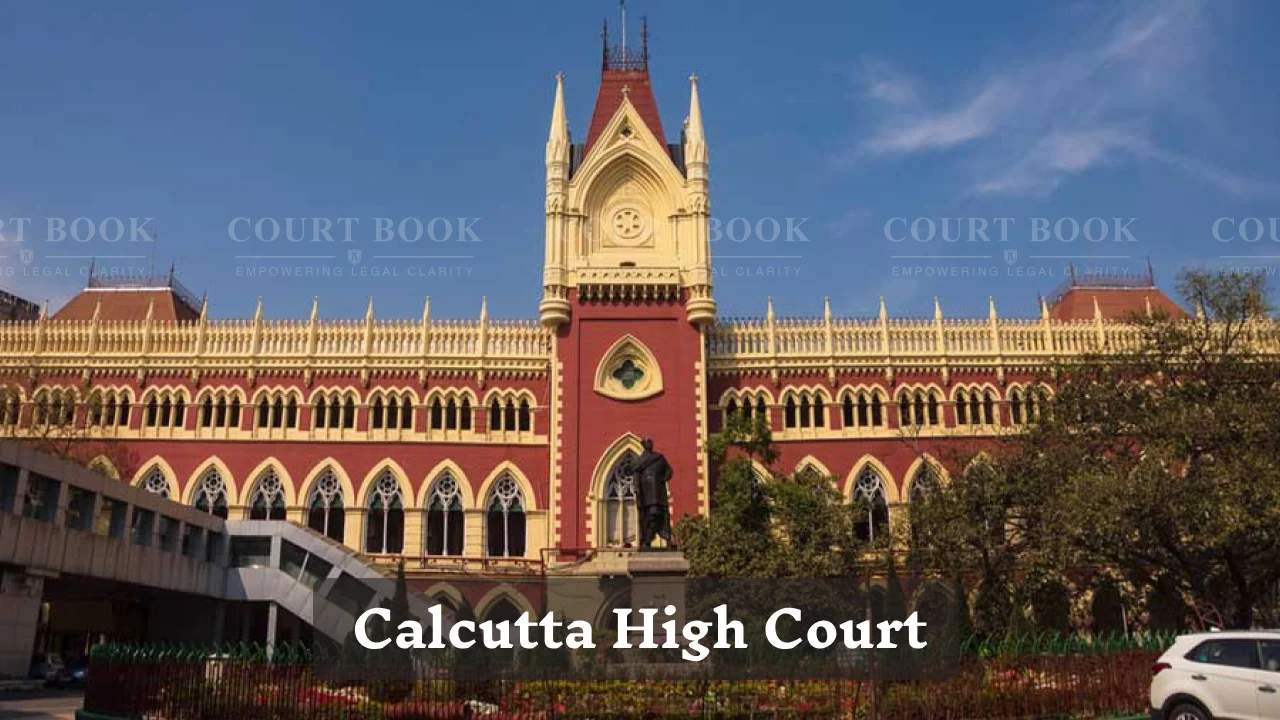
In a significant ruling on land acquisition disputes, the Calcutta High Court has upheld the maintainability of a second execution petition filed to recover enhanced compensation. The Division Bench dismissed an appeal by the State of West Bengal, holding that as long as the awarded amount remains unpaid, more than one execution petition can be filed.
The judgment was delivered by Justice Debangsu Basak, with Justice Md. Shabbar Rashidi concurring.
Read also:-Gujarat HC Clears Way for Police Recruit, Says Minor, Quashed FIR Can’t Block Appointment
Background of the Case
The dispute traces back to the acquisition of premises at Narkeldanga Main Road in Kolkata under the West Bengal Land (Requisition and Acquisition) Act, 1948.
An award was first passed by the Collector in February 1997. One of the landowners challenged the compensation amount, leading to a reference before the Special Land Acquisition Judge at Alipore. In August 2001, the reference court enhanced the compensation.
The State challenged that enhancement before the High Court. In 2017, while granting a stay on execution, the High Court directed the State to deposit over ₹4.11 crore with the Registrar General. The appeal was eventually disposed of in December 2024, further enhancing the market value to ₹4 lakh per cottah. The State’s challenge before the Supreme Court failed in August 2025.
Meanwhile, execution proceedings had been initiated earlier before the Alipore court. Later, a second execution petition was filed before the High Court on its Original Side. This move was challenged by the State, which argued that a second execution petition was not maintainable.
State’s Objections
Appearing for the State, the Advocate General argued that the High Court could not entertain the execution petition because it had not passed the original decree in 2001. He also contended that once an execution petition had been filed earlier, a second one could not be maintained.
He further submitted that the money already deposited with the Collector and the Registrar General must be adjusted against the decretal amount.
Respondents’ Stand
Senior counsel for the landowners countered that neither the 1948 Act nor the Land Acquisition Act, 1894 provides a specific mechanism for executing an award. Therefore, the award is treated as a “deemed decree” - meaning it is legally treated like a court decree for enforcement purposes, even though it is not one in the strict sense.
Read also:-Karnataka HC Quashes Defamation Case Against Rahul Gandhi Over 2023 BJP Ad Row, Cites Lack
Relying on past Supreme Court rulings, the respondents argued that such an award can be executed like a decree and that there is no legal bar on filing a second execution petition if the amount remains unpaid.
Court’s Observations
The Bench carefully examined the statutory framework. It clarified that acquisition proceedings under the 1948 Act are not civil suits under the Code of Civil Procedure (CPC). The Collector is not a civil court deciding a dispute in the usual sense.
“The award of the Collector cannot be said to be a decree passed by a Civil Court,” the Bench observed.
However, the law creates a legal fiction - treating the award as a decree so that it can be executed. The Court noted that this legal fiction exists only to enable enforcement.
On the question of multiple execution petitions, the Bench made it clear: “So long as the decree remains outstanding, any number of execution petitions are permissible.”
The judges found that the earlier execution petition had not resulted in full satisfaction of the award. Importantly, the State did not claim that the entire amount had been paid.
The Court also rejected the argument that Section 38 of the CPC - which deals with execution by the court that passed the decree - would bar the High Court from entertaining the execution petition. Since the award is only a “deemed decree” and not an actual decree passed by a civil court, Section 38 does not apply.
Read also:-Madras High Court Sets Aside Order Granting Notional Promotion to Rural Welfare Officer
Decision
Answering both issues against the State, the Division Bench held:
• A second execution petition is maintainable if the awarded amount remains unpaid.
• The execution petition filed before the High Court is legally valid.
The Court declined to interfere with the directions issued by the executing court, which had ordered payment.
However, it clarified that it had not adjudicated on the exact amount receivable by the respondents under the award. That issue remains open before the executing court.
With these findings, the Court dismissed the appeal and all connected applications, without any order as to costs.
Case Title: The State of West Bengal vs Shiladitya Banerjee & Ors.
Case No.: APOT 277 of 2025
Decision Date: February 13, 2026


