

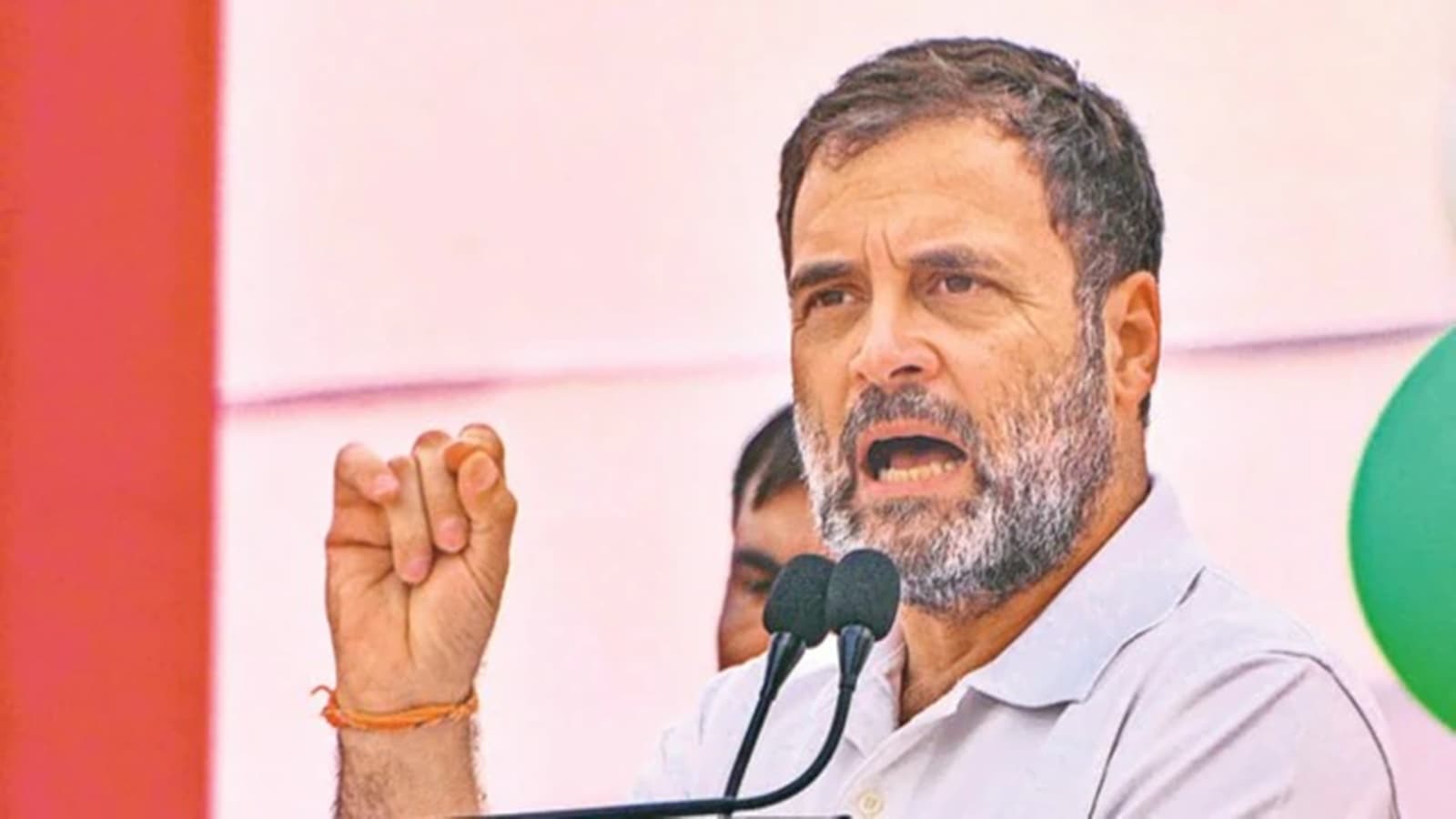
In a significant order delivered on February 17, 2026, the High Court of Karnataka set aside criminal defamation proceedings against Congress leader Rahul Gandhi in connection with a controversial 2023 advertisement targeting the Bharatiya Janata Party (BJP).
Justice S Sunil Dutt Yadav allowed Gandhi’s petition and ruled that the continuation of proceedings against him would amount to an “abuse of legal process.”
Read also:-Gujarat HC Clears Way for Police Recruit, Says Minor, Quashed FIR Can’t Block Appointment
Background of the Case
The case arose from a complaint filed by the Bharatiya Janata Party, represented by its Karnataka State Secretary. The BJP alleged that an advertisement published on May 5, 2023, carried defamatory imputations against the party and its government in the state.
The complaint named four accused, including Rahul Gandhi as Accused No. 4. It alleged that he had conspired in issuing the advertisement and had also shared it on his social media account, thereby defaming the BJP.
The trial court in Bengaluru took cognizance of the offence under Sections 499 and 500 of the Indian Penal Code (criminal defamation) and issued summons to all accused in February 2024.
Gandhi then approached the High Court under Section 482 of the Criminal Procedure Code, seeking to quash the proceedings.
Key Arguments Before the Court
Gandhi’s counsel argued that:
• The advertisement did not contain any direct imputation against the BJP as a legally identifiable entity.
• There was no material linking Gandhi to the publication of the advertisement.
• The tweet allegedly posted by him was neither marked as evidence nor supported by a mandatory certificate under Section 65B of the Evidence Act (required for electronic records).
• The complaint was not filed by a legally competent person representing the BJP at the national level.
• No inquiry was conducted under Section 202 CrPC, which is mandatory when the accused resides outside the court’s territorial jurisdiction.
On the other hand, the BJP argued that:
• At the stage of issuing summons, only a prima facie (initial) satisfaction is required.
• A political party is a “person” in law and can claim defamation.
• Gandhi’s social media activity showed intent to defame.
• All accused shared common intention under Section 34 IPC.
Court’s Observations
Justice Yadav carefully examined whether the complainant qualified as a “person aggrieved” under Section 199 of the Criminal Procedure Code.
The Court noted that if the BJP, as a national political party, was claiming defamation, the complaint should have been filed by a duly authorised representative of the national body.
Instead, the authorisation letter was issued by the President of the Karnataka State Unit. The Court found no material showing that the national party had authorised the state unit president to initiate such proceedings.
“The complainant is not represented by a competent person,” the Court observed, adding that this defect itself vitiated the proceedings.
On the role of Rahul Gandhi, the Court pointed out that his photograph appeared in the advertisement, but there was no clear material showing that the advertisement was issued at his instance.
“Mere presence of a photograph would not establish the required intention to defame,” the bench noted.
The Court stressed that criminal defamation requires proof of intention or knowledge that harm would be caused. Without material connecting Gandhi to the publication, such intention could not be presumed.
Missing Tweet and Electronic Evidence
A crucial part of the BJP’s case relied on a tweet allegedly posted by Gandhi while sharing the advertisement.
However, the Court found that:
• The text of the tweet was not marked as an exhibit.
• No Section 65B certificate was produced.
• The trial judge had not considered the tweet while issuing summons.
“Sans the tweet, the advertisement by itself cannot lead to any presumption” of defamation by the petitioner, the Court remarked.
The judge further held that even if the tweet existed in the file, failure to place it properly on record at the time of issuing process was a serious legal deficiency.
Failure to Conduct Mandatory Inquiry
The Court also flagged procedural lapses.
Since Gandhi resides outside the territorial jurisdiction of the Bengaluru court, an inquiry under Section 202 CrPC was mandatory before issuing summons. No such inquiry was conducted.
The Court said this omission had prejudiced the accused and reflected a “very casual approach.”
Decision
Allowing the petition, the High Court set aside the proceedings in C.C. No. 7399/2024 insofar as Rahul Gandhi was concerned.
“The continuance of the proceedings would amount to an abuse of the legal process,” Justice Yadav concluded.
The defamation case will not proceed against him.
Case Title: Rahul Gandhi vs Bharatiya Janata Party
Case No.: Criminal Petition No. 14473 of 2024
Decision Date: February 17, 2026


