

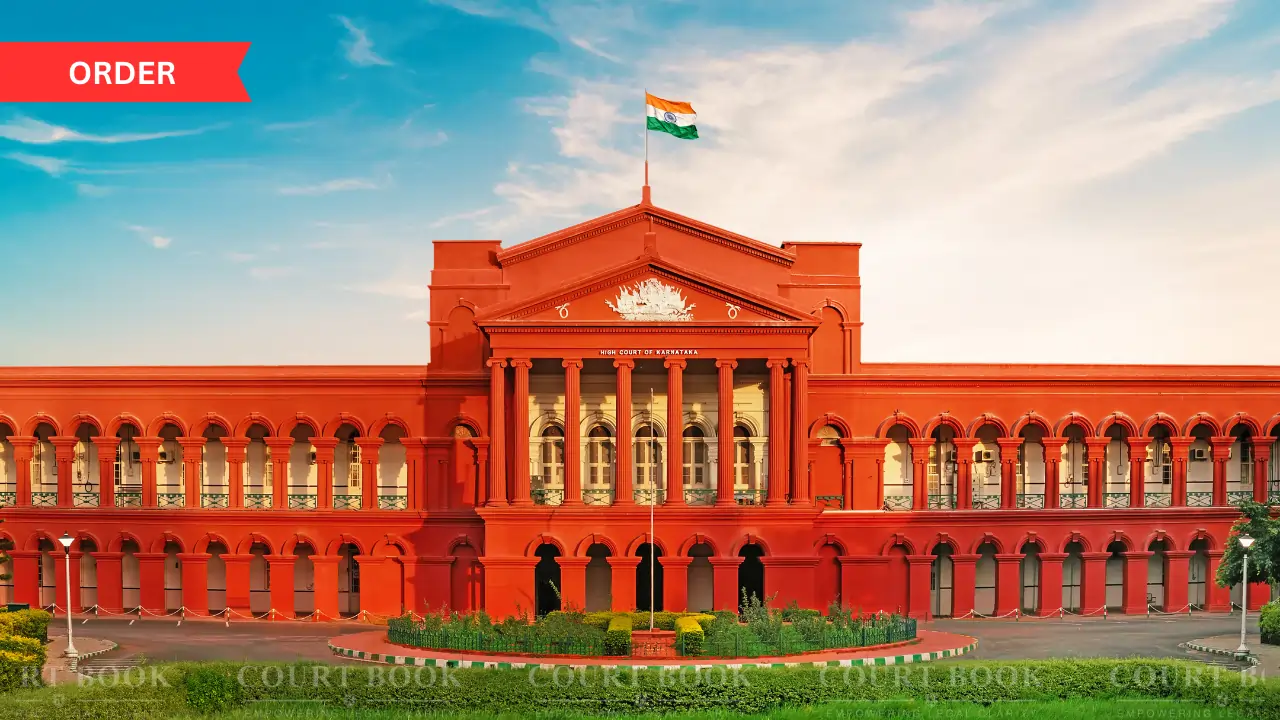
In a closely watched election dispute from Karnataka’s Bagepalli constituency, the High Court on Monday delivered a detailed verdict on allegations of asset suppression against sitting MLA S.N. Subbareddy.
Justice M.G.S. Kamal, while examining multiple claims of false declarations in the candidate’s affidavit, held that certain disclosures were indeed incomplete. However, the Court stopped short of setting aside the 2023 election result.
Read also:-Gujarat HC Clears Way for Police Recruit, Says Minor, Quashed FIR Can’t Block Appointment
The judgment came in an election petition filed by C. Muniraju, the BJP candidate who had lost the seat in the 16th Karnataka Legislative Assembly elections.
Background of the Case
The case, SRI. C MUNIRAJU v. S.N. SUBBAREDDY, arose out of the May 10, 2023 Assembly elections from 140–Bagepalli constituency.
Muniraju had challenged the election of Congress candidate S.N. Subbareddy, alleging that the latter failed to disclose full details of his assets, liabilities, business interests and tax dues in Form 26 - the mandatory affidavit filed with nomination papers.
The petition was filed under Sections 80, 81, 100 and 101 of the Representation of the People Act, 1951.
The petitioner sought two main reliefs:
• To set aside Subbareddy’s election.
• To declare himself as the duly elected candidate.
The matter was reserved for orders on February 5, 2026, and pronounced on February 16, 2026.
What the Petitioner Alleged
Muniraju alleged 15 instances of non-disclosure or false disclosure, including:
• Failure to disclose current account balances of business entities.
• Suppression of details relating to GST dues.
• Non-payment of property tax despite declaring “nil” dues.
• Omission of certain agricultural lands.
• Non-disclosure of loans allegedly advanced to third parties.
• Incorrect valuation of properties.
He argued that such suppression amounted to “corrupt practice” under Section 123 of the Representation of the People Act, particularly undue influence on voters.
“The voters were deprived of complete information about the candidate,” the petitioner’s counsel submitted during arguments.
Court’s Observations
Justice Kamal framed multiple issues, including whether there was false declaration, whether it amounted to corrupt practice, and whether the Returning Officer had improperly accepted the nomination.
On Bank Account Balances
The Court found no substantial violation in the disclosure of savings account balances up to March 31, 2023, even though the affidavit was filed on April 20.
The judge noted that no evidence was brought to show material change in balance during the 20-day gap. Therefore, this allegation failed.
On Business Entities and Current Accounts
However, the Court took a different view regarding non-disclosure of business entities and corresponding current accounts.
During cross-examination, the returned candidate admitted that he had not furnished details of current accounts linked to his hotel and liquor businesses.
The Court examined the wording of Form 26, which requires disclosure of “all types of deposits,” and referred to the Reserve Bank of India’s definition of “demand deposit,” which includes current accounts.
The bench observed that the business concerns - including R & R Bar and Restaurant, Bhagini Residency, Srinivasa Wines and others - were not specifically disclosed along with their current account balances.
The Court concluded that there was non-compliance in this respect.
On Loans Advanced
The petitioner pointed to affidavits of other political figures to claim loans were suppressed.
But the Court accepted the explanation that one loan was time-barred and the other had been fully repaid.
No material was placed to contradict this version.
On Agricultural Lands
A key finding emerged regarding agricultural properties in Sy.No. 21 at Basabathanahalli village.
The Court found that 2 acres 22.5 guntas of land purchased under a sale deed dated March 9, 2006, was not disclosed in the affidavit.
Not only was the extent omitted, but its approximate market value was also not shown.
“If it was merely an oversight, the value would at least have been reflected,” the Court reasoned.
The explanation of inadvertence was not accepted in this instance.
Read also:-Supreme Court Grants Bail to Rajasthan Man Accused in Brother’s Death After 15 Months
On Property Tax and GST Dues
The petitioner produced records to show that significant property tax payments were made after the election.
However, the Court examined whether there was a formal demand notice prior to filing the affidavit.
On GST dues, the respondent argued that no statutory demand had arisen at the time of filing.
The Court assessed each claim individually rather than treating them collectively as proof of corrupt practice.
Did It Amount to Corrupt Practice?
The petitioner argued that suppression of financial information interfered with voters’ right to make an informed choice.
The respondent countered that corrupt practice requires proof of intent and direct interference with electoral rights.
Justice Kamal held that while certain disclosures were incomplete, the petitioner failed to establish that such omissions amounted to “undue influence” under Section 123 or that they materially affected the election result.
The winning margin was over 19,000 votes.
The Court observed that there was no evidence to show that voters were misled in a manner that changed the outcome.
On Improper Acceptance of Nomination
The additional issue was whether the Returning Officer improperly accepted the nomination.
The Court answered this in the negative.
It held that defects must be substantial in character to justify rejection of nomination papers. The Returning Officer had acted within the framework of the law.
Read also:-Supreme Court Transfers ESIC Construction Workers Coverage Cases to Itself for Uniform Hearing
The Decision
The Court held:
• Some allegations of non-disclosure were proved.
• However, corrupt practice under Section 123 was not established.
• There was no material proof that the election result was materially affected.
• The acceptance of nomination was not improper.
Accordingly, the petition was partly allowed on limited findings but the election of S.N. Subbareddy from Bagepalli Assembly Constituency was not set aside.
Case Title: SRI. C Muniraju v. S.N. Subbareddy & Others
Case No.: Election Petition No. 4 of 2023
Decision Date: 16 February 2026


