

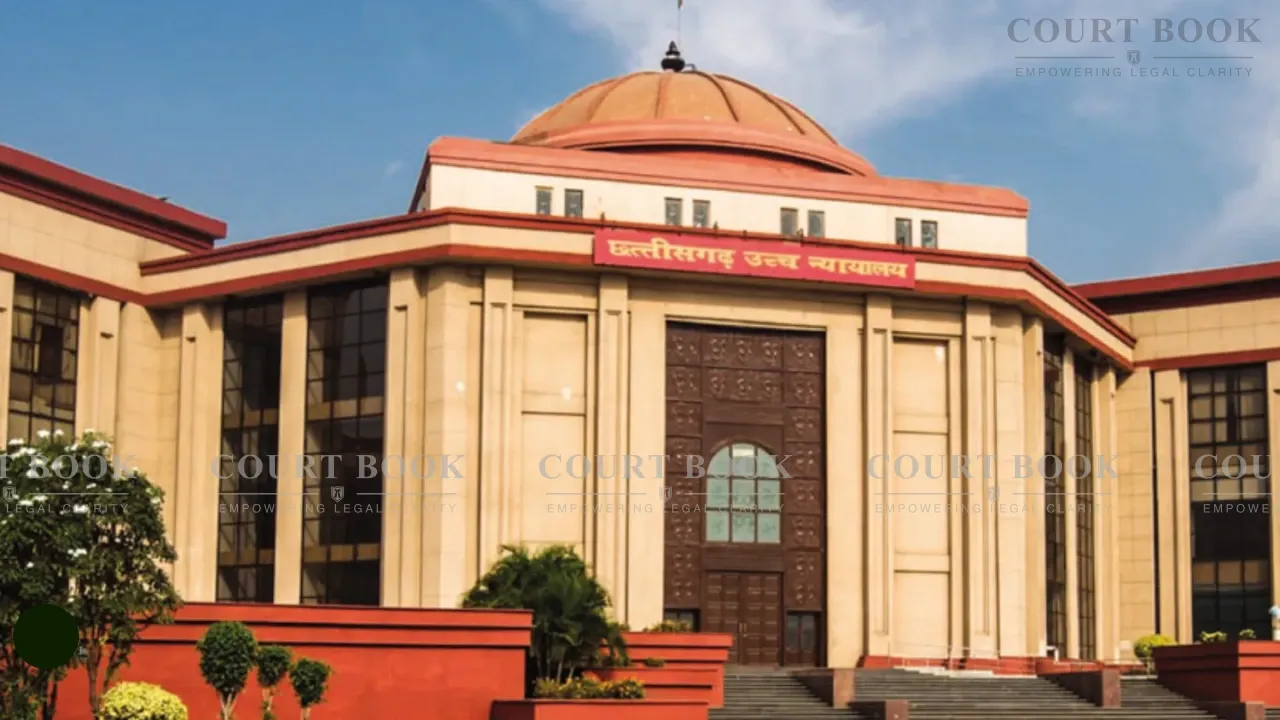
The Chhattisgarh High Court has acquitted a man who was serving a life sentence in connection with the 2013 murder of a woman at the Shriram Finance Company office in Ambikapur. The Division Bench held that the prosecution failed to establish a complete chain of circumstances required for conviction in a case based entirely on circumstantial evidence.
Background of the Case
The appeal was filed by Manoj Sharma against the trial court's judgment dated December 18, 2015, which had convicted him under Sections 302 (murder), 450 (house trespass) and 427 (mischief causing damage) of the Indian Penal Code.
According to the prosecution, on the night of September 5, 2013, the accused allegedly entered the office of Shriram Finance Company in Ambikapur, killed Urmila alias Guddi with a hammer, and attempted to break open a safe, causing substantial damage to the office property. The trial court had sentenced him to life imprisonment along with other concurrent sentences.
Court's Observations
The High Court first agreed with the trial court that the death of the deceased was homicidal, relying on the post-mortem report and the doctor's testimony. However, it found that proving homicidal death alone was insufficient to sustain the conviction.
The Bench examined each circumstance relied upon by the prosecution. It accepted that the appellant had earlier worked as an interior decorator at the finance company's office and was familiar with the premises. However, it held that this fact alone did not establish his involvement in the crime.
The Court also found the alleged extra-judicial confession unreliable. It noted that the confession was said to have been made more than 12 days after the incident to a co-worker and lacked sufficient corroboration.
"Extra judicial confession is a weak piece of evidence. Wherever the Court... intends to base a conviction on an extra judicial confession, it must ensure that the same inspires confidence and is corroborated by other prosecution evidence," the Bench observed.
Regarding the recovery of a hammer and cutter at the instance of the accused, the Court noted that the articles were not subjected to forensic examination. It further observed that recovery alone, without supporting evidence, could not form the basis of conviction. The Bench also noted that the fingerprint and footprint evidence had not been proved by the trial court itself.
Decision
After analysing the evidence, the High Court concluded that the prosecution had failed to satisfy the "five golden principles" governing convictions based on circumstantial evidence, as laid down by the Supreme Court in Sharad Birdhichand Sarda v. State of Maharashtra.
The Bench set aside the trial court's conviction and sentence, acquitted Manoj Sharma of all charges under Sections 302, 450 and 427 IPC by giving him the benefit of doubt, and allowed the criminal appeal. Since the appellant was already on bail, the Court directed that he would not be required to surrender, while his bail bond would remain operative for six months under Section 437-A of the Code of Criminal Procedure.
Case Details:
Case Title: Manoj Sharma v. State of Chhattisgarh
Case Number: CRA No. 78 of 2016
Judge: Justice Sanjay K. Agrawal and Justice Sanjay Kumar Jaiswal
Decision Date: July 1, 2026


