

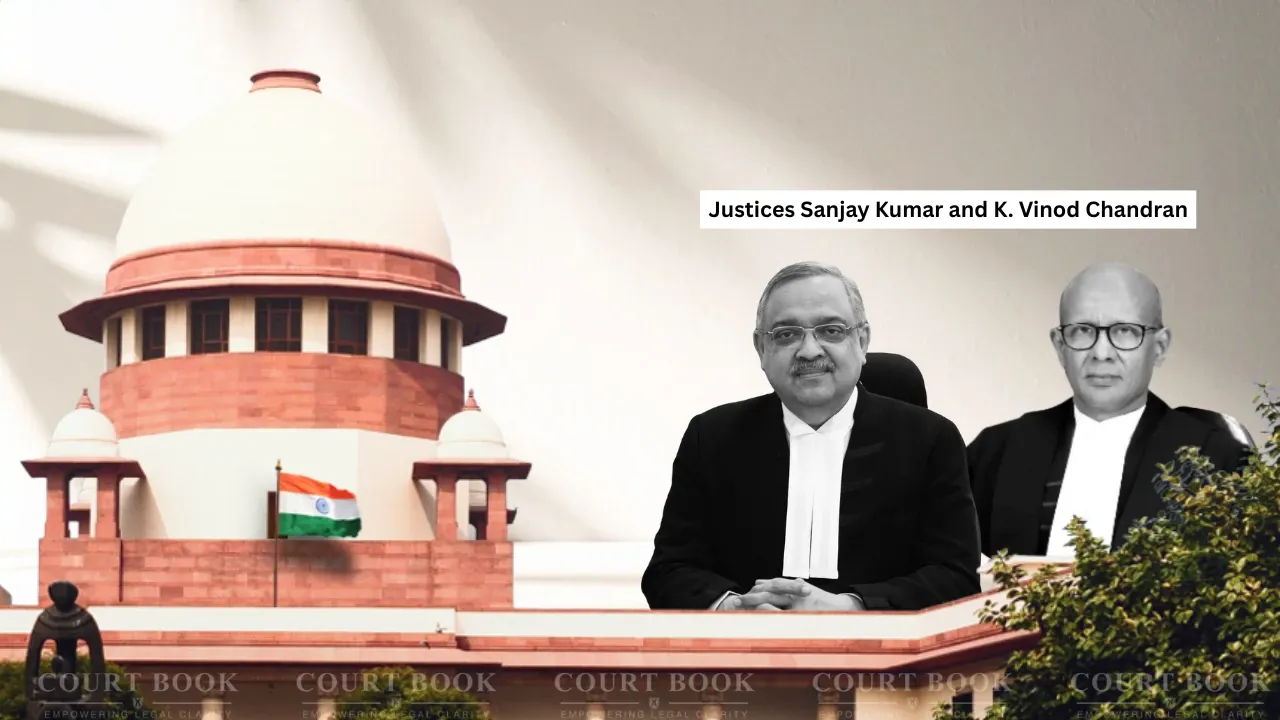
The Supreme Court has set aside a Calcutta High Court order that had allowed a defendant in a property dispute to file an additional written statement at an advanced stage of trial. The top court observed that the attempt amounted to a complete change of stand and was contrary to the provisions of the Code of Civil Procedure.
The judgment was delivered by a Bench of Justice Sanjay Kumar and Justice K. Vinod Chandran on May 26, 2026.
Background Of The Case
The dispute arose out of a civil suit filed by Mondira Ghosh before the City Civil Court in Kolkata seeking eviction of Chaitali Ghosh from the suit property and claiming damages. In her original written statement filed in 2022, the defendant claimed she was a “bonafide co-sharer” of the property and denied the allegations made in the suit.
Issues in the suit were framed in May 2023, and the trial had already progressed with the plaintiff’s witness being cross-examined on multiple dates.
At that stage, the defendant moved an application under Order 8 Rule 9 of the Code of Civil Procedure seeking permission to file an additional written statement along with a counterclaim. However, the Trial Court rejected the plea in June 2025.
The Trial Court noted that while the defendant had initially claimed to be a co-sharer, she now wanted to assert that she was actually a tenant under the plaintiff. The court held that such a contradictory stand could not be permitted after commencement of trial.
The defendant challenged the Trial Court’s decision before the Calcutta High Court under Article 227 of the Constitution.
The High Court agreed that the counterclaim could not be entertained after the trial had commenced. However, it permitted the filing of the additional written statement on payment of ₹15,000 as costs, observing that the new facts were necessary for deciding the “real controversy” between the parties.
The High Court also accepted the defendant’s explanation for the delay in seeking permission.
The Supreme Court disagreed with the High Court’s reasoning and held that the defendant was not merely adding omitted facts but attempting to completely alter her earlier position in the case.
“The defendant wanted to completely change her stand with regard to her status and claim for being in possession,” the Bench observed.
The Court pointed out that such a contradictory plea was barred under Order 6 Rule 7 CPC, which prevents parties from introducing allegations inconsistent with earlier pleadings unless properly amended.
The Bench further observed that the defendant appeared to be attempting to bypass the restrictions imposed under the proviso to Order 6 Rule 17 CPC, which limits amendment of pleadings after commencement of trial.
Calling the move an “abuse of process,” the Court held that the Trial Court had taken the correct view both on facts and law.
Allowing the appeal, the Supreme Court set aside the Calcutta High Court’s order dated September 3, 2025, and restored the Trial Court’s decision rejecting the defendant’s application for filing the additional written statement.
The Court also directed the parties to bear their own costs.
Case Details
Case Title: Mondira Ghosh v. Chaitali Ghosh
Case Number: Civil Appeal arising out of SLP (C) No. 34411 of 2025
Court: Supreme Court of India
Judges: Justice Sanjay Kumar and Justice K. Vinod Chandran
Decision Date: May 26, 2026


