

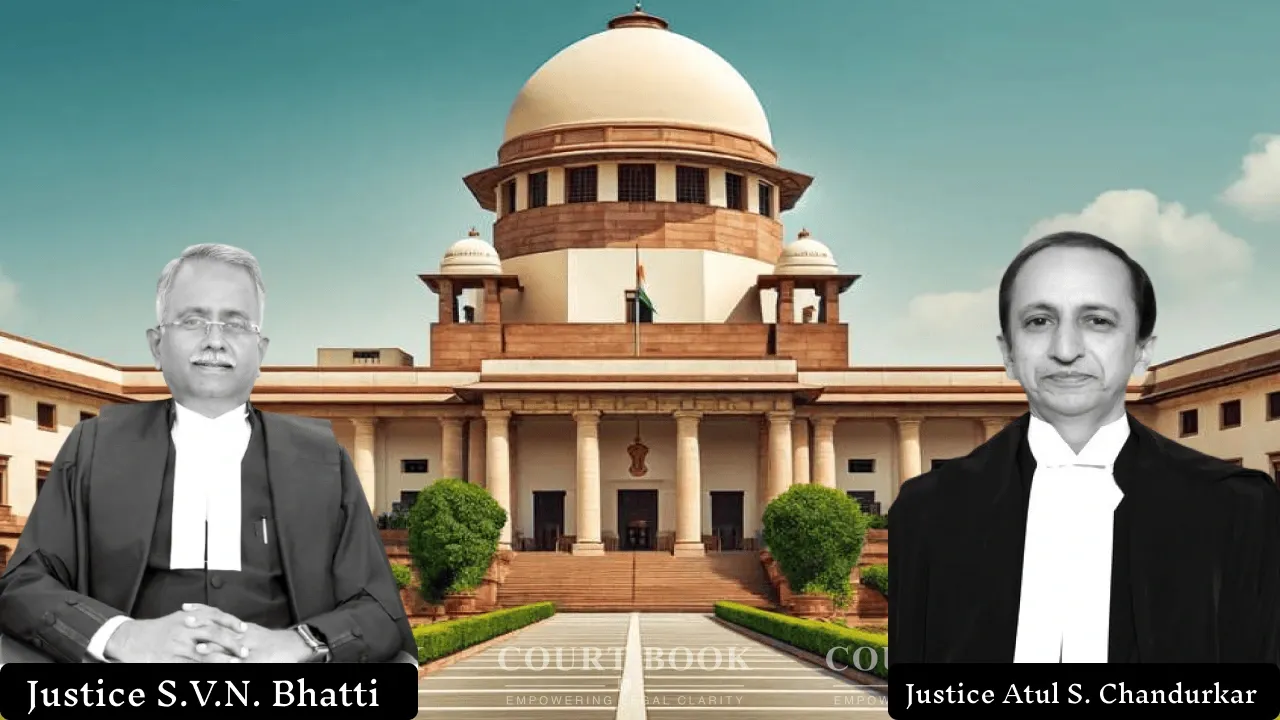
The Supreme Court on June 19, 2026, set aside a Punjab and Haryana High Court judgment that had replaced decrees for removal of alleged encroachments with monetary compensation. The Court held that compensation cannot be imposed on a litigant when no such relief was sought in the suit and the affected party has not consented to it.
A Bench of Justice S.V.N. Bhatti and Justice Atul S. Chandurkar allowed the appeals filed by the legal heirs of the original plaintiff and directed the High Court to reconsider the second appeals on their merits.
Background of the Case
The dispute originated from two civil suits filed by Om Parkash against a school and its authorities in Haryana.
In the first suit, filed in 1996, Om Parkash alleged that the defendants had illegally constructed a wall on a common open space adjoining his property. He sought a mandatory injunction directing removal of the wall and a permanent injunction restraining further construction. The Trial Court decreed the suit, and the first appellate court affirmed that decision.
In the second suit, filed in 2000, he challenged the construction of a lintel of a school building that had allegedly been placed on the wall of his house. That suit too was decreed in his favour and later upheld in appeal.
However, while hearing second appeals, the Punjab and Haryana High Court modified the decrees and directed payment of compensation instead of enforcing removal of the disputed structures. The matter eventually reached the Supreme Court.
The Supreme Court found serious flaws in the High Court’s approach.
The Bench noted that the original plaintiff had never sought damages or monetary compensation. His claim was limited to removal of the alleged encroachments and protection of his property rights.
“The legal heirs of the plaintiff did not consent for such course to be followed,” the Court observed while holding that the High Court could not compel them to accept compensation in place of the relief granted by the trial court.
The Court further stated that once the decrees in favour of the plaintiff had been set aside, there was no basis for directing the executing court to assess the value of the structures and award compensation.
According to the Bench, such directions were not supported by the provisions governing execution of decrees under the Code of Civil Procedure.
The judges also pointed out that the High Court had earlier adopted a similar course, which had already been disapproved by the Supreme Court during an earlier round of litigation. Despite that, the High Court again attempted to substitute the decrees with monetary relief.
The Supreme Court also found that the High Court had proceeded on an incorrect factual assumption.
The High Court had treated the disputed wall as a common wall between the parties. However, the Supreme Court noted that no such finding had been recorded by the Trial Court. Instead, the Trial Court had ordered removal of the wall after finding that the defendants had failed to establish any right over the land where it was constructed.
The Bench further observed that the High Court had effectively introduced a new form of relief that was never requested by the plaintiff.
“Such course has resulted in miscarriage of justice,” the Court remarked while criticising the manner in which the decrees were overturned.
Allowing the civil appeals, the Supreme Court set aside the Punjab and Haryana High Court’s common judgment dated May 2, 2016, in RSA Nos. 363 and 364 of 2008.
The Court held that the High Court’s judgment was unsustainable and directed it to reconsider both second appeals afresh in accordance with Section 100 of the Code of Civil Procedure. Considering that the appeals have been pending since 2008, the Supreme Court requested the High Court to dispose of them expeditiously.
Case Details
Case Title: Rajat Kumar and Others v. S.D. Adarsh Jain Kanya Mahavidyalaya, Sadhaura and Others
Case Number: Civil Appeal Nos. 19552–19553 of 2017
Bench: Justice S.V.N. Bhatti and Justice Atul S. Chandurkar
Decision Date: June 19, 2026


