

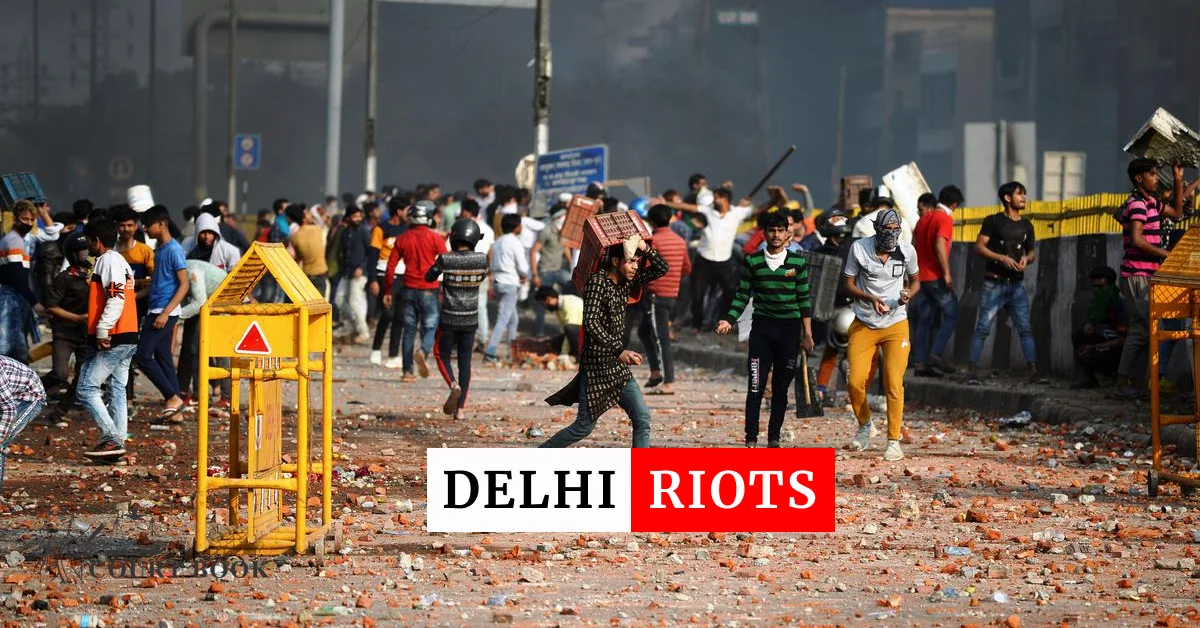
The Delhi High Court has refused regular bail to an accused in the larger conspiracy case arising out of the 2020 North-East Delhi riots, holding that his case could not be equated with co-accused who had previously secured bail from the Supreme Court. The Court observed that the allegations against the appellant, at this stage of the proceedings, placed him in a different category from those granted relief earlier.
Background of the Case
The appeal challenged a January 29, 2026 order of the trial court rejecting the appellant's second application for regular bail in FIR No. 59/2020, registered by the Delhi Crime Branch in connection with the North-East Delhi riots of February 2020.
According to the prosecution, the FIR concerns an alleged larger conspiracy behind the riots that took place between February 23 and 25, 2020, during which 53 people lost their lives, many others suffered injuries, and widespread damage was caused to public and private property. Several offences under the Indian Penal Code, the Unlawful Activities (Prevention) Act (UAPA), the Arms Act and other laws were invoked during the investigation.
The appellant had earlier been denied bail by both the trial court and the Delhi High Court in 2025. Unlike several co-accused, he did not challenge that decision before the Supreme Court. After the Supreme Court granted bail to some other accused in a separate judgment, he again sought bail before the trial court on the ground of parity, but the request was rejected, leading to the present appeal.
Arguments Before the High Court
The appellant argued that he stood on the same footing as certain co-accused who had already been granted bail by the Supreme Court. His counsel submitted that he had remained in custody for nearly six years, while the trial involved more than 880 witnesses and was unlikely to conclude soon.
It was also argued that he was only a local-level participant and that the prosecution's reliance on the statement of a protected witness was misplaced because there were alleged inconsistencies between statements recorded during the investigation. The defence further contended that WhatsApp chats relied upon by the prosecution reflected support only for peaceful protests and did not establish involvement in any violent acts.
The prosecution opposed the plea, maintaining that the appellant's role was materially different from that of the co-accused who had received bail. It relied on the statement of a protected witness and electronic evidence, including WhatsApp conversations, to contend that the appellant had allegedly encouraged violent protests. The State also argued that the earlier High Court judgment denying bail had attained finality because it had never been challenged before the Supreme Court.
Court's Observations
After examining the record, the Division Bench noted that the present appeal arose from a second bail application and that earlier findings against the appellant had remained unchallenged.
The Court observed that the material relied upon by the prosecution, including WhatsApp chats and the statement of a protected witness, prima facie attributed a distinct role to the appellant. It said the prosecution case alleged involvement extending beyond participation in protests and included allegations connected with violence and resulting deaths, which distinguished his position from several co-accused who had obtained bail.
While discussing the Supreme Court's earlier decision granting bail to some accused in the same conspiracy case, the High Court analysed how the apex court had individually assessed the role of each accused rather than applying a uniform standard.
Referring to the appellant's claim of parity, the Bench held that such comparison could not automatically justify bail because the allegations against each accused had to be examined independently.
The Court observed:
“The Appellant, therefore, cannot be held to be a mere local-level operator but one of the main conspirators... Thus, the case of the Appellant is clearly distinguishable from the other co-accused persons.”
The Bench also considered recent Supreme Court rulings discussing prolonged incarceration, constitutional liberty, and the interpretation of Section 43D(5) of the UAPA, while noting that broader legal questions relating to bail under special statutes have been referred to a larger Bench of the Supreme Court.
Court's Decision
Declining to interfere with the trial court's order, the Delhi High Court held that the appellant did not satisfy the requirements for grant of bail under Section 43D(5) of the UAPA in the facts of the present case.
The Bench further observed that concerns regarding possible influence on witnesses and other factors relevant to bail weighed against granting relief.
Accordingly, the Court upheld the trial court's order rejecting regular bail and dismissed the appeal. It clarified that all observations made in the judgment were confined solely to the consideration of the bail application and would not affect the merits of the pending criminal trial.
Case Details
Case Title: Athar Khan v. State of NCT of Delhi
Case Number: CRL.A. 137/2026
Judge: Justice Prathiba M. Singh and Justice Madhu Jain
Decision Date: July 7, 2026


