

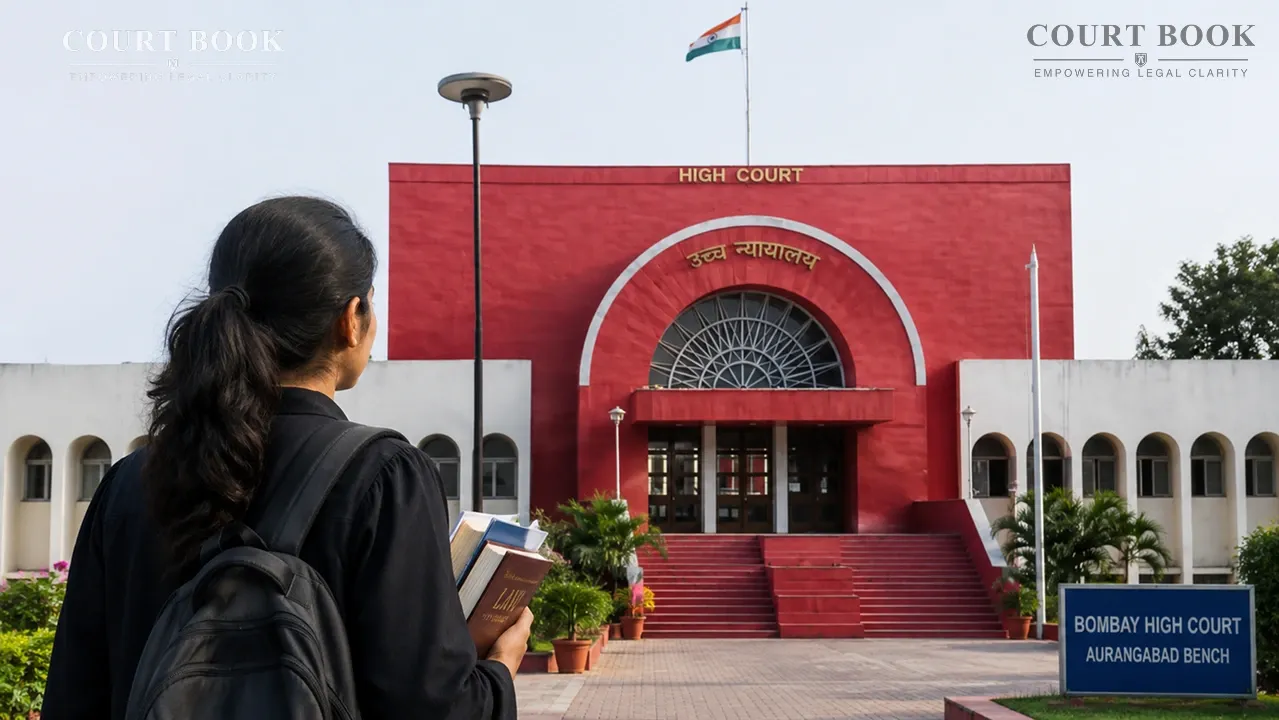
The Bombay High Court's Aurangabad Bench has dismissed a review application filed by an LL.M. student who sought reconsideration of an earlier order refusing her permission to appear for semester examinations due to inadequate attendance.
The court held that the student had failed to establish any error apparent on the face of the record, which is a necessary requirement for invoking review jurisdiction. It also declined her request for a special examination after the regular examinations had already concluded.
Background of the Case
The applicant was pursuing postgraduate studies in law at Maharashtra National Law University, Chhatrapati Sambhajinagar. She was barred from appearing in her second-semester examination because she did not satisfy the minimum 75% attendance requirement prescribed under the university's regulations.
Her earlier writ petition challenging the university's decision was dismissed by the High Court on 30 April 2026. Following that setback, she filed a review application seeking reconsideration of the judgment and several additional directions, including production of attendance records, examination of grievance committee proceedings, and a direction to conduct a special examination for her.
Student's Arguments
Appearing in person, the applicant argued that there were errors in the calculation of her attendance and alleged that the university had presented incorrect attendance figures before the court.
She further claimed that certain students had been granted attendance benefits while similar relief was denied to her. The student also sought to place additional medical documents on record, contending that her absence was linked to health issues and Ayurvedic treatment.
Another argument raised was that the university ought to have exercised reasonable relaxation in attendance requirements and that the court should reconsider its earlier findings in light of subsequent judicial developments.
University's Stand
The university opposed the review application and maintained that its actions were consistent with the applicable regulations.
Its counsel informed the court that a policy adopted by the institution permitted attendance relaxation only for students who had achieved at least 67% attendance and could justify their absence with valid medical grounds. According to the university, the applicant had not crossed even that threshold.
The university also denied allegations of discrimination and asserted that there was no basis for conducting a special examination after the regular examination process had concluded.
Court's Observations
The bench examined the scope of review jurisdiction under Order XLVII of the Code of Civil Procedure and emphasized that a review cannot be used as an appeal in disguise.
Addressing the attendance dispute, the court noted that even according to the applicant's own calculations, her attendance could at best reach slightly above 51%, far below both the mandatory 75% requirement and the 67% benchmark considered for relaxation.
The bench observed,
“It is clear that in any case, the applicant could neither reach 75% attendance nor 67% attendance.”
The judges also found that several allegations made in the review application were unsupported by material on record. The court remarked that many of the issues raised had already been argued during the hearing of the original writ petition and could not be reopened through review proceedings.
Referring to the nature of the application, the court observed that the student was effectively seeking a re-hearing of the entire matter rather than pointing out a reviewable error. The bench stated that the applicant had attempted to re-agitate issues already decided on merits.
Decision
Dismissing the application, the High Court held that no ground for review had been established under the law. It rejected the request for a special examination and found no reason to interfere with its earlier judgment.
While expressing concern over certain allegations made in the application, the court refrained from imposing costs, noting that the applicant was still a student. It also directed the court registry to mask the name of a batchmate referred to in the proceedings in order to protect his privacy.
The review application was accordingly dismissed.
Case Details
Case Title: Student v. State of Maharashtra & Ors.
Case Number: Review Application (Civil) No. 95 of 2026 in Writ Petition No. 4881 of 2026
Judges: Justice Vibha Kankanwadi and Justice Ajit B. Kadethankar
Decision Date: 18 June 2026


