.webp)
The Supreme Court has set aside a GST show cause notice issued against Tata Steel Limited for the financial years 2018-19, 2019-20 and 2020-21, holding that the extended five-year limitation under Section 74 of the Central Goods and Services Tax Act, 2017 cannot be invoked merely by using words such as “fraud”, “wilful misrepresentation” or “suppression of facts”.
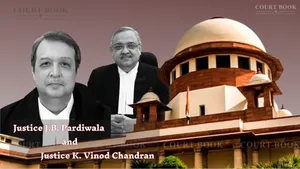
A Bench of Justice J.B. Pardiwala and Justice K. Vinod Chandran delivered the judgment on August 25, 2026. The Court also set aside the consequential Order-in-Original dated December 26, 2025, while allowing the Department liberty to initiate an appropriate Section 74 proceeding if legally permissible.
Background of the Case
The dispute arose from an audit objection concerning an alleged mismatch in input tax credit (ITC) for three financial years and alleged short payment of tax for 2019-20.
The proceedings initially began with a communication dated May 27, 2024. Tata Steel submitted its replies, following which the Department sought supporting documents. A show cause notice was eventually issued on June 13, 2025 under Section 74 of the CGST Act.
Tata Steel argued that Section 74, which provides an extended limitation period of five years, could apply only where there was an allegation supported by facts showing fraud, wilful misrepresentation or suppression of facts.
The company also pointed out that the Department had subsequently placed the proceedings in the “call book”, meaning they were kept in abeyance, while the audit objection itself was being contested before the Public Accounts Committee.
Supreme Court Examines GST Limitation
The Court examined the limitation periods under Sections 73 and 74 of the CGST Act.
It noted that Section 73 applies where there is no allegation of fraud, wilful misrepresentation or suppression, while Section 74 permits an extended period where such circumstances are established.
The Court found that, after taking into account statutory extensions and the Supreme Court’s earlier directions excluding the COVID-19 period from limitation, the three-year limitation for the relevant financial years expired on February 28, 2025.
The show cause notice dated June 13, 2025 was therefore beyond the extended limitation applicable under Section 73.
The Department sought to sustain the notice under Section 74. The Supreme Court, however, found that the material placed before it did not establish the necessary foundation for invoking the extended period.
Court Says ‘Suppression’ Cannot Be Added Mechanically
The Bench stressed that an officer must independently apply his mind before invoking Section 74, even when an audit objection has been raised.
The Court observed:
“The foundational facts which led to the inference arrived at of fraud/willful misrepresentation/suppression should be evident from the notice itself.”
It further made clear that simply inserting statutory expressions into a notice would not be enough.
“The words are not to be mechanically recited in the notice to enable recovery outside the normal limitation provided under the statute.”
The Court also noted that the Department’s decision to contest the audit objection before the Public Accounts Committee indicated that there was no clear satisfaction on the part of the Assessing Officer regarding the alleged mismatch or short payment, much less the alleged suppression.
Show Cause Notice Lacked Foundational Facts
The Supreme Court found that the show cause notice contained only a broad statement alleging that Tata Steel had availed ITC “without documentary evidence” and had “suppressed the facts”.
According to the Court, the notice did not set out factual material showing a deliberate device to evade tax or obtain excess ITC.
The Bench held:
“The bland statement made at some places of suppression of facts, merely to avail the extended period of limitation would barely suffice and puts to peril the notice under Section 74.”
On this reasoning, the Court concluded that the show cause notice could not be sustained.
Decision of the Supreme Court
The Supreme Court set aside the June 13, 2025 show cause notice as well as the consequential Order-in-Original dated December 26, 2025.
However, the Court clarified that the Department was not completely barred from taking further action. Since the extended period of two years had not yet expired, the Department could, if it considered appropriate, initiate a fresh proceeding under Section 74, provided the notice contained the necessary foundational facts and an order was passed before February 28, 2027.
With this reservation and liberty, the Supreme Court allowed Tata Steel’s appeal and disposed of the pending application, if any.
Case Details
Case Title: M/s Tata Steel Limited v. Union of India through the Secretary, Ministry of Finance and Others
Case Number: Civil Appeal No. of 2026, arising out of SLP (C) No. 16859 of 2026
Judges: Justice J.B. Pardiwala and Justice K. Vinod Chandran
Decision Date: August 25, 2026








-300x169.webp)