

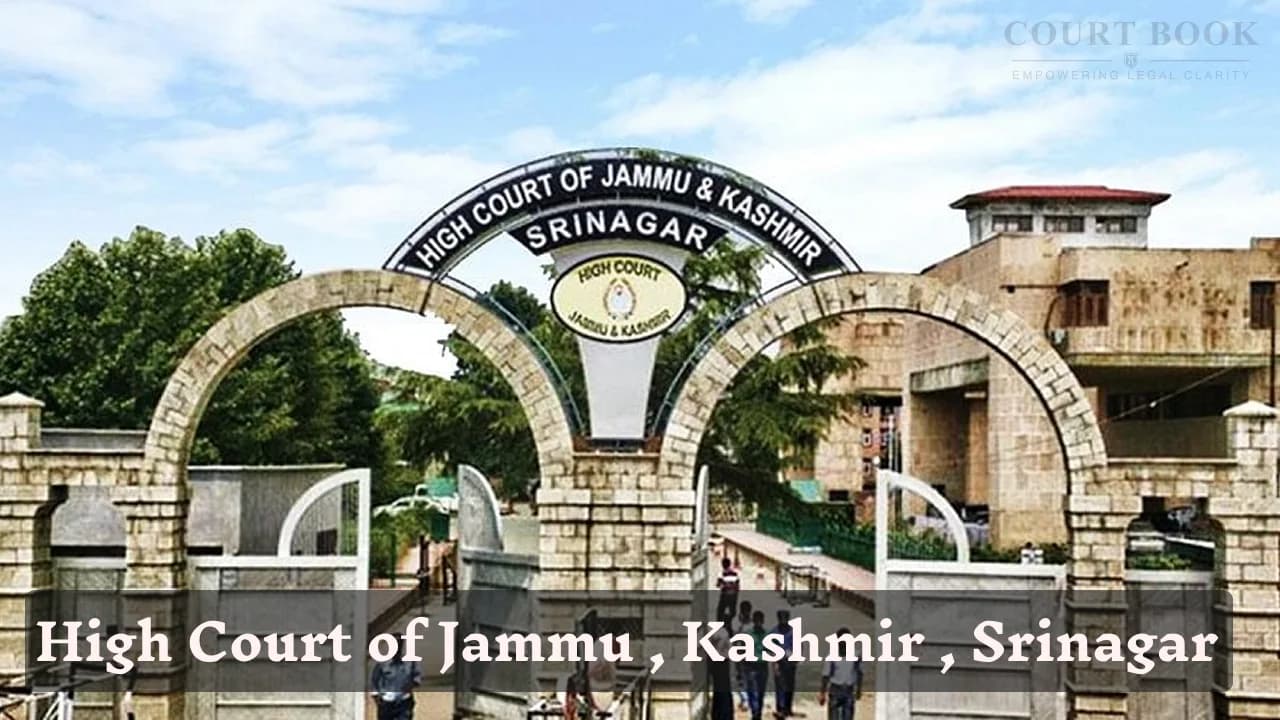
The High Court of Jammu & Kashmir and Ladakh has refused to interfere with the acquittal of six men accused in a 2020 gang rape and cybercrime case from Anantnag, observing that the prosecution lacked material evidence to sustain the charges. Dismissing the Union Territory’s appeal, the court held that continuing the trial would have served no meaningful purpose.
The judgment was delivered by Justice Sanjay Dhar, who affirmed the trial court’s decision to close the prosecution evidence and acquit all accused.
Read also:-Supreme Court Rules Dumpers, Excavators Not ‘Motor Vehicles’; Gujarat Road Tax Demand Quashed
Background of the Case
The case arose from FIR No. 5/2020, registered at Police Station Larnoo, Anantnag. The complainant had alleged that two men forcibly entered her home, administered an intoxicating substance, sexually assaulted her, recorded the act, and circulated the video on WhatsApp. She also claimed threats were issued to silence her.


Based on these allegations, police invoked serious offences, including gang rape under the IPC and circulation of obscene material under the Information Technology Act. Several accused were arrested, and electronic devices were seized during investigation.
During trial before the Additional Sessions Judge, Anantnag, the prosecution examined the complainant as its primary witness. However, in court, she completely retracted her allegations.
She told the court that no sexual assault had taken place and that the images and videos she had seen on social media were fake. She said she filed the police complaint while she was under depression and later realised that the content circulating online did not relate to her.
“The witness categorically stated that nobody committed rape upon her,” the High Court noted while referring to her testimony.
Read also:-Preventive Detention Misused: Supreme Court Frees Telangana Woman Held in Ganja Cases
Following this, the complainant was declared hostile, and her earlier statements under criminal procedure law were disowned by her.
The High Court observed that once the prosecutrix denied the incident itself, the foundation of the sexual assault charge collapsed. It further noted that even the remaining witnesses did not provide independent or direct evidence connecting the accused to the alleged crime.
Police witnesses admitted during cross-examination that there was a consensual relationship between one of the accused and the complainant, a fact that further weakened the prosecution’s case.
“The cornerstone of the prosecution case was the statement of the prosecutrix,” the bench observed, adding that her testimony no longer supported the charges.
Addressing the argument that the trial court should have continued proceedings for the offence under Section 67 of the IT Act, the High Court found serious gaps in the investigation.
The seized mobile phone and memory card were sent to the forensic laboratory, but the expert report clearly stated that authentication tools were unavailable. The expert was also not examined as a witness during trial.
More importantly, the court noted that the investigating agency failed to collect any proof showing that the alleged content was actually published or transmitted through WhatsApp or Facebook.
“Without authentication and proof of electronic transmission, conviction under Section 67 of the IT Act was impossible,” the bench said.
Read also:-Supreme Court curbs private fraud complaints under Companies Act, partially quashes Telangana
Court’s Decision
After analysing the evidence on record, the High Court concluded that the trial court was justified in truncating the proceedings and acquitting the accused.
The bench observed that even if the remaining witnesses were examined, no conviction could legally follow. Prolonging the trial would have been, in the court’s words, “an empty formality.”
Finding no perversity or legal error in the acquittal, the High Court dismissed the Union Territory’s appeal and upheld the trial court’s judgment.
Case Title: UT of J&K vs. Bilal Ahmad Wani & Ors.
Case No.: CrlA(AS) No. 35/2024
Case Type: Criminal Appeal against Acquittal
Decision Date: 26 December 2025
Download Judgment


