

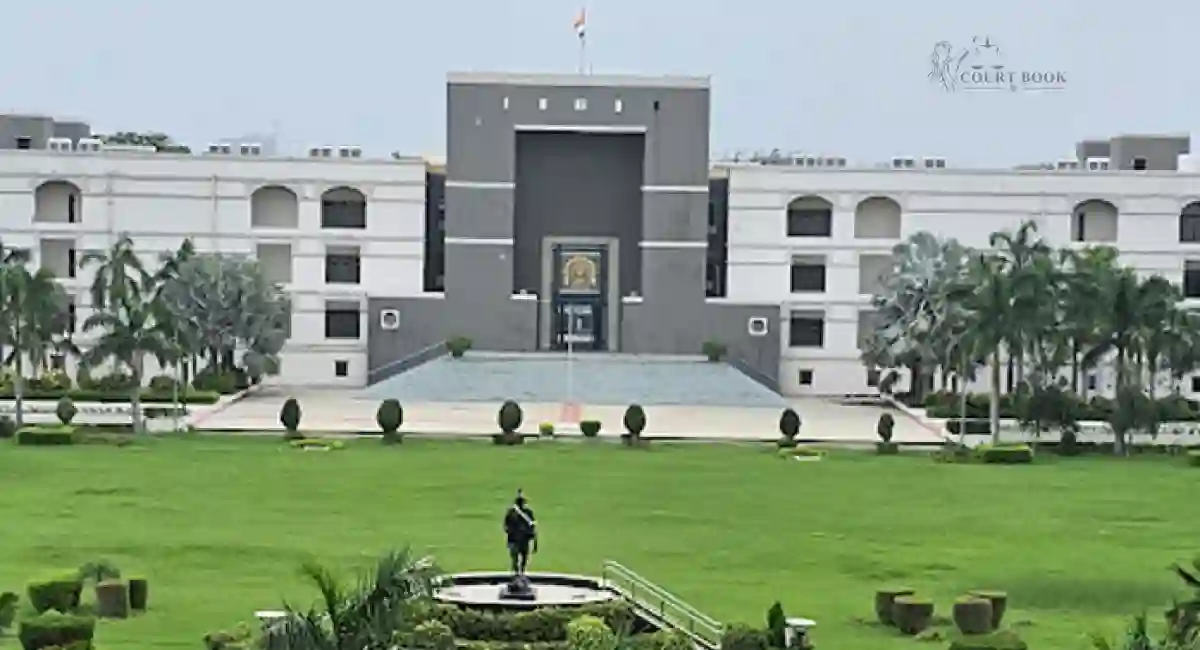
Nearly five decades after a village man alleged brutal custodial torture, the Gujarat High Court on February 24, 2026, set aside the conviction of a former police officer and dismissed the State’s appeal seeking enhancement of sentence.
The judgment was delivered by Justice Gita Gopi in a pair of criminal appeals arising from a 2003 trial court verdict. The case concerned serious charges under the Indian Penal Code, including wrongful confinement, kidnapping, and causing grievous hurt to extort confession.
Read also:-Two Women Killed in Acid Attack: Allahabad High Court Modifies Life Imprisonment
Background of the Case
The matter traces back to October 7, 1976. The complainant, Merag Haja of Village Sutrej in Junagadh district, alleged that police officials searched his house and later took him into custody at Porbandar Police Station.
According to him, on the following morning, he was beaten severely inside the police station by officers including the then Police Sub-Inspector S.S. Khandwawala. He claimed he was assaulted, suspended with ropes, and dropped to the ground, resulting in a fracture of his left thigh bone (femur).
A private complaint was filed on October 28, 1976. After years of procedural delays and revisions, the matter was committed to the Sessions Court in 1982.
In September 2003, the trial court convicted Khandwawala under Sections 331, 348, 352, and 365 of the IPC and sentenced him to five years’ rigorous imprisonment for the main offence. The State later filed an appeal seeking enhancement of the sentence.
Read also:-Karnataka HC Makes Crowd Control SOP Binding Till New Law Is Enacted After Tragedy Concerns
Prosecution’s Stand
The prosecution relied primarily on the complainant’s testimony and medical evidence. It argued that the victim had suffered a serious fracture while in police custody and that the injury could not have occurred without custodial violence.
The State contended that the trial court imposed an inadequate sentence. “Considering the gravity of custodial torture and the permanent disability caused, maximum punishment ought to have been imposed,” the Additional Public Prosecutor submitted.
Senior Advocate Jal Unwala, appearing for the accused, argued that the complainant had been lawfully arrested under the Arms Act. He submitted that the allegation of kidnapping and illegal confinement was false.
The defence pointed out inconsistencies in medical evidence and emphasized that no clear history of custodial assault was recorded by the doctors. It was also argued that the injury could have occurred due to a fall.
The defence further highlighted delays in filing the complaint and questioned why key witnesses were not examined.
Court’s Observations
After examining oral and documentary evidence, the High Court found serious gaps in the prosecution’s case.
The Court noted that the Civil Surgeon who examined the complainant did not record external injuries consistent with the detailed assault described. The medical certificate referred only to a fracture of the femur.
“The prosecution has failed to establish beyond reasonable doubt that the injury was the result of custodial torture,” the bench observed.
The Court also pointed out that the complainant’s version lacked corroboration from independent witnesses. Other persons allegedly present in custody did not testify regarding torture.
Further, the Court found inconsistencies between the search proceedings described by police officers and the complainant’s account. The medical evidence, it said, did not conclusively support the allegation of violent assault.
Referring to established principles of criminal law, the Court reiterated that conviction must rest on reliable and corroborated evidence.
Read also:-Delhi High Court Upholds Disability Pension for Air Force Veteran, Dismisses Union’s Plea
Decision
In its final order dated 24/02/2026, the High Court allowed Criminal Appeal No. 1195 of 2003 filed by the accused and set aside the conviction and sentence awarded by the trial court.
The connected appeal filed by the State for enhancement of sentence was dismissed.
The accused was acquitted of all charges.
Case Title: State of Gujarat v. Shabbirhusein Shekhadam Khandvawala & Ors.
Case No.: R/Criminal Appeal No. 1509 of 2003 (with 1195 of 2003)
Decision Date: 24 February 2026


