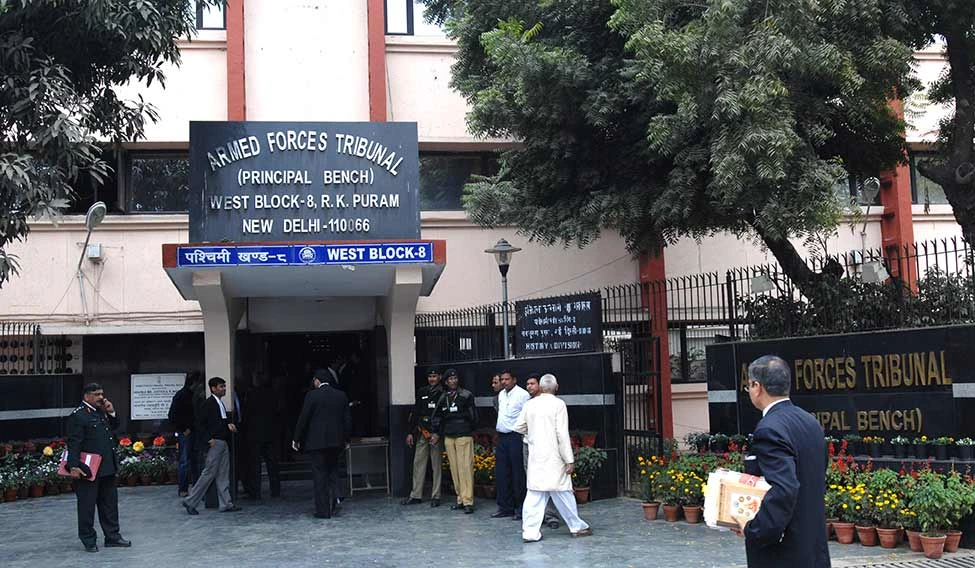
The Delhi High Court on January 19, 2026, refused to interfere with an Armed Forces Tribunal order granting disability pension to a retired Indian Air Force officer diagnosed with primary hypertension. The Bench made it clear that a Medical Board cannot deny benefits with a vague or unsupported opinion.
The case, Union of India vs. 627281 Ex MWO (HFO) Tejpal Singh, was decided by Justice V. Kameswar Rao and Justice Manmeet Pritam Singh Arora
Background of the Case
The Union of India had challenged a 2023 order of the Armed Forces Tribunal (AFT), which had partly allowed the officer’s application. The Tribunal held that the respondent was entitled to disability pension for “Primary Hypertension” assessed at 30% for life, and directed that it be rounded up (broad-banded) to 50% in line with Supreme Court precedent.
Read also:- Two Women Killed in Acid Attack: Allahabad High Court Modifies Life Imprisonment
The officer had joined the Air Force in October 1981 and served for more than 37 years before retiring in March 2019. It was undisputed that he had no disability at the time of entry into service.
The Release Medical Board later assessed him with Primary Hypertension and another cardiac condition, but opined that the hypertension was neither attributable to nor aggravated by military service. The government argued that the illness was a lifestyle-related disorder and occurred in a “peace area,” not under combat conditions.
Counsel for the Union of India contended that under the 2008 Entitlement Rules for Casualty Pensionary Awards, there is no automatic presumption linking a disease to military service. The government said the Tribunal had wrongly granted pension despite the Medical Board’s findings.
Read also:- Karnataka HC Makes Crowd Control SOP Binding Till New Law Is Enacted After Tragedy Concerns
However, the Bench examined earlier judgments of the High Court and the Supreme Court, which emphasise that the burden lies on the authorities to show why a disease is not connected to service. A mere conclusion is not enough - reasons must be recorded.
The Court noted that the officer did not suffer from any disability at the time of joining the Air Force. It also examined the Medical Board’s remarks and found them lacking in reasoning.
The Bench observed that while declaring hypertension as not related to service, the Medical Board did not explain why.
“It does not even give any reasons to relate the disability to lifestyle,” the Court recorded
The judges stressed that lifestyle varies from person to person. Simply labeling a condition as a lifestyle disorder cannot justify denial of pension unless specific facts about the individual are examined and recorded.
Referring to settled law, the Court reiterated that the Medical Board must provide “clear and cogent reasons” when denying disability benefits. The onus to rebut the presumption of service connection lies on the employer.
After reviewing the facts and legal position, the Bench held that the Tribunal’s conclusion could not be faulted. The Court found no merit in the Union of India’s challenge.
“The petition being without any merit is dismissed,” the Bench ruled, also dismissing the pending application as infructuous.
With this, the Tribunal’s direction granting disability pension at 50% for life, along with arrears, remains in force.
Case Title:- Union of India vs. 627281 Ex MWO (HFO) Tejpal Singh
Case Number:- W.P.(C) 749/2026
Date of Decision:- 19 January 2026
Download Order











-300x169.webp)

-300x169.webp)