

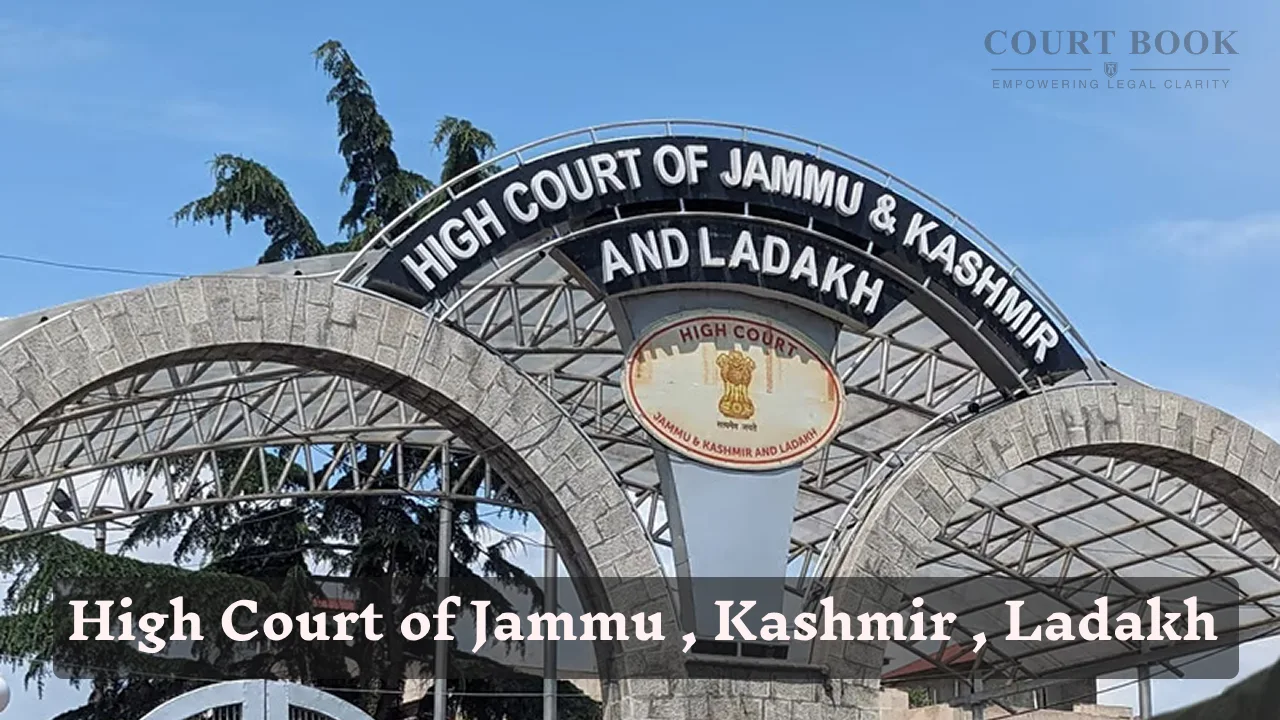
The High Court of Jammu & Kashmir and Ladakh has upheld the dismissal of a police constable accused of activities considered prejudicial to the security of the State, ruling that the government was justified in dispensing with a regular departmental inquiry under constitutional provisions meant for exceptional security situations.
A Division Bench comprising Justice Sanjeev Kumar and Justice Sanjay Parihar allowed an appeal filed by the Union Territory administration and set aside an earlier judgment that had reinstated the employee.
Background of the Case
The case concerned Ghulam Mohd. Tantray, who joined the Jammu and Kashmir Police in 1991. According to the government, he came under investigation in 2004 after being linked to activities viewed as harmful to national and State security.
An FIR was registered against him, and a departmental inquiry was initially started. However, before the inquiry could be completed, the government invoked Section 126(2)(c) of the Constitution of Jammu and Kashmir, a provision corresponding to Article 311(2)(c) of the Constitution of India, and dismissed him from service without holding a full-fledged inquiry.
The dismissal order was challenged before a Single Judge of the High Court, who in 2011 held that the government had not adequately justified bypassing the inquiry process and quashed the dismissal. The government then filed the present appeal.
The Division Bench examined the constitutional framework governing dismissal of government employees and the exceptions that permit authorities to dispense with an inquiry.
The court noted that while a departmental inquiry is ordinarily mandatory before imposing a major penalty, Article 311(2)(c) permits the government to waive that requirement where it is satisfied that holding such an inquiry would not be expedient in the interest of the security of the State.
Referring to Supreme Court precedents, the Bench observed that judicial review in such cases is limited and courts are not expected to reassess the adequacy of the material considered by the government.
“The action to be taken by the President/Government in the interest of the security of the State must be based upon the subjective satisfaction drawn on the aid and advice of the Council of Ministers,” the Bench observed.
The judges further noted that courts may interfere only where such satisfaction is tainted by mala fides, arbitrariness, or absence of relevant material.
After reviewing the official records, the Bench found that the government had relied on reports, investigation material, and recommendations placed before the Cabinet.
The court recorded that the authorities had considered allegations that the employee had links with a Pakistani militant and had facilitated shelter for him. The material was examined by a committee constituted by the government, following which a memorandum was prepared for Cabinet consideration.
According to the memorandum, witnesses could be unwilling to testify due to fear of retaliation and there were concerns that conducting a regular inquiry could expose individuals connected with security-sensitive information. These factors, the court said, formed the basis for invoking the constitutional exception.
The Bench observed that the Single Judge had failed to properly consider this material while setting aside the dismissal order.
Allowing the appeal, the Division Bench held that sufficient material existed to justify the government's decision to dispense with a departmental inquiry in the interest of State security.
“The writ Court seems to have ignored all this material available on record,” the Bench stated while finding fault with the earlier judgment.
Consequently, the court set aside the 2011 judgment of the Single Judge and restored the dismissal order issued against the employee.
The writ petition challenging the dismissal was dismissed.
Case Details
Case Title: State of Jammu & Kashmir and Others v. Ghulam Mohd. Tantray
Case Number: LPAW No. 268/2011
Judges: Justice Sanjeev Kumar and Justice Sanjay Parihar
Decision Date: 30 May 2026


