

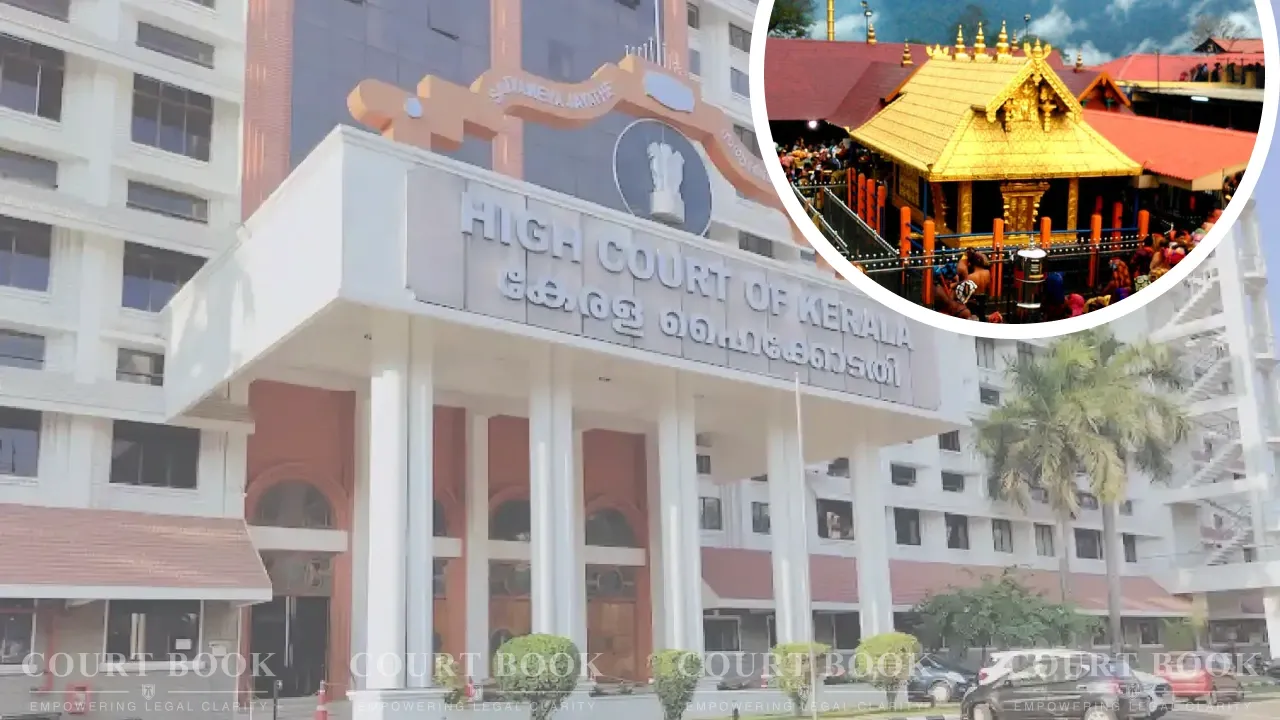
The Kerala High Court has ordered the removal of certain observations made by a Vigilance Court while granting bail to a person accused in two Crime Branch cases linked to the Sabarimala temple affairs. The Court held that remarks appearing to virtually clear an accused at the bail stage could adversely affect the ongoing investigation and prosecution.
Justice A. Badharudeen passed the order on June 9, 2026, while deciding two petitions filed by the State of Kerala.
Background of the Case
The petitions arose from orders passed by the Enquiry Commissioner and Special Judge (Vigilance), Kollam, in connection with Crime Nos. 3700/2025 and 3701/2025 investigated by the Crime Branch. The accused concerned was Kandararu Rajeevaru alias Rajeev T., who was arrayed as Accused No. 16 in both cases.
The State did not seek cancellation of the bail granted to the accused. Instead, it challenged specific findings recorded in paragraphs 79, 80, 87 and 88 of the Special Court’s order, arguing that those observations effectively gave the accused a “clean chit” and could prejudice the investigation.
The prosecution submitted that while a court hearing a bail application may examine available materials to assess whether a prima facie case exists, it should not make findings that could undermine future investigation or prosecution.
The accused opposed the plea, contending that the Special Judge had merely recorded reasons required for a lawful bail order. It was argued that courts are expected to discuss allegations and available material while deciding bail applications, and that the order was a reasoned one rather than a mechanical grant of bail.
After examining the disputed portions of the bail order, the High Court noted that the Special Judge had gone beyond what was necessary at the stage of deciding bail.
The bench observed that although a court granting bail can evaluate available materials to determine whether a prima facie case is disclosed, “such power shall not be exercised to efface the investigation and to annul the prosecution of the accused.”
The Court further pointed out that the investigating agency may collect additional evidence during the course of investigation and that assessment of the entire material ultimately falls within the jurisdiction of the trial court.
According to the High Court, the Special Judge should not have made observations that appeared to conclusively assess the accused’s role while the investigation was still underway.
Allowing the State’s limited request, the Kerala High Court ordered that the remarks contained in paragraphs 79, 80, 87 and 88 of the Special Judge’s bail order stand expunged. The Court clarified that this would be without prejudice to the prosecution’s right to continue its investigation and pursue the case in accordance with law.
The Court also directed that the trial court should independently assess the prosecution materials in their entirety while considering discharge, framing of charges, and the final adjudication of the case based on evidence produced during trial.
Case Details:
Case Title: State of Kerala v. Kandararu Rajeevaru @ Rajeev T.
Case Numbers: Crl.M.C. Nos. 2455 of 2026 & 2717 of 2026
Judge: Justice A. Badharudeen
Decision Date: June 9, 2026


