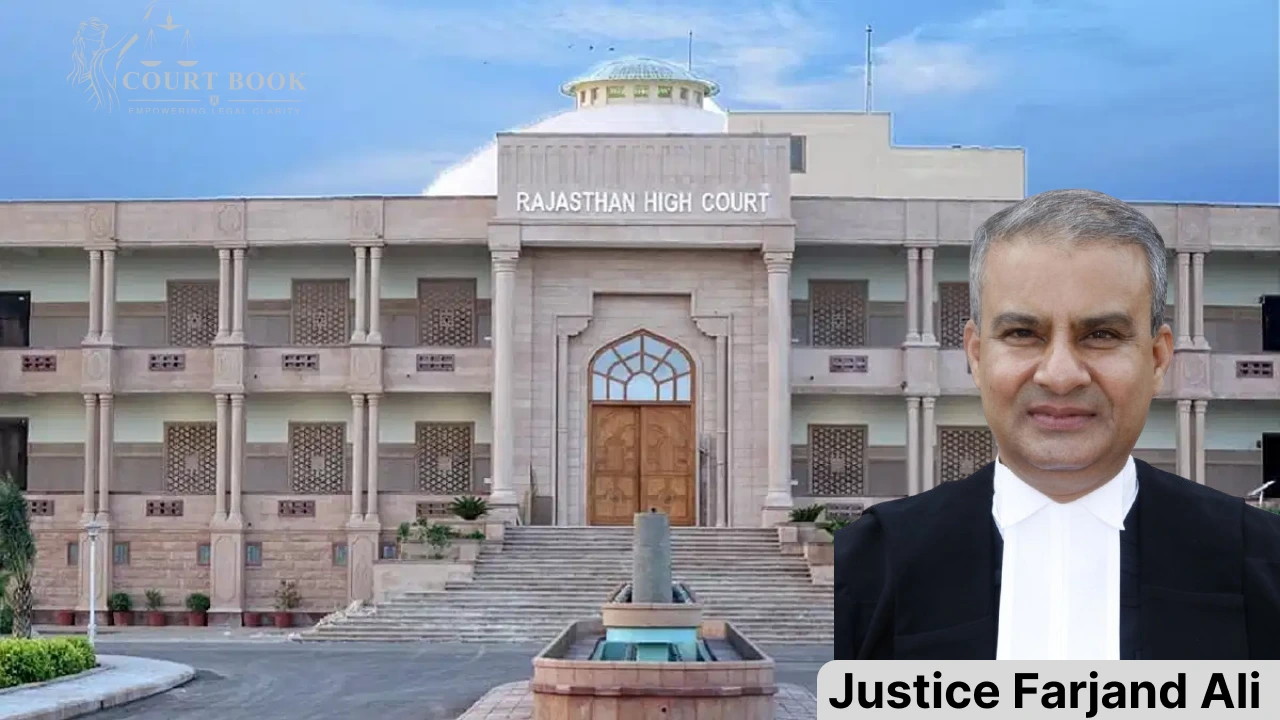
The Rajasthan High Court has held that a locked house or an incomplete address, by itself, cannot justify substituted service of summons through newspaper publication under Order V Rule 20 of the Code of Civil Procedure (CPC). The Court said that before adopting this exceptional method, the trial court must examine whether the defendant was deliberately avoiding service and whether ordinary service had genuinely become impracticable.
Justice Farjand Ali delivered the ruling on September 17, 2026, while deciding an appeal against an order of the District Judge, Churu, which had refused to set aside an ex-parte decree in a specific performance suit.
Background
The dispute arose from Civil Regular Suit No. 116/2013 concerning specific performance of an agreement to sell agricultural land. Summons issued to the defendants were returned unserved after the process server found the house locked. The report also indicated that Kanta Devi was residing in Jaipur, with Shankar Vihar Colony mentioned as her locality, although her complete address was unavailable.
Instead of making further efforts to obtain the defendants' complete address, the trial court allowed an application for substituted service through newspaper publication. The defendants were subsequently proceeded against ex parte, and the suit resulted in a decree affecting their rights in the property. They later claimed that they learnt about the decree only during execution proceedings and sought relief under Order IX Rule 13 CPC.
Justice Farjand Ali noted that substituted service is an exception to the normal method of personal service. The Court held that failure of an initial attempt does not automatically permit newspaper publication.
"The Court must examine the circumstances which resulted in such failure and must satisfy itself that the statutory conditions for adopting substituted service exist. A locked house, without anything further, does not establish deliberate evasion. Likewise, an incomplete address does not justify dispensing with further efforts to ascertain the defendant's correct address when the material before the Court itself furnishes a clue to his whereabouts."
The Court further held that the trial court was required to consider three matters: whether the defendant was deliberately avoiding service, whether summons could not reasonably be served through the ordinary method, and whether reasonable efforts had first been made to effect personal service.
It also observed that newspaper publication cannot automatically be treated as effective service. The Court said that factors including the defendant's last known residence, the newspaper's circulation, its language and the likelihood of the publication reaching the defendant should be considered.
"Publication is not an end in itself. Its purpose is communication." The Court found no convincing material showing that the appellants knew about the suit or the hearing date, nor that the newspaper used had sufficient circulation in their locality.
The Rajasthan High Court allowed the appeal and set aside the District Judge's order dated August 29, 2024. It also set aside the ex-parte judgment and decree dated August 23, 2017, restoring the suit to its original number and the stage at which it stood on November 16, 2013.
The defendants were directed to appear before the trial court and file their written statement within 60 days of appearance.
The High Court clarified that its observations would not affect the trial court's consideration of the merits of the underlying specific performance dispute.
Case Details:
Case Title: Kanta Devi & Ors. v. Parsaram & Anr.
Case Number: S.B. Civil Miscellaneous Appeal No. 2623/2024
Judge: Justice Farjand Ali
Decision Date: September 17, 2026