

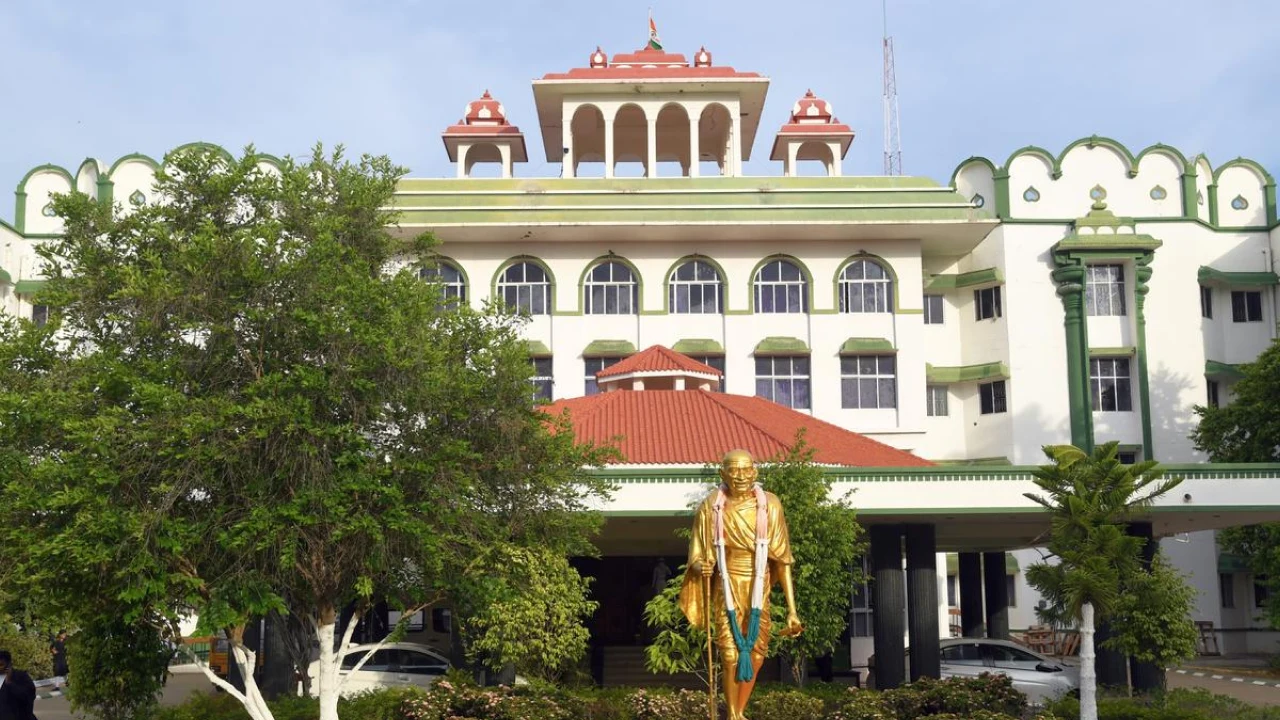
The Madras High Court has ruled that an American citizen who has genuinely embraced and practiced Hinduism cannot be denied the rights of a Hindu devotee merely because of her nationality or name. The Court set aside a communication issued by the Tamil Nadu Hindu Religious and Charitable Endowments (HR&CE) Department that described the petitioner as an "American Christian woman" and restricted her access within a temple.
Background of the Case
The petitioner, Laura Frances Iyengar, approached the Madurai Bench after challenging an order dated August 10, 2024, issued by the Assistant Commissioner of the HR&CE Department. She stated that although she is an American citizen, she had embraced Hinduism years ago, consistently identified herself as a Hindu in official records, undertaken pilgrimages to several temples, and later married a Hindu in a ceremony conducted at Sri Arulmighu Abishta Varatharajaperumal Temple in Thanjavur district.
According to the petition, local residents objected to her entry into the temple, believing she did not belong to the Hindu faith. Following a representation made by her husband, the authorities issued a communication treating her as an "American Christian woman" and permitting her only to remain in the temple's outer precincts. She challenged this characterisation before the High Court.
Court's Observations
Justice D. Bharatha Chakravarthy observed that Hinduism has historically been inclusive and does not require any mandatory formal conversion ceremony or certificate before a person can be accepted into the faith. Referring to the Supreme Court's ruling in Perumal Nadar v. Ponnuswami, the Court noted that a genuine intention to embrace Hinduism, supported by consistent conduct, is sufficient to establish conversion.
Rejecting the authorities' assumption, the Court said,
"Merely because the petitioner bears the name 'Laura Frances' or holds American citizenship, she cannot be denied recognition as a Hindu when her conduct and belief unequivocally establish her adherence to Hinduism."
The Court found that the documentary material and the petitioner's conduct clearly demonstrated that she had consistently professed and practiced Hinduism. It therefore held that the official description of her as an "American Christian woman" was factually incorrect and legally unsustainable.
The bench further clarified that once recognised as a Hindu devotee, the petitioner would enjoy the same rights as any other Hindu woman worshipper, subject to the customs, usages, Agamas, and regulations applicable to the concerned temple. At the same time, she could not claim any special privileges beyond those available to other Hindu women devotees.
Court's Decision
Allowing the writ petition, the High Court declared the impugned order illegal to the extent that it described the petitioner as an "American Christian woman." The Court directed the HR&CE Department and its officials not to deny her any right available to a Hindu woman devotee in any temple, including Sri Arulmighu Abishta Varatharajaperumal Temple, subject to the temple's established customs and religious practices.
No costs were awarded, and the connected miscellaneous petition was closed.
Case Details
Case Title: Laura Frances Iyengar v. TN HR and CE Department & Others
Case Number: W.P.(MD) No. 15422 of 2026
Judge: Justice D. Bharatha Chakravarthy
Decision Date: 25 June 2026


