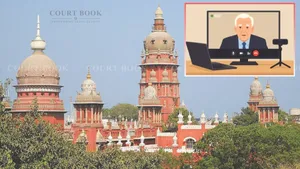
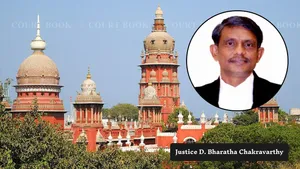
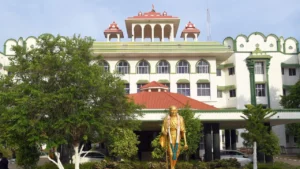
The Madras High Court has raised serious institutional concerns over the increasing number of practising advocates facing criminal prosecutions and observed that the issue may require a comprehensive policy response from the Bar Council of India and the Bar Council of Tamil Nadu and Puducherry. While hearing a criminal original petition filed by advocate B. Jagadeeshwaran, Justice D. Bharatha Chakravarthy clarified that the observations were not directed against the petitioner personally but were intended to address a larger concern affecting the legal profession.
Background of the Case
The petition was filed by B. Jagadeeshwaran seeking relief in connection with Crime No. 163 of 2026 registered by the Kannankurichi Police Station, Salem District. At the initial hearing, the High Court issued notice to the second respondent and permitted the police to continue the investigation in accordance with law. The investigating agency was also directed to file its counter affidavit before the next hearing.
During the proceedings, the Court noted that it had been regularly dealing with petitions filed by practising advocates under criminal law provisions. According to the Court, a noticeable number of such petitions either involved advocates who were already facing criminal proceedings before enrolment or lawyers against whom criminal allegations had arisen after joining the profession.
Court's Observations
Justice D. Bharatha Chakravarthy acknowledged the settled principle of criminal law that registration of a First Information Report (FIR) does not by itself create a stigma and that every accused is presumed innocent until proven guilty through due process.
"The mere registration of an FIR does not attach any stigma to a person. Every accused is presumed to be innocent until proved guilty in accordance with law," the Court observed.
However, the Court drew a distinction when advocates facing multiple criminal prosecutions seek leadership positions in Bar Associations. Since advocates are officers of the Court and form an integral part of the justice delivery system, the Court said the issue extends beyond individual cases and raises broader institutional concerns.
The bench observed,
"If persons facing serious criminal allegations become office-bearers of Bar Associations and their number manifoldly increases in every bar, a legitimate concern arises as to whether they would be in a position to effectively safeguard the interests of the clients whom they represent and uphold the dignity and values expected of the legal profession."
The Court further remarked that it was not dealing with isolated incidents. It noted that nearly 30 to 40 criminal matters involving practising advocates were coming before it on almost every working day, adding that such a trend could ultimately affect public confidence in the justice delivery system.
Call for a Policy Review
The High Court observed that the matter had reached a stage where statutory regulatory bodies may have to examine whether new policies or rules are required.
It suggested that the Bar Council of India and the Bar Council of Tamil Nadu and Puducherry consider conducting a comprehensive study on practising advocates facing criminal prosecutions. The proposed exercise could examine the number of such cases, whether the allegations relate to the period before or after enrolment, whether Bar Association office-bearers are involved, and whether the allegations arise from professional activities or concern offences involving moral turpitude or other serious crimes. The Court said such empirical data would assist the authorities in taking informed policy decisions.
Importantly, the Court clarified that these observations should not be construed as casting any aspersion on the present petitioner or any individual advocate. It emphasised that the concern was purely institutional and aimed at ensuring an objective assessment of the prevailing situation.
Court's Decision
While allowing the police investigation to continue, the High Court suo motu impleaded the Bar Council of India and the Bar Council of Tamil Nadu and Puducherry as respondents in the proceedings.
The newly added respondents were granted liberty to place their views, suggestions and practical concerns before the Court regarding the issues identified in the order.
The matter has been directed to be listed on 24 August 2026 for further hearing.
Case Details
Case Title: B. Jagadeeshwaran v. State & Anr.
Case Number: CRL OP No. 19749 of 2026 & CRL.MP. No. 13093 of 2026
Judge: Justice D. Bharatha Chakravarthy
Decision Date: 23 July 2026







-300x169.webp)