

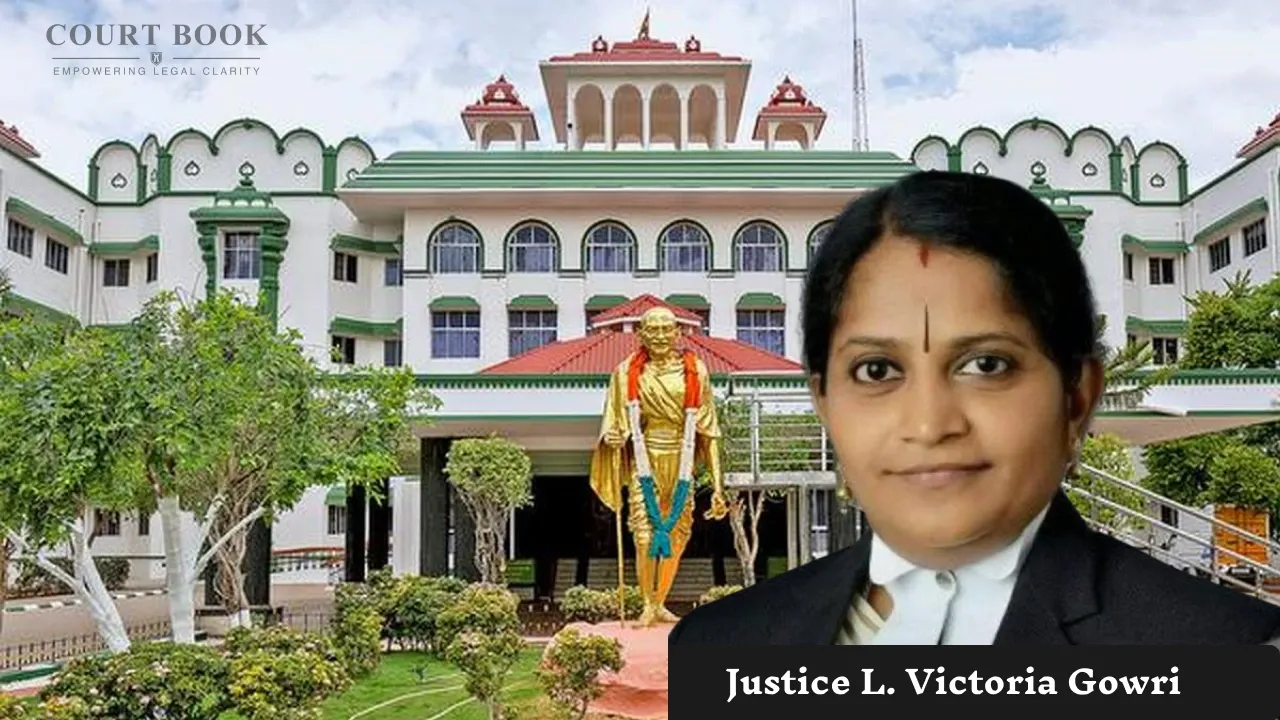
The Madurai Bench of the Madras High Court has set aside a trial court order that permitted the prosecution to recall an investigating officer in a murder case for marking additional documents. The Court held that powers under Section 348 of the Bharatiya Nagarik Suraksha Sanhita (BNSS) cannot be used to allow the prosecution to overcome weaknesses exposed during trial unless the proposed evidence is shown to be truly essential for delivering justice.
Justice L. Victoria Gowri observed that while courts possess broad powers to summon or recall witnesses, such powers must be exercised cautiously and supported by clear reasons.
Background of the Case
The case arises from the alleged murder of a company official who, according to the prosecution, had a financial dispute with the accused, Anbu.
The prosecution claimed that the deceased had entrusted agricultural products worth around ₹14 lakh to the accused for sale. It alleged that the accused failed to return the sale proceeds, leading to disagreements between the parties.
According to the prosecution, the accused later took the deceased in his car, after which the deceased was allegedly killed and his body disposed of. A charge sheet was filed for the offence punishable under Section 302 of the Indian Penal Code.
During the trial, the prosecution examined fourteen witnesses, including the investigating officer (PW-14), who was cross-examined in November 2024.
After substantial progress in the trial, the prosecution sought to recall PW-14 to mark call detail records, tower location data, IMEI information, SIM details and bank transaction records.
The trial court allowed the request, prompting the accused to challenge the order before the High Court.
Court Examines Scope of Section 348 BNSS
The High Court noted that Section 348 BNSS, corresponding to Section 311 of the Code of Criminal Procedure, gives courts authority to summon or recall witnesses if their evidence is essential for a just decision.
However, the Court stressed that the provision is not intended to provide either side with an opportunity to repair shortcomings in its case.
“The power is intended to aid the cause of justice. It is not intended to confer an unfair advantage on either party,”
the Court observed.
Justice Gowri referred to several Supreme Court decisions explaining that recall of witnesses cannot be permitted routinely and must be supported by tangible reasons demonstrating necessity.
Court Finds Lack of Adequate Reasons
Examining the trial court's order, the High Court found that it merely concluded that the documents were necessary to complete the chain of circumstances without adequately explaining why they were indispensable.
The Court noted that prosecution witnesses had already spoken about meetings between the accused and the deceased, alleged phone calls and location sharing. Therefore, the proposed call records and tower location details appeared largely corroborative in nature.
Similarly, bank transaction records could potentially support the prosecution's claim regarding motive, but motive alone could not establish the charge of murder.
“The expression ‘essential to the just decision of the case’ carries a higher threshold than mere usefulness,”
the Court said.
“Every useful document is not essential.”
The Court further observed that the prosecution had already completed its evidence and the accused had been questioned. Allowing additional material at such a late stage, without strong justification, risked causing prejudice to the defence.
Concern Over Fair Trial Rights
Justice Gowri emphasised that the timing of the recall request was significant.
The Court noted that the prosecution had full opportunity to introduce the documents when the investigating officer was originally examined. Seeking to produce them only after cross-examination and after the defence highlighted omissions raised serious concerns.
“The later the stage, the stronger must be the reasons,”
the Court remarked while discussing the exercise of powers under Section 348 BNSS.
According to the judgment, the trial court failed to assess whether the documents were previously supplied to the accused, whether they formed part of the final report and whether their introduction would require further procedural safeguards.
Decision
Holding that the trial court had not recorded “strong, valid and tangible reasons” for recalling the investigating officer, the Madras High Court concluded that the order suffered from non-application of mind.
The Court found that permitting recall in the circumstances of the case would effectively allow the prosecution to fill gaps in its evidence and would prejudice the accused's right to a fair trial.
Accordingly, the High Court allowed the criminal original petition, set aside the trial court's order dated 9 September 2025, and directed the trial court to proceed with the murder trial in accordance with law and dispose of it expeditiously, without being influenced by any observations made in the High Court's order.
Case Details:
Case Title: Anbu v. State of Tamil Nadu
Case Number: Crl.O.P.(MD) No.1327 of 2026
Judge: Justice L. Victoria Gowri
Decision Date: 1 June 2026


