

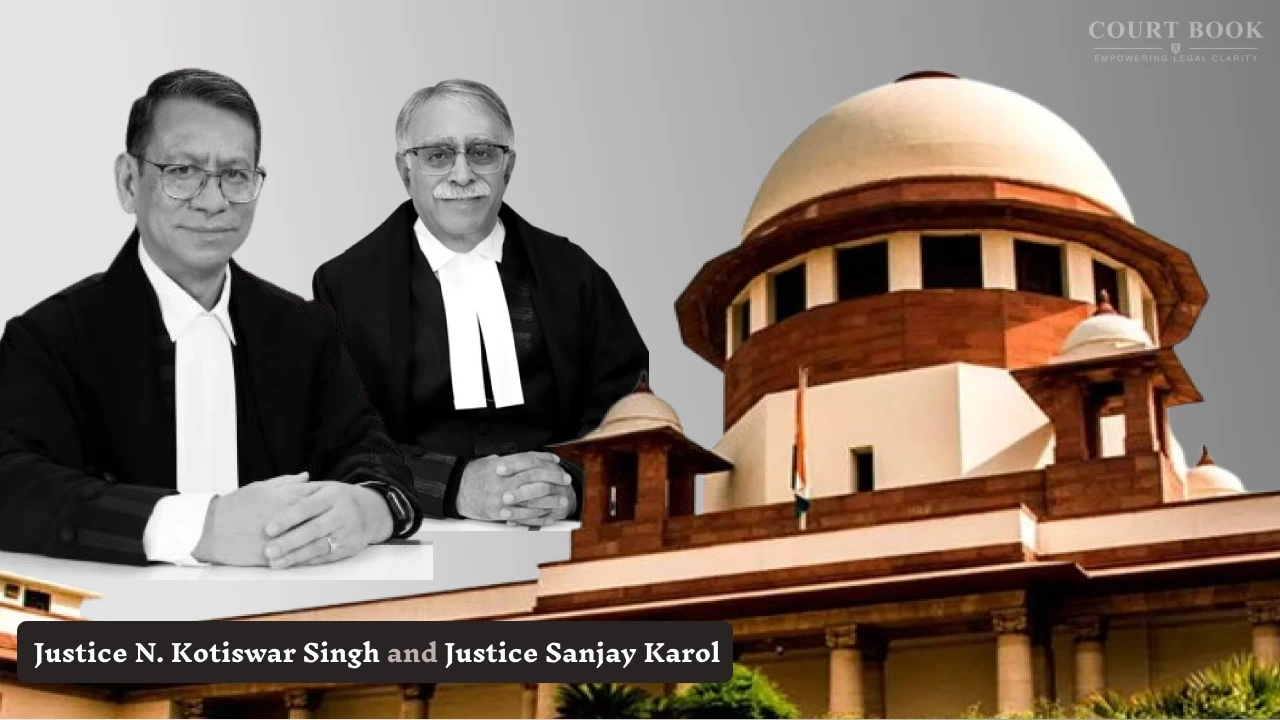
The Supreme Court has clarified that a Magistrate is not required to record prosecution evidence under Section 244 of the Code of Criminal Procedure (CrPC) before committing a complaint case to the Sessions Court if the alleged offences are exclusively triable by that court. Setting aside a Punjab and Haryana High Court order, the bench held that such a requirement finds no support in law and would unnecessarily delay criminal trials.
Background of the Case
The dispute arose from an incident on 12 April 2007, when a verbal and physical altercation allegedly took place between the complainant, Neeraj Gupta, and his father on one side, and the respondents on the other. During the incident, the complainant's father collapsed and was later declared dead at the hospital. According to the record, no FIR was initially registered despite complaints made to the police.
The complainant thereafter approached the Judicial Magistrate First Class, Chandigarh, under Section 156(3) CrPC. The Magistrate initiated proceedings under Section 200 CrPC, recorded pre-summoning evidence, and issued summons in December 2009. The matter was later committed to the Sessions Court, where charges were framed only against one accused, while two others were discharged.
The complainant challenged the discharge before the Punjab and Haryana High Court. The High Court, however, remanded the matter to the Magistrate, holding that prosecution evidence under Section 244 CrPC had to be recorded before commitment.
Court's Observation
Allowing the appeal, the Supreme Court ruled that the High Court had incorrectly interpreted the procedural provisions of the CrPC.
The bench examined Sections 200, 209 and 244 CrPC and observed that once it appears to the Magistrate that an offence is exclusively triable by the Sessions Court, the Magistrate's role is limited to committing the case after complying with the statutory requirements. Recording evidence under Section 244 is not mandatory at that stage.
Rejecting the High Court's reasoning, the Court said that accepting such an interpretation would compel witnesses to depose twice on the same facts before two different courts, resulting in avoidable delay without any legal basis.
The bench observed,
"If the reasoning of the High Court is accepted, a number of witnesses would be required to depose about the same set of facts and circumstances, at least twice. This may not be of any particular use, nor mandate of law."
The Court also relied on earlier Constitution Bench and three-judge bench decisions which explained that the present CrPC intentionally abolished the detailed pre-committal inquiry that existed under the old Code of Criminal Procedure, 1898. It noted that Parliament had consciously reduced the Magistrate's role at the commitment stage to ensure expeditious criminal trials.
Decision
Holding that the Punjab and Haryana High Court had proceeded on an erroneous reading of the law, the Supreme Court set aside the remand order.
The Court directed the High Court to hear afresh both the complainant's revision challenging the discharge of two accused and the connected petition filed by one of the respondents challenging the framing of charges. It further requested the High Court to decide both matters independently and as expeditiously as possible, preferably within nine months, with the parties directed to appear before the High Court on 16 July 2026. The appeal was accordingly allowed.
Case Details:
Case Title: Neeraj Gupta v. Pardeep Kumar Bansal & Ors.
Case Number: Criminal Appeal arising out of Special Leave Petition (Criminal) No. 776 of 2020
Judge: Justice Sanjay Karol and Justice Nongmeikapam Kotiswar Singh
Decision Date: 1 July 2026


