

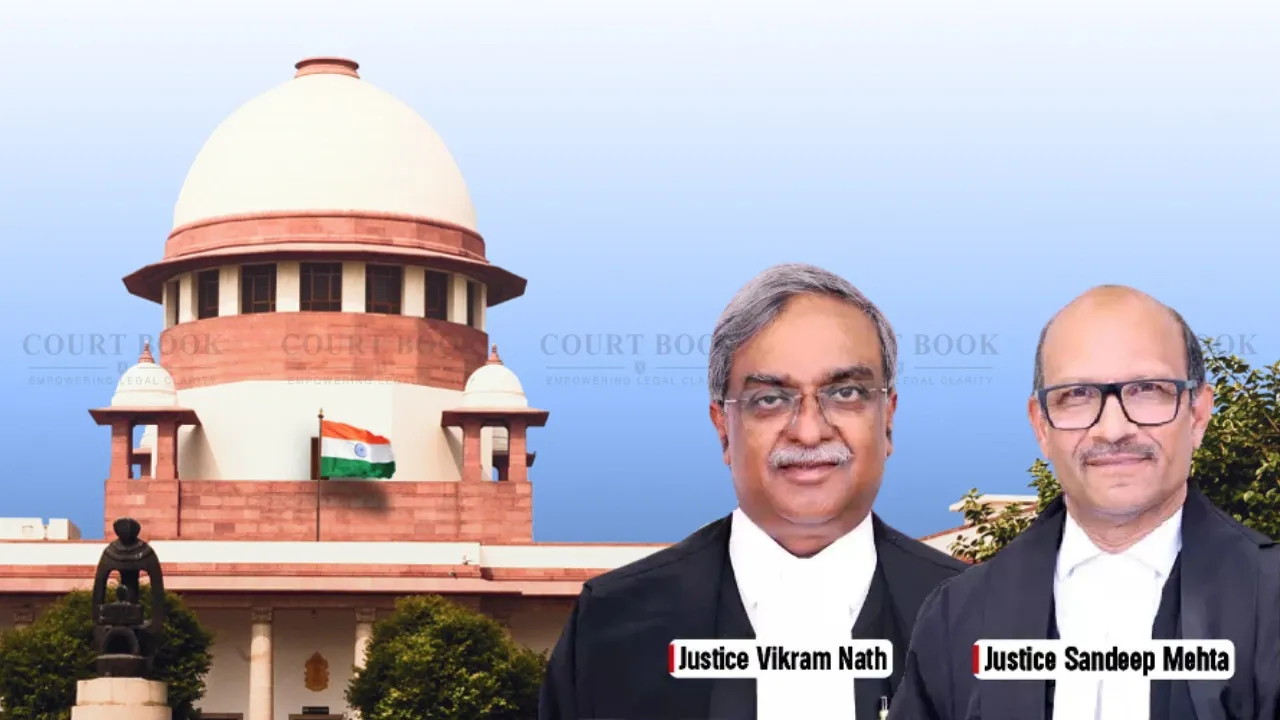
In a significant ruling on motor accident compensation claims, the Supreme Court held that minor inconsistencies in records cannot be used to deny relief to accident victims under welfare legislation. The Court restored compensation to the family of a labourer who suffered permanent paralysis after a road accident in West Bengal and later died during the pendency of the case.
A bench of Justice Vikram Nath and Justice Sandeep Mehta set aside the orders of the Motor Accident Claims Tribunal (MACT) and the Calcutta High Court, both of which had dismissed the claim petition on the ground that the accident itself was not proved.
Background Of The Case
The case arose from an accident that allegedly took place on May 21, 2004. Raj Kumar Das claimed that after getting down from a rickshaw near Mondalpara Bus Stop, he was hit by a lorry while paying the fare. The accident allegedly left him with traumatic paraplegia and 100% permanent disability.
Das filed a compensation claim under Section 163A of the Motor Vehicles Act seeking ₹3.5 lakh. However, the Tribunal dismissed the plea in 2007, holding that he failed to establish that his injuries were caused by the accident. The Calcutta High Court upheld that finding in 2022.
During the proceedings before the Supreme Court, the original claimant died and the matter was pursued by his legal representatives.
Supreme Court’s Observations
The Supreme Court said the approach adopted by the courts below was excessively technical and ignored the welfare nature of motor accident compensation law.
“The question for consideration before us is not whether every detail of the occurrence stands proved with precision, but whether the material on record reasonably establishes that the injuries sustained by the original claimant arose out of the accident in question,” the bench observed.
The Court reiterated that proceedings under the Motor Vehicles Act are summary in nature and claims are decided on the principle of “preponderance of probability” rather than proof beyond reasonable doubt.
The bench rejected reliance placed on an MRI report mentioning “fall from lorry,” noting that medical histories recorded during emergency treatment are often based on information supplied by attendants and cannot be treated as exact reconstructions of accidents.
It also held that delay in lodging the FIR could not by itself cast suspicion on the claim, particularly when the injured person remained under prolonged medical treatment.
On discrepancies regarding the vehicle registration number, the Court said an isolated mistake in oral testimony could not outweigh consistent documentary records.
The bench further clarified that non-examination of independent witnesses was not fatal where the claimant’s testimony remained consistent and unshaken in cross-examination.
Compensation Awarded
Taking note of the fact that the accident occurred over two decades ago, the Supreme Court decided not to remand the matter back to the Tribunal. Instead, it assessed compensation itself by invoking Article 142 of the Constitution.
The Court awarded compensation of ₹14.9 lakh along with 6% interest from the date of filing of the claim petition. The amount has to be deposited by the insurance company within three months before the MACT for release to the legal representatives of the deceased claimant.
“The absence of perfect proof cannot be a ground to deny compensation under a welfare statute,” the bench said while allowing the appeal.
Case Details
Case Title: Raj Kumar Das (D) Thr. LRs. v. National Insurance Co. Ltd.
Case Number: Civil Appeal arising out of SLP (C) No. 3585 of 2023
Judges: Justice Vikram Nath and Justice Sandeep Mehta
Decision Date: May 25, 2026


