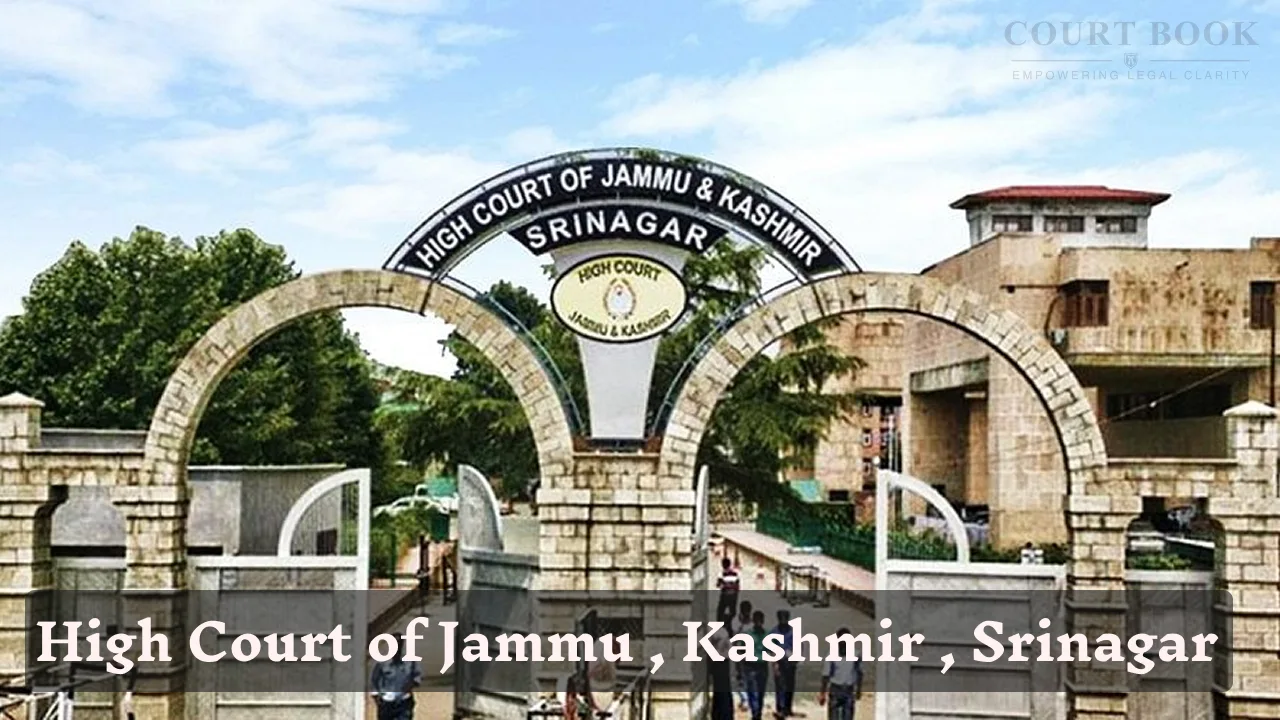
The Jammu & Kashmir and Ladakh High Court at Srinagar has declined a long-pending plea by four engineers seeking retrospective regularisation of their services. The court ruled that even if an employee completes the required service period, regularisation can take effect only from the date it is formally granted, not earlier.
Justice Sanjay Dhar delivered the verdict while dismissing a writ petition filed by Ghulam Rasool Bhat and others against the Government of Jammu & Kashmir and officials of the Power Development Corporation.
Background of the Case
The petitioners were engaged as Shift Engineers in 2005 at the Pahalgam Micro Hydel Project on a consolidated basis. Their engagements were extended periodically over the years.
They argued that as per the Corporation’s policy, employees were entitled to regularisation after completing two years of service. According to them, although similarly placed employees were regularised earlier, their own cases remained pending despite repeated representations.
In 2017, the Corporation finally issued an order regularising their services. However, the benefit was given only prospectively, from 24 November 2017. Aggrieved by the denial of retrospective effect-from either completion of two years or seven years of service-the engineers approached the High Court.
Read also:-No AI Deepfakes or Fake Merchandise: Madras High Court Protects Kamal Haasan’s Personality Rights
The petitioners contended that:
• Other engineers, appointed after them, were regularised earlier.
• They had completed seven years of continuous service by 2012 and were therefore entitled to regularisation under the J&K Civil Services (Special Provisions) Act, 2010.
• Denial of retrospective regularisation amounted to discrimination and violated Article 14 of the Constitution.
They also relied on internal recommendations made by technical officers and the Chief Engineer in their favour.
Stand of the Government
The respondents opposed the petition, stating that:
• The petitioners were engaged without any formal selection process.
• The policy of regularisation after two years applied only to those appointed under the Contractual Appointment Rules through proper recruitment.
• Section 5 of the 2010 Act clearly mandates that regularisation takes effect only from the date of sanction, not retrospectively.
The government further informed the court that the petitioners’ representations had been examined and rejected in 2023.
Read also:-‘Tiger’ Is Generic word, Not Exclusive: Delhi High Court Rejects Injunction in Trademark Battle
Court’s Observations
After examining the record, the court noted that the petitioners were not appointed through any recognised recruitment process. As a result, they could not claim parity with employees regularised after two years under contractual appointment rules.
On the interpretation of the 2010 Act, Justice Dhar referred to multiple Division Bench judgments, including Rabia Shah, Ulfat Ara, and Abdul Majid Magray. The court acknowledged that earlier rulings appeared to take differing views.
However, the judge held that the later judgment in Abdul Majid Magray laid down the correct legal position.
“The statute does not provide for retrospective regularisation merely because an employee has completed seven years of service,” the court observed.
The judge emphasised that completion of the qualifying period only creates a right to be considered, not an automatic right to backdated regularisation.
Read also:-Motor Accident Claims Can’t Include Expenses Paid by Charitable Trusts, Rules Gujarat High Court
Final Decision
Concluding the matter, the High Court held that the petitioners were lawfully regularised only from 24 November 2017, the date on which the sanction order was issued.
The writ petition was dismissed as lacking merit, and all interim directions were vacated.
Case Title: Ghulam Rasool Bhat & Ors. vs Government of J&K & Ors.
Case No.: WP(C) No.175/2020
Case Type: Service – Regularisation
Decision Date: 19 December 2025
Download Judgment