

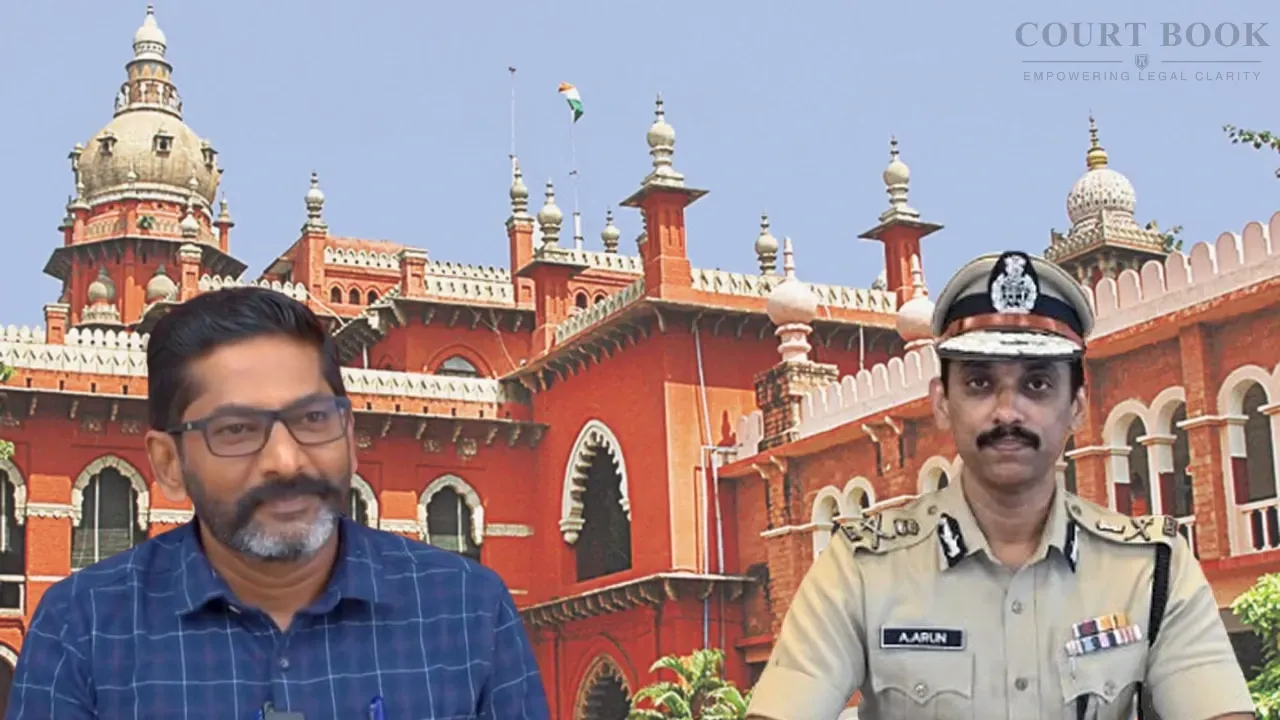
The Madras High Court has dismissed a public interest litigation (PIL) filed by journalist and activist Shankar @ Savukku Shankar seeking a Central Bureau of Investigation (CBI) probe against Arun IPS, Director of the Directorate of Vigilance and Anti-Corruption (DVAC), Tamil Nadu. The Court held that the petition was not maintainable because it stemmed from a personal dispute rather than genuine public interest.
Background of the Case
Savukku Shankar approached the High Court under Article 226 of the Constitution seeking a direction to the CBI to conduct an independent investigation against Arun IPS. The plea relied heavily on adverse observations made by another Division Bench of the High Court in Varsha Sharma v. The Additional Chief Secretary to Government, where the officer had been criticised while quashing a preventive detention order.
The petitioner argued that those observations raised serious concerns about the officer's conduct and that continued leadership of the State's anti-corruption agency by the officer could undermine public confidence. He also contended that despite representations, no action had been initiated by the State, making an independent CBI inquiry necessary.
Court's Observations
The Bench, headed by Chief Justice Sushrut Arvind Dharmadhikari and Justice G. Arul Murugan, acknowledged that the earlier Division Bench had indeed made strong observations against Arun IPS while setting aside the detention order.
However, the Court clarified that the real issue before it was not the earlier findings but whether the present petitioner had the necessary bona fide credentials to maintain a PIL.
Referring to the earlier judgment itself, the Court noted that it had recorded the existence of serious allegations previously made by Savukku Shankar against Arun IPS, demonstrating a clear adversarial relationship between the two.
The Bench observed:
“Public Interest Litigation is a sacred tool intended to bring justice within the reach of the marginalized and vulnerable segments of society... It cannot be reduced to a forum for vindicating personal animosity.”
The Court further stressed that Article 226 jurisdiction cannot be invoked by litigants seeking to settle personal grievances under the guise of public interest.
Reliance on Supreme Court Precedents
The High Court referred to the Supreme Court's decisions in Janata Dal v. H.S. Chowdhary and Dattaraj Nathuji Thaware v. State of Maharashtra, which caution courts against entertaining PILs filed for private motives.
Quoting these precedents, the Bench reiterated that a PIL must be filed by a person acting bona fide and not for personal gain, private vengeance, or any hidden motive.
Rejecting the petitioner's reliance on S.P. Gupta v. Union of India and Vishwanath Chaturvedi v. Union of India, the Court held that while those judgments recognise the role of public-spirited citizens, they equally require the litigant to act without personal bias or oblique motives. According to the Court, that essential requirement was absent in the present case.
Decision
Holding that the petitioner lacked the bona fides required for maintaining a public interest litigation, the Madras High Court concluded that the writ petition was driven by personal animosity rather than genuine public interest.
Accordingly, the Court dismissed the writ petition as not maintainable, without imposing any costs.
Case Details:
Case Title: Shankar @ Savukku Shankar v. The State & Others
Case Number: W.P. No. 23757 of 2026
Judge: Chief Justice Sushrut Arvind Dharmadhikari and Justice G. Arul Murugan
Decision Date: 01 July 2026


