

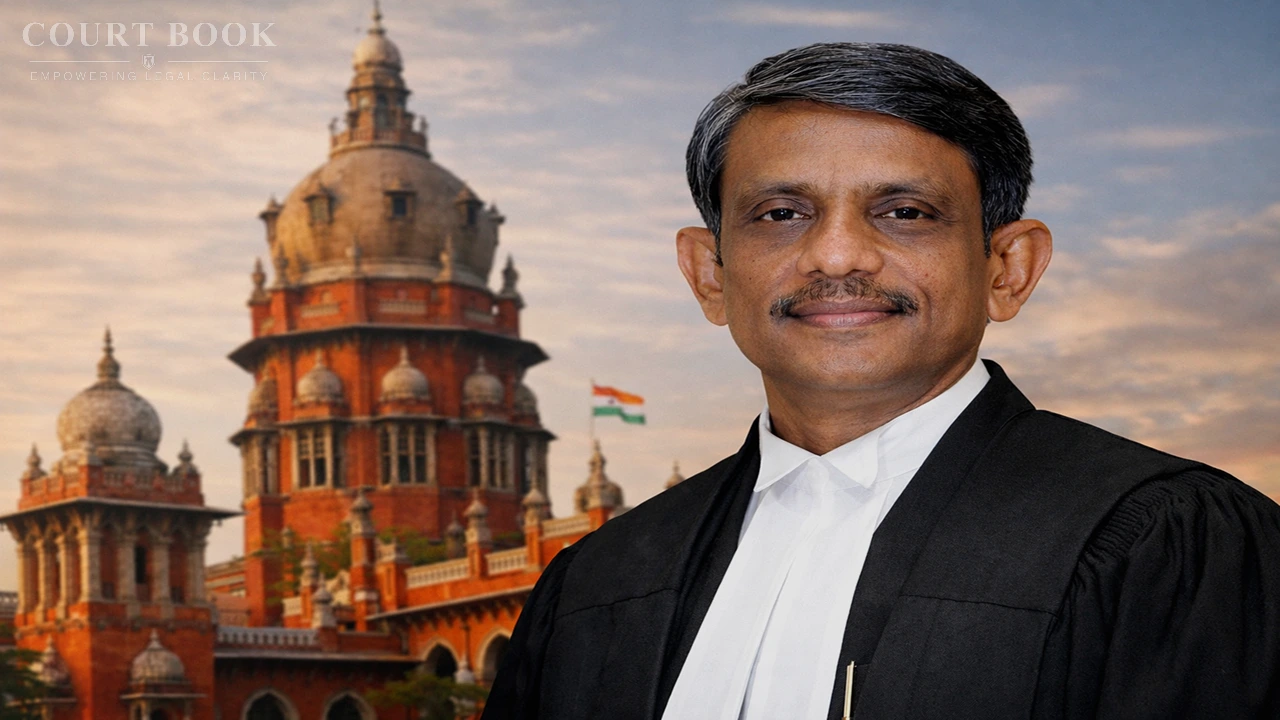
The Madurai Bench of the Madras High Court has refused to allow two paper manufacturing companies to re-export consignments containing municipal solid waste to Dubai, holding that illegally imported waste must be sent back to the country from which it originated. The court also rejected the companies' alternative request to dispose of the waste within India, observing that the country cannot become a destination for foreign waste.
Background of the Case
The batch of petitions was filed by M/s. Sripathi Paper and Boards Private Limited and M/s. Rajarajeswari Krafts Pvt. Ltd., both engaged in manufacturing paper products. The companies had imported consignments declared as waste paper from Canada, the United States, and Singapore.
However, inspections by Customs authorities and the Tamil Nadu Pollution Control Board allegedly revealed that the containers contained municipal solid waste, including used plastic bottles, food waste paper, plastic bags, broken glass, and other prohibited materials. The consignments were seized, confiscated, and ordered to be re-exported to the exporting countries at the importers' cost. Penalties were also imposed.
After accepting the adjudication orders and paying the penalties, the companies requested permission to send the cargo to Dubai instead of the countries of origin, stating that the exporters had agreed to receive the waste there and that transportation costs would be lower. They also sought permission, in the alternative, to recycle or dispose of the waste within India.
Court's Observations
Justice D. Bharatha Chakravarthy first held that the companies could not reopen the adjudication orders after accepting them and paying the penalties. The court noted that the importers had not challenged the findings through the statutory appellate process and had instead approached the High Court only after their request to re-export to Dubai was not accepted.
"The adjudication orders have attained finality and no ground exists to interfere with them in writ jurisdiction," the bench observed.
On the request to re-export the cargo to Dubai, the court interpreted Rule 15(2) of the Hazardous and Other Wastes (Management and Transboundary Movement) Rules, 2016, together with India's obligations under the Basel Convention. It held that the expression "re-export" necessarily means sending the waste back to the exporting country, not diverting it to a third country.
The bench observed that allowing hazardous or municipal waste to be redirected elsewhere would defeat the object of international environmental law and weaken the responsibility of the exporting nation for illegal waste shipments.
In strong remarks, the court said the Basel Convention was framed to prevent developed countries from shifting the burden of hazardous waste onto developing nations. Referring to this practice as "waste colonialism," the court stressed that India cannot permit itself to become a transit point for such consignments.
The court also rejected the plea to dispose of the waste within India through recycling, cement kilns or waste-to-energy facilities. It held that the statutory framework prohibits such a course where the imported material consists of prohibited municipal solid waste.
"The prayer seeking permission to dispose of the consignments within India is contrary to the applicable statutory provisions, inconsistent with the objectives of the Basel Convention and opposed to public policy,"
the bench observed.
Decision
The High Court upheld the confiscation orders and dismissed the challenge to them. It directed the companies to re-export the waste to the respective countries of origin within 60 days.
The court further held that disputes over detention, demurrage or freight charges cannot delay the removal of the waste from India. It directed that the petitioners would remain liable to pay the applicable charges, while the re-export process must continue. The court also recorded that the petitioners would jointly pay ₹4 crore along with freight charges to the shipping line as part of the arrangement placed before it.
The bench added that if the waste is not re-exported within 60 days, the petitioners will be liable to pay environmental compensation of ₹50,000 per day under the "Polluter Pays Principle," and prosecution may also be initiated under the Environment (Protection) Act, 1985. Costs of ₹10,000 each were also imposed on the petitioners.
Case Details:
Case Title: M/s. Sripathi Paper and Boards Private Limited v. The Commissioner of Customs and Others (Connected Matters)
Case Number: W.P.(MD) Nos. 24097, 24098, 24099, 24101, 24102, 24103 & 24104 of 2024Judge: Justice D. Bharatha ChakravarthyDecision Date: 19 June 2026

