

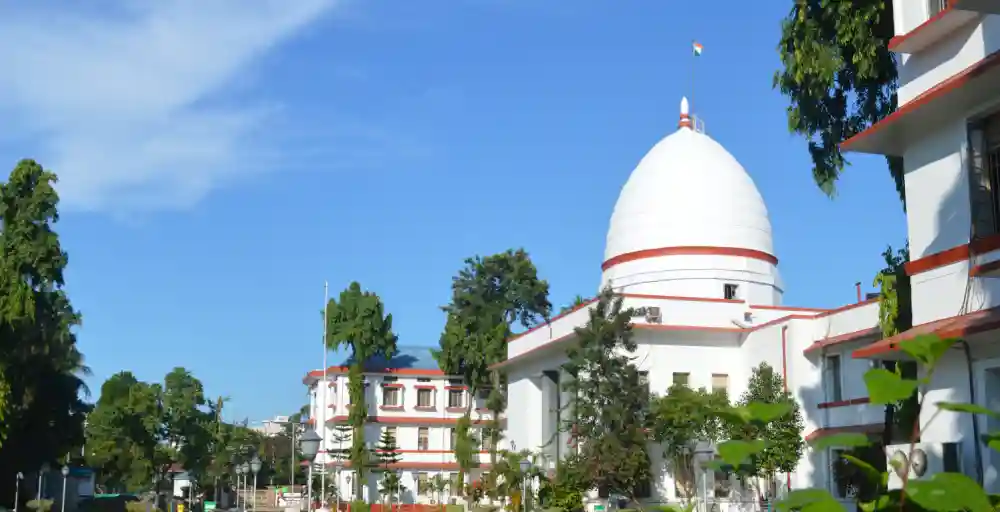
The Gauhati High Court has dismissed a writ appeal filed by former Associate Professor Anjuman Ara Begum, holding that her challenge to her termination by Assam Royal Global University arose out of a contractual employment relationship and did not involve the public law element necessary for invoking the High Court's writ jurisdiction under Article 226 of the Constitution. A Division Bench upheld the earlier order of the Single Judge, which had dismissed her writ petition as not maintainable.
Background of the Case
Begum was appointed as an Associate Professor at the Royal School of Law and Administration of Assam Royal Global University in 2022. According to her, she successfully completed probation, received salary revisions and performance incentives, and was recognised as a Ph.D. supervisor in March 2023. At the time of her termination, she was supervising six Ph.D. scholars, including two whose theses had reached the pre-submission stage.
The dispute arose after one of her research scholars sought a change of supervisor, which the University permitted. Begum claimed that after she protested the decision, she was asked to resign and was denied access to her official email and HR portal. She was later served with a termination letter dated October 17, 2025, citing "insubordination" and "major misconduct." She further contended that the University reassigned her research scholars to another supervisor who, according to her, was ineligible under the UGC Regulations to supervise Ph.D. candidates.
Court's Observations
Before the Division Bench, the appellant argued that although the University is privately managed, it is governed by the University Grants Commission (UGC) Regulations relating to appointments, service conditions, research supervision and academic standards. She submitted that her termination was not merely a private employment dispute because it affected statutory academic processes and the interests of her research scholars.
The University, on the other hand, argued that the dispute arose solely from a contract of employment and did not involve any public law element. It relied on Supreme Court decisions to contend that regulatory oversight by the UGC does not convert every service dispute involving a private university into a matter for writ jurisdiction.
Agreeing with the Single Judge, the Bench referred to the principles laid down by the Supreme Court in St. Mary's Education Society v. Rajendra Prasad Bhargava and observed:
"Individual wrongs or breach of mutual contracts without having any public element as its integral part cannot be rectified through a writ petition under Article 226."
The Court further observed that the appellant had been appointed under contractual terms and that her tenure as a Ph.D. guide was limited to the period during which she remained a regular faculty member of the University. It held that her termination did not relate to the discharge of a public function so as to attract writ jurisdiction under Article 226.
Decision
Affirming the Single Judge's decision, the Division Bench held that the appellant's termination was governed by her contract of service and the First Statute of the University, and therefore did not fall within the public law domain. Finding no reason to interfere with the earlier judgment, the Court dismissed the writ appeal.
Case Details:
Case Title: Anjuman Ara Begum v. The Assam Royal Global University
Case Number: WA/159/2026
Judge: Hon'ble Chief Justice Ashutosh Kumar and Hon'ble Mr. Justice Arun Dev Choudhury
Decision Date: 22 June 2026


