In a significant ruling protecting the rights of legally wedded wives, the Gauhati High Court has held that a mere nomination made by a deceased government employee cannot defeat the statutory right of his lawful wife to receive family pension. The court made it clear that pension rules, not personal nominations, decide who gets the benefit.
Background of the Case
The case was filed by Smt. Shibani Dutta, widow of late Sankar Dutta, who worked as Deputy Director of Economics and Statistics in Haflong under the Assam government. He retired in 2002 and passed away on 4 January 2021.
Shibani Dutta approached the court seeking release of family pension, arrears, and Death-cum-Retirement Gratuity (DCRG) after the state authorities refused to process her claim.
The couple had married in 1970 as per Hindu rites and had two daughters. Interestingly, Sankar Dutta had filed for divorce in 2007 before the Family Court in Silchar. However, neither party pursued the case, and it was dismissed for default in 2010. No divorce decree was ever passed, meaning the marriage legally continued till his death.
The dispute arose because, while submitting his pension papers, Sankar Dutta had nominated one Smt. Gayatri Roy Barman, describing her as his wife, for family pension and gratuity purposes. Based on this nomination, the Accountant General's office issued the Pension Payment Order (PPO) and Gratuity Payment Order (GPO) in her name, prompting the state to deny Shibani Dutta's claim.
Arguments In Court
Counsel for the petitioner argued that since the divorce case was dismissed without a decree, the marriage between Shibani Dutta and the deceased subsisted till his death. He contended that under Hindu law, a second marriage during the existence of the first is void, and nomination alone cannot create a right that doesn't exist under law.
The government's counsel, on the other hand, maintained that the authorities simply acted on the records available since the employee himself had named Gayatri Roy Barman as his wife in the pension documents, the department had no option but to process it accordingly.
Court's Observations
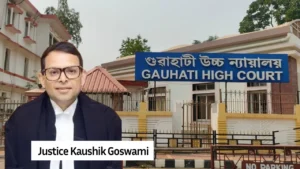
Justice Kaushik Goswami examined Rule 143 of the Assam Services (Pension) Rules, 1969, which defines "family" for pension purposes to include the wife of a male government servant. The court noted that this entitlement flows from the statute, not from any nomination form.
The bench observed that a nomination does not have the effect of displacing the lawful beneficiary entitled under the governing statute, and a nominee merely receives the amount on behalf of the person actually entitled to it. The court relied on earlier Supreme Court rulings, including Smt. Sarbati Devi vs. Smt. Usha Devi, to support this position.
It also referred to its own earlier decision in Tinku Das vs. State of Assam, where a similar view was taken that a second wife, during the subsistence of the first marriage, cannot claim family pension merely on the strength of nomination.
The court further noted that documents such as Form VII under the Group Insurance Scheme, filed in 1994, had themselves recorded Shibani Dutta as the wife of the deceased employee, further supporting her claim.
Court's Decision
The Gauhati High Court disposed of the writ petition, directing the state authorities to re-examine Shibani Dutta's claim. It held that if she is found to be the legally wedded wife on verification, the authorities must recognise her as the rightful beneficiary, correct the PPO and GPO wherever necessary, and release the family pension with arrears and the DCRG within two months from receipt of the order.
Case Details
Case Title: Smt. Shibani Dutta v. The State of Assam & Ors.
Case Number: WP(C) No. 6004 of 2023
Judge: Hon'ble Mr. Justice Kaushik Goswami
Decision Date: 23 July 2026