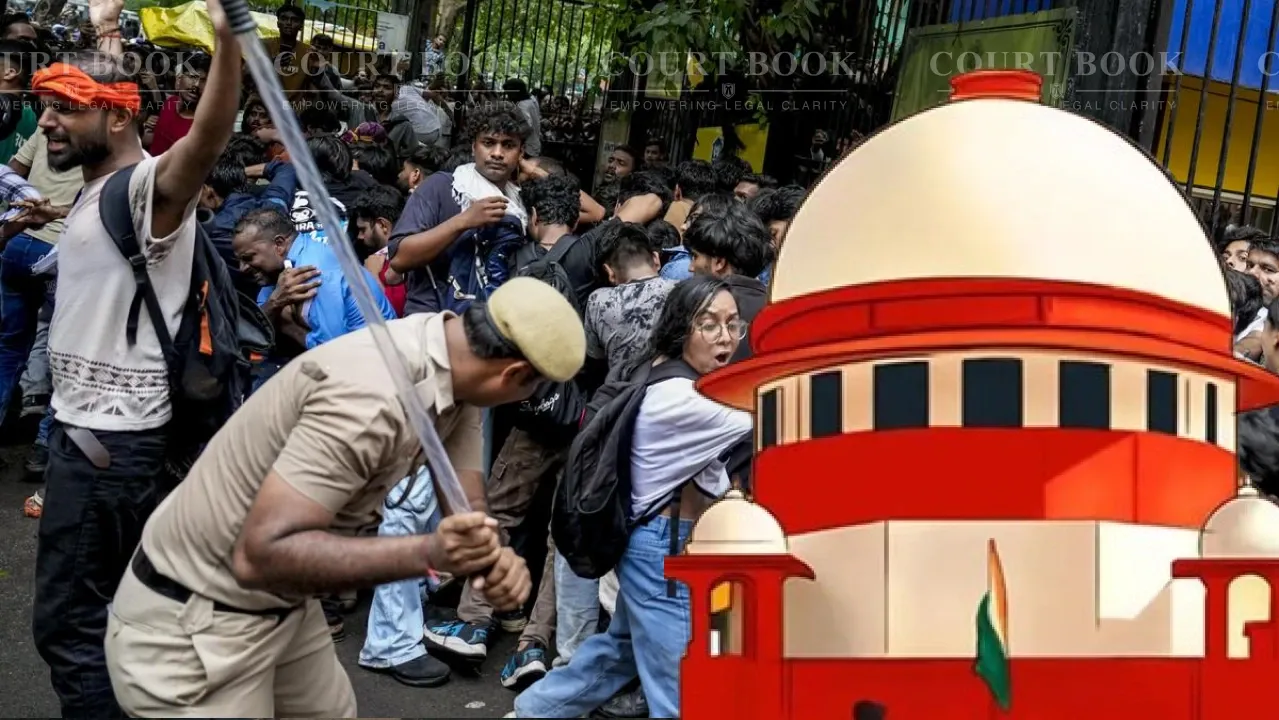
The Supreme Court on Monday clarified that State governments, including the Delhi government, are free to close or withdraw First Information Reports (FIRs), in accordance with law, against students and other protesters who participated in the recent nationwide demonstrations linked to the Cockroach Janata Party (CJP) movement.
The Bench headed by Chief Justice of India Surya Kant, along with Justice Joymalya Bagchi and Justice V. Mohana, also made it clear that the expression "criminal antecedents" used in its earlier order dated July 28 refers only to grave and heinous offences, removing concerns that people facing minor or unrelated cases could be denied protection.
Background of the Case
The matter arises from a batch of petitions concerning police action during the student protests that took place in Delhi and several other States over alleged examination paper leaks and related issues. The demonstrations intensified after a "Chalo Sansad" march in Delhi on July 20, during which protesters alleged excessive use of force by the police, including baton charges, tear gas and pellet guns.
Alongside petitions alleging police excesses, the Court is also hearing pleas seeking action regarding injuries allegedly suffered by police personnel during the protests. Earlier, on July 28, the Supreme Court had directed that no coercive action be taken against protesters who did not have criminal antecedents while permitting investigation into the registered FIRs to continue.
However, several petitioners later sought clarification, arguing that the phrase "criminal antecedents" was too broad and could be interpreted to include petty offences or cases arising from previous protests.
Court Clarifies Meaning of 'Criminal Antecedents'
During Monday's hearing, senior advocates appearing for the petitioners submitted that the earlier order could create unnecessary hardship for students facing minor violations, such as traffic-related offences or participation in previous demonstrations.
Accepting the concern, the Bench clarified its earlier direction.
The Court ordered,
"It is clarified... the NCT of Delhi and any other State shall be at liberty to close or withdraw FIRs against protesters. The expression 'criminal antecedents' shall be read as grave and heinous offences."
The clarification means that minor or petty cases will not automatically prevent protesters from receiving the protection granted by the Court's earlier order.
Solicitor General Tushar Mehta, appearing for the Delhi Police, informed the Court that the governments intended to honour their commitment regarding withdrawal of cases but required clarity on the legal mechanism, since criminal law does not provide for simply "withdrawing" an FIR. He submitted that closure reports, withdrawal of prosecution in accordance with law, or other legal procedures may be adopted where appropriate.
The Bench observed that FIRs relating to students and those involving persons accused of serious crimes should be examined separately before any decision is taken.
Court Examines Allegations of Police Excesses
The hearing also focused on allegations of excessive force used during the protests.
Petitioners referred to the alleged use of pellet guns, surveillance measures and other police actions during the demonstrations. They argued that there was no clear legal framework governing the deployment of pellet guns against civilian protesters.
Responding to these submissions, the Bench indicated that it intends to formulate uniform standards on the issue.
The Chief Justice remarked,
"We would like to lay down a complete protocol on how and where pellet guns can be used."
The Court also reiterated that police officers accused of using excessive force should not receive undue protection, while at the same time ensuring that individuals accused of serious criminal offences do not obtain immunity merely because they participated in the protests.
The Bench informed the parties that it is considering whether allegations of police excesses should be investigated by a Special Investigation Team (SIT) comprising senior police officers or by a committee headed by a retired judge.
Matter Posted for Further Hearing
Since responses from the Union Government, Delhi Police and the concerned States are still awaited, the Supreme Court decided not to pass any further substantive directions at this stage.
The Bench posted the batch of petitions for further consideration on August 18, when it is expected to examine the responses filed by the authorities and consider the appropriate mechanism for investigating the allegations.
Court's Decision
The Supreme Court clarified that:
- States, including the Delhi Government, are at liberty to close or withdraw FIRs against protesters in accordance with law.
- The expression "criminal antecedents" in the Court's July 28 order refers only to persons facing grave and heinous offences, not minor or petty violations.
- The Court will consider framing a protocol governing the use of pellet guns and will examine the appropriate mechanism for investigating allegations of police excesses after receiving responses from the concerned authorities.
- The matter has been listed for further hearing on August 18.
Case Details
Case Title: Shailendra Mani Tripathi v. Union of India & Ors. and connected matters
Case Number: Diary No. 44078/2026 and connected cases
Judge: Chief Justice of India Surya Kant, Justice Joymalya Bagchi, Justice V. Mohana
Decision Date: August 3, 2026



 chief. Eknath Shinde – Shiv Sena leader-300x169.webp)
-300x169.webp)
-300x169.webp)
-300x169.webp)