

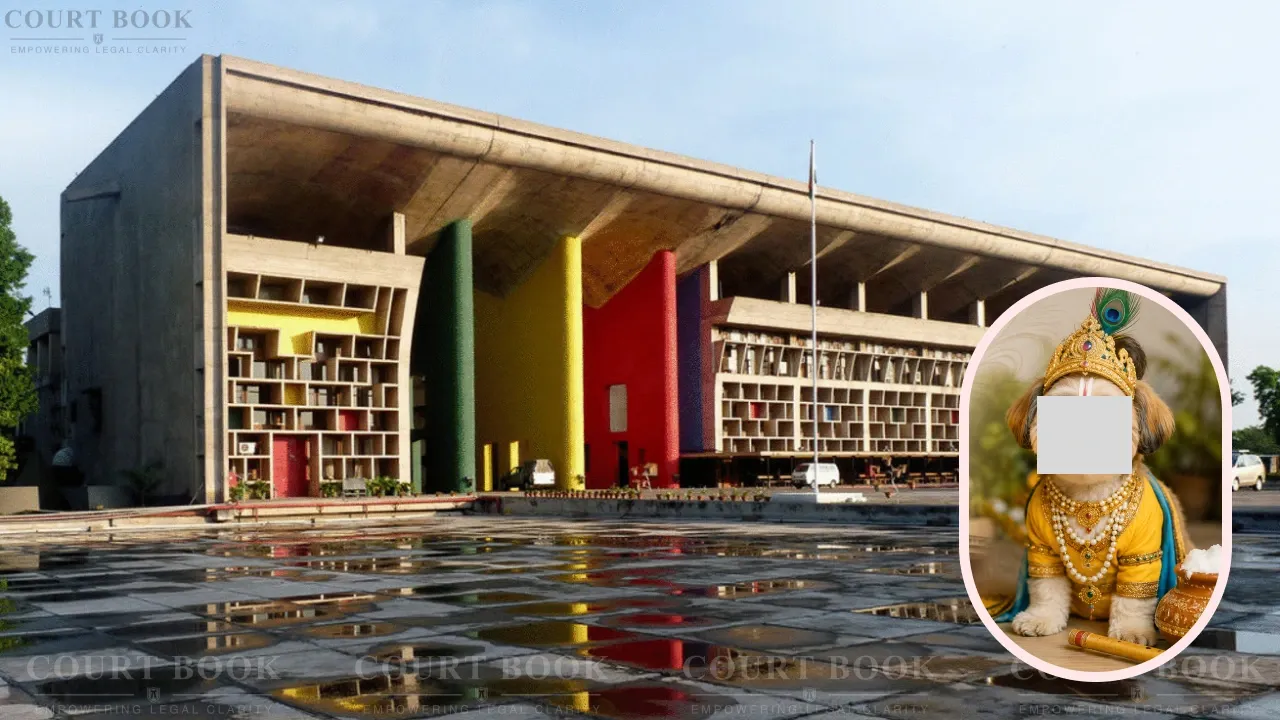
The Punjab and Haryana High Court has quashed an FIR registered against a woman accused of hurting religious sentiments after she dressed her pet dog as Lord Krishna and posted its photograph as her WhatsApp status on Janmashtami. The Court held that criminal law cannot be invoked merely because some individuals perceive an act as offensive when there is no deliberate or malicious intention to insult religion.
Background of the Case
The case arose from FIR No. 67 dated September 3, 2024, registered at Police Station Talwara, District Hoshiarpur, under Section 298 of the Bharatiya Nyaya Sanhita (BNS). A complaint was filed by a private complainant alleging that the petitioner had hurt the religious sentiments of the Hindu community by dressing her pet dog as Lord Krishna and displaying the image on WhatsApp during Janmashtami.
During the investigation, the petitioner explained that she had no intention to offend anyone. She stated that she had remained childless for six years after marriage and treated her pet dog as her own child. As part of her Janmashtami celebrations, she dressed the dog with a crown and ornaments associated with Lord Krishna and uploaded the picture as her WhatsApp status, unaware that anyone could consider it offensive.
Court's Observations
Justice Subhas Mehla examined whether the allegations satisfied the ingredients of Section 298 BNS. The Court observed that the provision applies where a person destroys, damages or defiles a place of worship or an object held sacred, coupled with the intention or knowledge of insulting a religion.
The Court found that the items used to dress the pet dog—a crown, yellow cloth and ornaments—could not be treated as "objects held sacred" within the meaning of the provision. It further held that the prosecution had failed to establish the essential requirement of mens rea, or criminal intent.
The bench observed,
"The gesture made by the petitioner by dressing up her pet in the customary attire of Janmashtami seems to have been done in good faith and without malice."
The Court emphasized that criminal liability cannot be based on the reactions of overly sensitive individuals. Instead, the law requires an objective assessment based on how an ordinary, reasonable member of society would perceive the act.
The judgment also referred to Articles 19(1)(a) and 25 of the Constitution, holding that symbolic forms of personal expression and genuine acts of devotion are protected unless they threaten public order or are carried out with deliberate intent to insult religion. The Court relied on previous Supreme Court decisions, including Mahendra Singh Dhoni v. Yerraguntla Shyamsundar and Priya Prakash Varrier v. State of Telangana, which stressed that criminal prosecution for hurting religious sentiments requires clear evidence of deliberate and malicious intent.
The bench observed,
"Individual expression of the petitioner, shaped by her personal experiences, cannot be criminalized merely because it does not align with the sensitivities of others."
Decision
Allowing the petition, the High Court quashed FIR No. 67 dated September 3, 2024, the final report dated January 19, 2025, and all consequential proceedings. The Court concluded that the material on record did not disclose the essential ingredients of an offence under Section 298 BNS and that continuing the prosecution would amount to an abuse of the legal process.
Case Details:
Case Title: Ranjanni Gaur v. State of Punjab and Another
Case Number: CRM-M-11112-2025 (O&M)
Judge: Justice Subhas Mehla
Decision Date: 01 July 2026


