

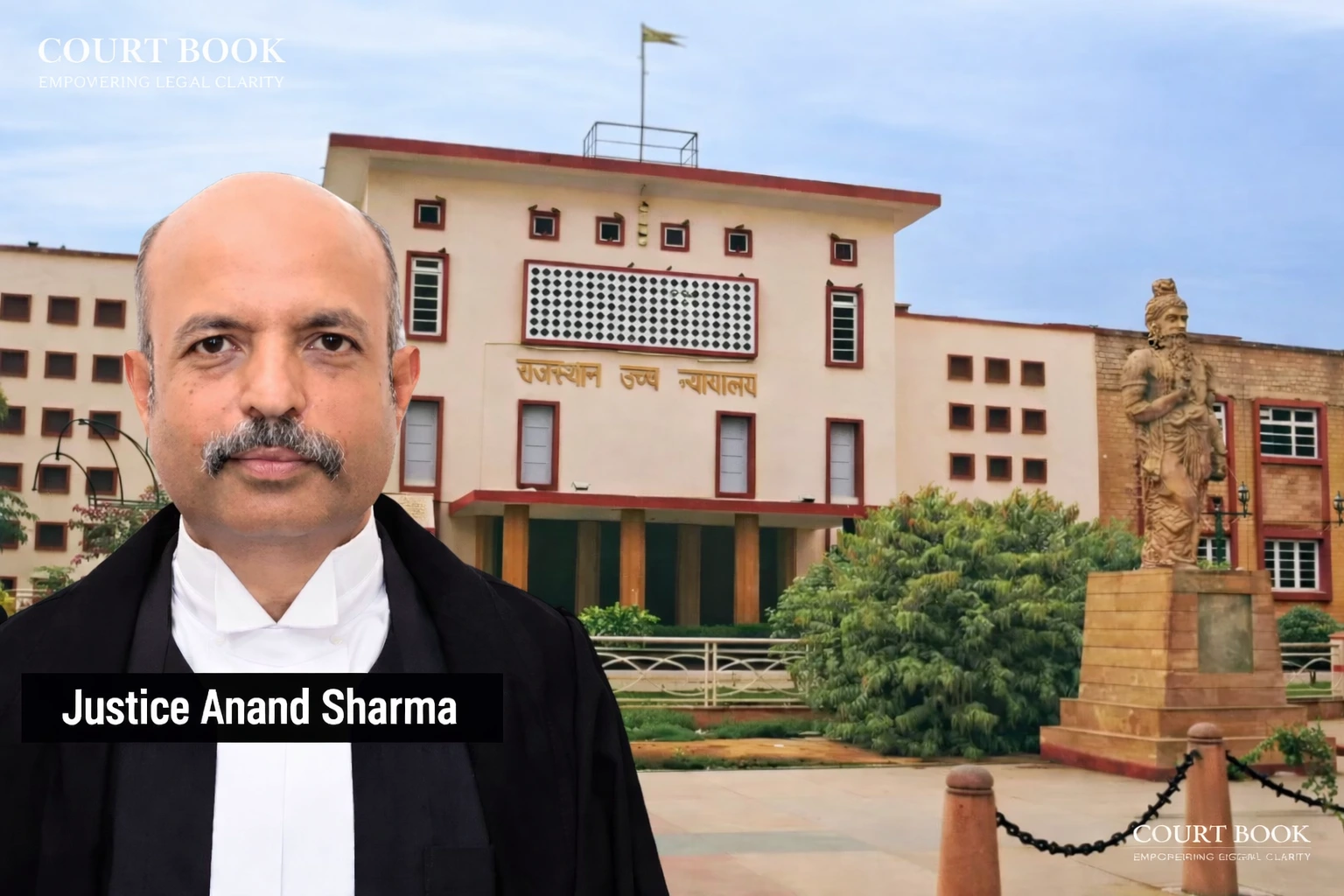
The Rajasthan High Court at Jaipur has set aside the removal of a CRPF constable who was dismissed more than two decades ago after being accused of “desertion” during training. The court held that the force had confused a short, medically explained absence with the serious offence of desertion and imposed a punishment that did not fit the facts. Justice Anand Sharma ordered the constable’s reinstatement with continuity of service, though without back wages.
Background of the Case
The petitioner, a constable recruited in 1995, had served with the CRPF and later with the Rapid Action Force. His service record showed several commendations, including appreciation for duty during sensitive deployments and disaster relief work.
In February 2002, he was served with a charge-sheet carrying four accusations. The main charge said he had “deserted” the force during a training course in November 2001 and reported back only in December. Other charges accused him of staying outside the camp without permission, showing poor conduct during training, and being a “habitual” indisciplined employee.
The constable denied desertion. He told the inquiry that he had suffered severe renal pain, was admitted to hospital, and later had to attend to his ill wife. He produced medical records and said he voluntarily rejoined duty within about 20 days. He also pointed out that he already had written permission to keep his family outside the camp for a limited period.
Read also:- Supreme Court Restores Membership Rights in Mumbai Housing Society Dispute Over Peddar Road Flat
Despite this, the department held a disciplinary inquiry and removed him from service in July 2002. His appeal and revision were rejected, leading him to approach the High Court.
The court carefully went through the charge-sheet, inquiry report, and the orders of the disciplinary, appellate, and revisional authorities. It also examined the Central Reserve Police Force Act and Rules, which clearly separate two things: “desertion” (a very serious offence requiring intention to permanently abandon duty) and “absence without leave” (a lesser offence).
The bench noted that the charge-sheet itself admitted the constable had returned to duty within about 20 days. “Such an admitted fact,” the court observed, “directly negates the essential element of intention to permanently abandon service.” In simple terms, if someone comes back on his own, it becomes very hard to call him a deserter.
Court’s Observations
Justice Anand Sharma was blunt about the way the case was handled. The court said branding a short-term absence as desertion showed “non-application of mind.” It added that desertion is a grave charge and cannot be used loosely when the facts only show a temporary absence followed by a voluntary return.
The bench also found serious procedural faults. The constable was not given copies of key documents, was not allowed to properly present defence witnesses, and the inquiry officer ignored medical records without giving reasons. On the second charge, the court pointed out that the department’s own records showed he had permission to keep his family outside the camp, making that charge “patently perverse.”
On the conduct-related charge, the court noted that training records actually showed good performance, and there was no reliable evidence to support the finding of misconduct. As for calling him a habitual offender, the court said two earlier minor punishments could not justify the harshest penalty of removal from service.
Decision
In the end, the High Court allowed the writ petition and quashed all the orders that had led to the constable’s removal. The court directed the authorities to reinstate him with continuity of service and seniority. However, it made it clear that he would not get actual back wages for the years he remained out of service; his pay and other benefits would be fixed only on a notional basis.
“The punishment of removal,” the bench said in effect, “was the result of a flawed foundation and could not stand.” With that, the long-running dispute finally came to a close in the constable’s favour.
Case Title: Hans Raj Doi v. Union of India & Others
Case Number: S.B. Civil Writ Petition No. 7778/2006
Judgment Date: 3 February 2026
Download Judgment

