

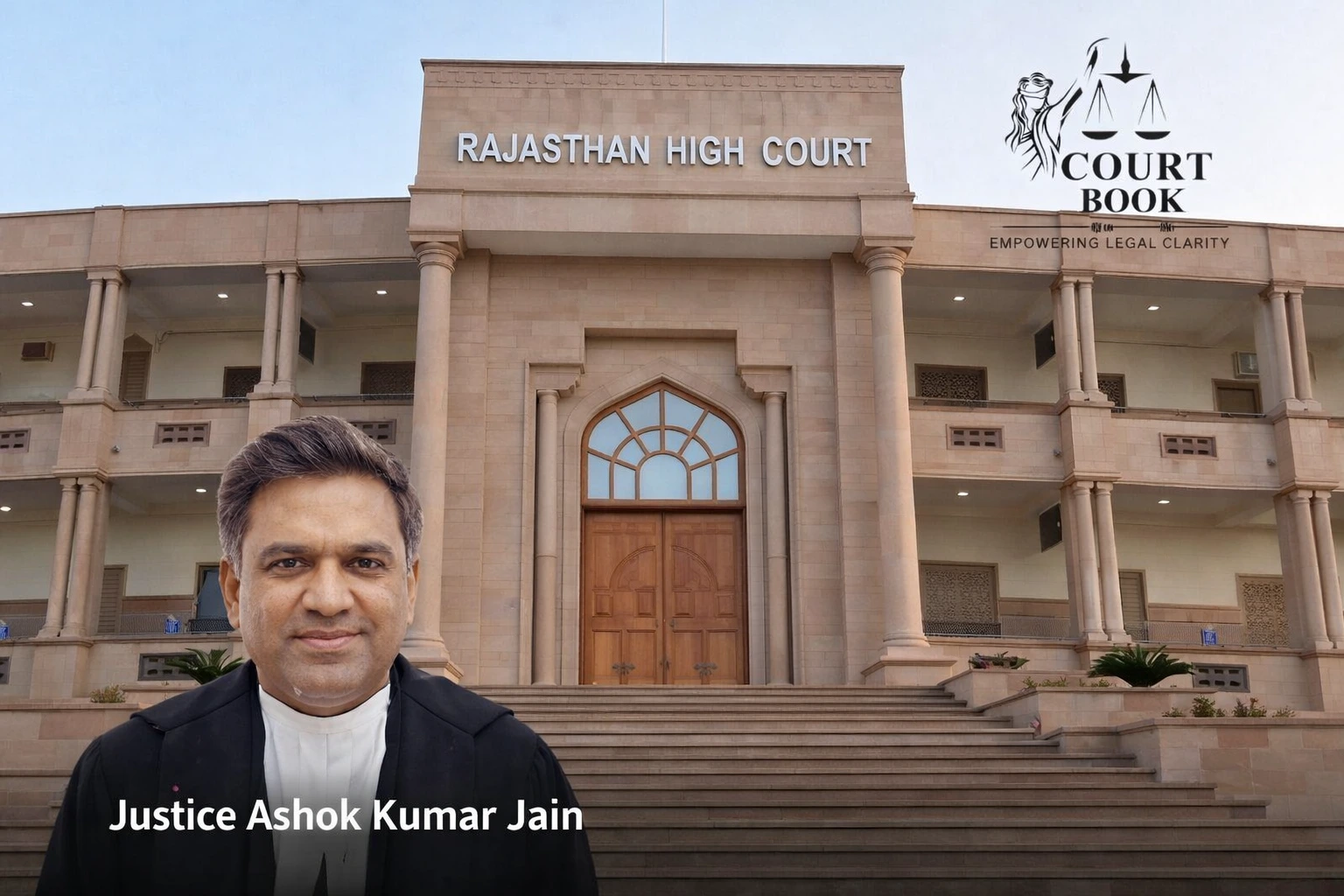
In a significant ruling protecting the rights of retired government employees, the Rajasthan High Court has set aside an order that had stopped the entire pension of a former Law Department officer. The court held that the disciplinary action was based on legally unreliable material and violated basic principles of natural justice.
Background of the Case
The case involved Vilayati Ram, a retired Vidhi Rachnakar (Law Officer) of the Rajasthan Government. He was appointed in 1994 and confirmed in service in 1997.
Read also:-Supreme Court Backs NCLAT in Gloster Trademark Dispute, Denies Title Claim to Resolution Applicant
In 2008, a departmental inquiry was initiated against him over allegations that he had secured employment using a false Scheduled Caste certificate. A criminal case was also registered on similar allegations.
While the criminal court later acquitted him, the departmental proceedings continued. After retirement, the government passed an order in August 2020 withholding 100% of his pension for life, invoking Rule 7 of the Rajasthan Pension Rules, 1996.
Aggrieved by this, the retired officer approached the Rajasthan High Court.
What the Petitioner Argued
The petitioner’s counsel told the court that:
• The Inquiry Officer had cleared him of all charges.
• The disciplinary authority overturned the findings without proper evidence.
• The punishment was based solely on a statement recorded under Section 161 CrPC, which has no evidentiary value unless tested in cross-examination.
• No witness, including the Tehsildar whose statement was relied upon, was examined during the inquiry.
• The petitioner had already been acquitted in the criminal case.
It was also argued that stopping an entire pension without proving “grave misconduct” was illegal.
Court’s Observations
Justice Ashok Kumar Jain examined the entire record in detail and found serious flaws in the disciplinary proceedings.
The court noted that:
• The disciplinary authority relied only on a police statement under Section 161 CrPC, which cannot be treated as evidence unless the witness is examined.
• The witness whose statement formed the basis of punishment was never produced for cross-examination.
• The Inquiry Officer had clearly held that the charges were not proved.
• The disciplinary authority did not explain how the alleged misconduct amounted to “grave misconduct”, which is mandatory before stopping pension.
The court observed:
“A statement recorded under Section 161 CrPC has no independent evidentiary value and cannot be the sole basis of punishment unless the witness is examined.”
It further held that the procedure adopted violated principles of natural justice.
Read also:-Notice Issued Before Cognizance Set Aside by Gauhati High Court in Cheque Case
Court’s Decision
Allowing the writ petition, the High Court ruled:
• The punishment order dated 19 August 2020 is illegal and arbitrary
• The order stopping 100% pension is quashed
• The petitioner is entitled to all consequential pensionary benefits
• The disciplinary action failed due to lack of evidence and procedural fairness
The court concluded that disciplinary authorities cannot rely on untested police statements and must follow due process strictly before imposing severe penalties like forfeiture of pension.
Case Title: Vilayati Ram vs State of Rajasthan & Ors.
Case No.: S.B. Civil Writ Petition No. 13646/2020
Decision Date: 6 January 2026
Download order

