

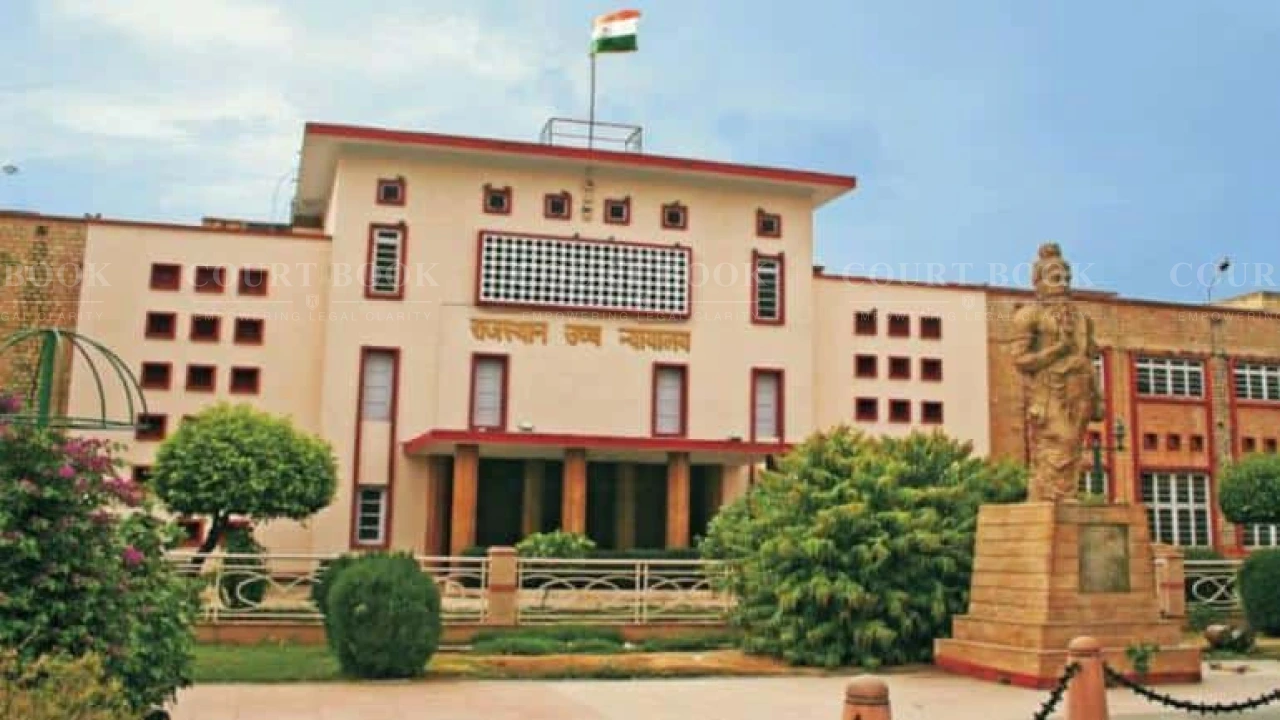
In a significant relief to a retired government employee, the Rajasthan High Court has directed the State authorities to pay full salary and allowances for a four-year period during which he was kept out of service under a compulsory retirement order that was later set aside.
Justice Praveer Bhatnagar passed the order on February 9, 2026, holding that once the retirement was found unjustified, the employee could not be denied wages merely because he did not work during that period.
Read also:-Bombay HC Disposes Unmarried Woman’s Abortion Plea, Cites Supreme Court Ruling on MTP Rights
Background of the Case
The petitioner, K.C. Jain, had been compulsorily retired on June 14, 2006. He challenged the order before the departmental appellate authority. In August 2014, the appellate authority quashed the retirement order, observing that there was no sufficient material to justify such action.
However, while setting aside the retirement, the authority denied Jain his salary for the period between June 14, 2006 and July 31, 2010. The reasoning was simple: he had not performed any duties during that time.
Aggrieved by the denial of wages, Jain approached the High Court seeking payment of salary with interest for the intervening period.
Read also:-Calcutta High Court Refuses to Quash Forgery Case Linked to 1963 Land Deed, Orders Police Prob
Arguments Before the Court
Counsel for the petitioner argued that once the compulsory retirement was declared invalid, Jain was entitled to all consequential benefits, including salary.
They relied on a Supreme Court judgment in Shobha Ram Raturi vs. Haryana Vidyut Prasaran Nigam Limited, where the apex court had ruled that an employee cannot be denied wages on the principle of “no work, no pay” if he was prevented from working due to an illegal order.
Quoting from that decision, the petitioner’s counsel submitted that the employer “cannot be allowed to press the self-serving plea of denying him wages” when it was the employer’s own action that kept the employee out of service.
On the other hand, the State’s counsel maintained that Jain had not worked during the disputed period and therefore was not entitled to salary. They argued that the appellate authority had rightly declined wages after due consideration.
Read also:-Bombay High Court Flags Flawed Tree-Felling Notices, Closes Pune Coconut Trees Case
Court’s Observations
Justice Bhatnagar carefully examined the service record and the findings of the appellate authority.
The court noted that the appellate authority had already found no justification for compulsory retirement. It had observed that there were no adverse entries in Jain’s service record in the five years preceding his retirement. The adverse remarks relied upon were from 1985–86 and 1990–91 - nearly 15 years old - and had never been communicated to him.
The authority had also recorded that Jain had received promotions and selection scales over the years. In that backdrop, he could not be branded as “dead wood” - a term sometimes used to describe an employee considered unproductive.
Referring to the Supreme Court ruling, the High Court observed that if an employee is kept out of service by an unlawful order, the fault lies with the employer.
“The analogy is equally applicable in the present case,” the court noted, adding that the retirement had been found to be without cogent grounds.
The bench made it clear that denying wages in such circumstances would amount to penalising the employee for an act not attributable to him.
Read also:- Kerala High Court Orders Probe Into ₹14 Lakh Sabarimala Staff Transfers During Mandala
The Decision
In light of the Supreme Court precedent and the factual findings on record, the High Court held that Jain was entitled to salary and allowances for the period from June 14, 2006 to July 31, 2010.
The court directed the respondents to pay the due salary and wages within three months.
With this direction, the writ petition was disposed of, and all pending applications were also closed.
Case Title: K.C. Jain v. State of Rajasthan & Ors.
Case No.: S.B. Civil Writ Petition No. 5502/2007
Decision Date: 09 February 2026


