

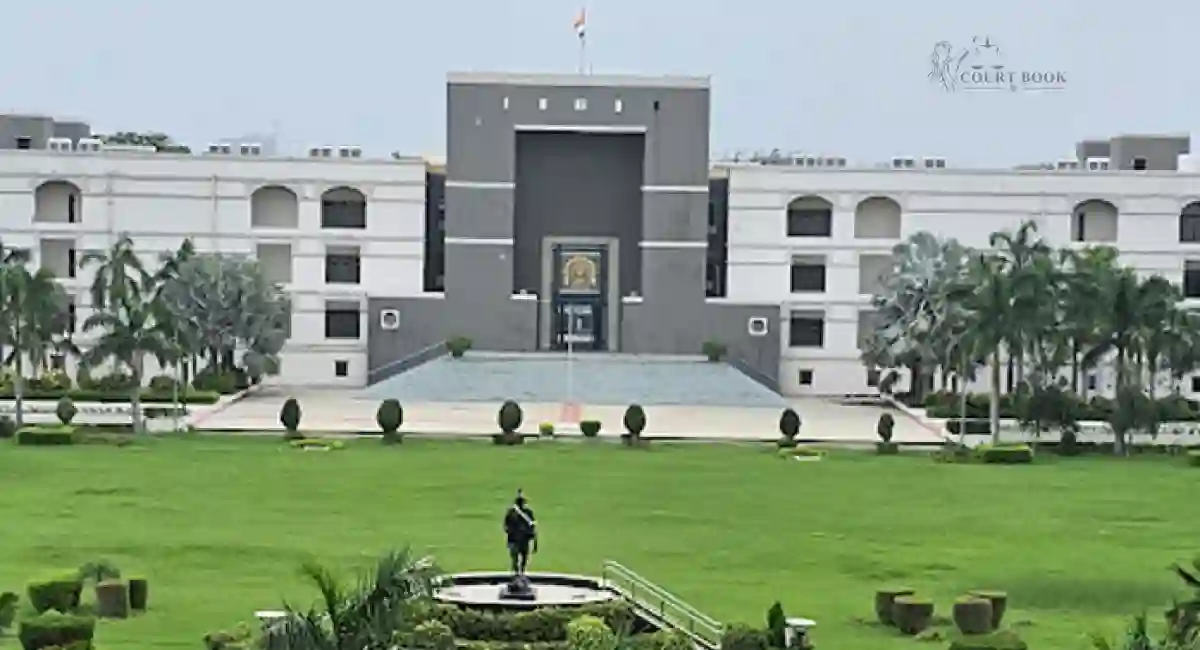
The High Court of Gujarat has refused to treat a five-year-old girl’s stay with her maternal grandparents as “illegal detention,” dismissing a habeas corpus petition filed by her father.
A division bench of Justice N.S. Sanjay Gowda and Justice D.M. Vyas held that a mother entrusting her minor child to her parents for care cannot be termed unlawful confinement, especially when no custody order exists.
Read also:-Bombay HC Disposes Unmarried Woman’s Abortion Plea, Cites Supreme Court Ruling on MTP Rights
“The custody of a minor girl with her mother can never be construed as unlawful,” the bench observed in its judgment dated February 6, 2026.
Background of the Case
The petition was filed by Akulkumar Dineshbhai Rana, a Union Government employee, who sought production of his minor daughter Swara before the court. He alleged that since August 14, 2023, the child had been kept in “illegal custody” by her maternal grandparents in Mehsana at the insistence of his wife.
The couple married in 2018. Both are government employees - the father with the Union Government and the mother with the State Government. Their daughter was born in 2019. Over the years, both were transferred to different locations across Gujarat before eventually living together in Bhachau.
However, marital discord surfaced. According to the father, his wife insisted that their daughter be raised in Mehsana with her parents. He claimed that despite his objections, the child was taken there and not returned.
In court, his counsel argued that the welfare of the child must be the “paramount consideration” and contended that custody with the father would better serve her interests.
Read also:-Calcutta High Court Refuses to Quash Forgery Case Linked to 1963 Land Deed, Orders Police Prob
Court’s Observations
The bench examined whether a mother’s decision to leave her four-year-old daughter in the care of her own parents could amount to illegal confinement.
The judges answered firmly in the negative.
“If a working lady, due to work constraints, takes the help of her parents to ensure that her child is brought up in a secure atmosphere, the husband cannot be permitted to say that such custody amounts to illegal confinement,” the court stated.
The court noted that both parents were working professionals. Raising a young child without support could be difficult. In such circumstances, the mother’s decision to rely on her parents for assistance was an arrangement for childcare - not an unlawful act.
Importantly, the court pointed out that no custody proceedings were pending before any Family Court. Nor was there any prior order governing custody.
“The act of entrusting the custody of her 5-year-old daughter to her parents for upkeep cannot amount to illegal confinement,” the bench said.
The judges also highlighted that habeas corpus - a legal remedy used to secure release from unlawful detention - cannot be invoked in routine custody disputes between parents.
Read also:-Bombay High Court Flags Flawed Tree-Felling Notices, Closes Pune Coconut Trees Case
Visitation Arrangements and Attempts at Reconciliation
During earlier hearings, the High Court had attempted to ease tensions between the estranged couple. On September 16, 2025, it facilitated visitation rights, allowing the father to meet his daughter at the Mehsana Circuit House on weekends.
Later, in October 2025, the arrangement was modified to extend custody over the entire weekend. Both sides informed the court that visitation was proceeding smoothly.
The bench noted that it had hoped the arrangement might open doors for reconciliation, at least concerning the child’s welfare. However, subsequent complaints and applications showed continuing friction.
Still, it was acknowledged that meetings between father and daughter were happening in a “good atmosphere.”
Read also:- Kerala High Court Orders Probe Into ₹14 Lakh Sabarimala Staff Transfers During Mandala
Decision
The court made it clear that the proper forum for deciding custody disputes is the Family Court, where evidence can be examined in detail.
“It is only if a proceeding is initiated before the appropriate court and evidence is adduced to show that the welfare of the child would be better served,” the judges said, that custody questions can be adjudicated.
The High Court permitted either parent to approach the Family Court for appropriate relief. It clarified that nothing in its judgment should be treated as an opinion on the merits of either side’s custody claim.
Until such proceedings are initiated and decided, the interim visitation arrangement will continue.
With these observations, the writ petition was dismissed. All pending civil applications were consigned to records.
Case Title: Akulkumar Dineshbhai Rana & Anr. v. State of Gujarat & Ors.
Case No.: R/Special Criminal Application (Habeas Corpus) No. 11700 of 2025
Decision Date: 06 February 2026
Download Judgment

