

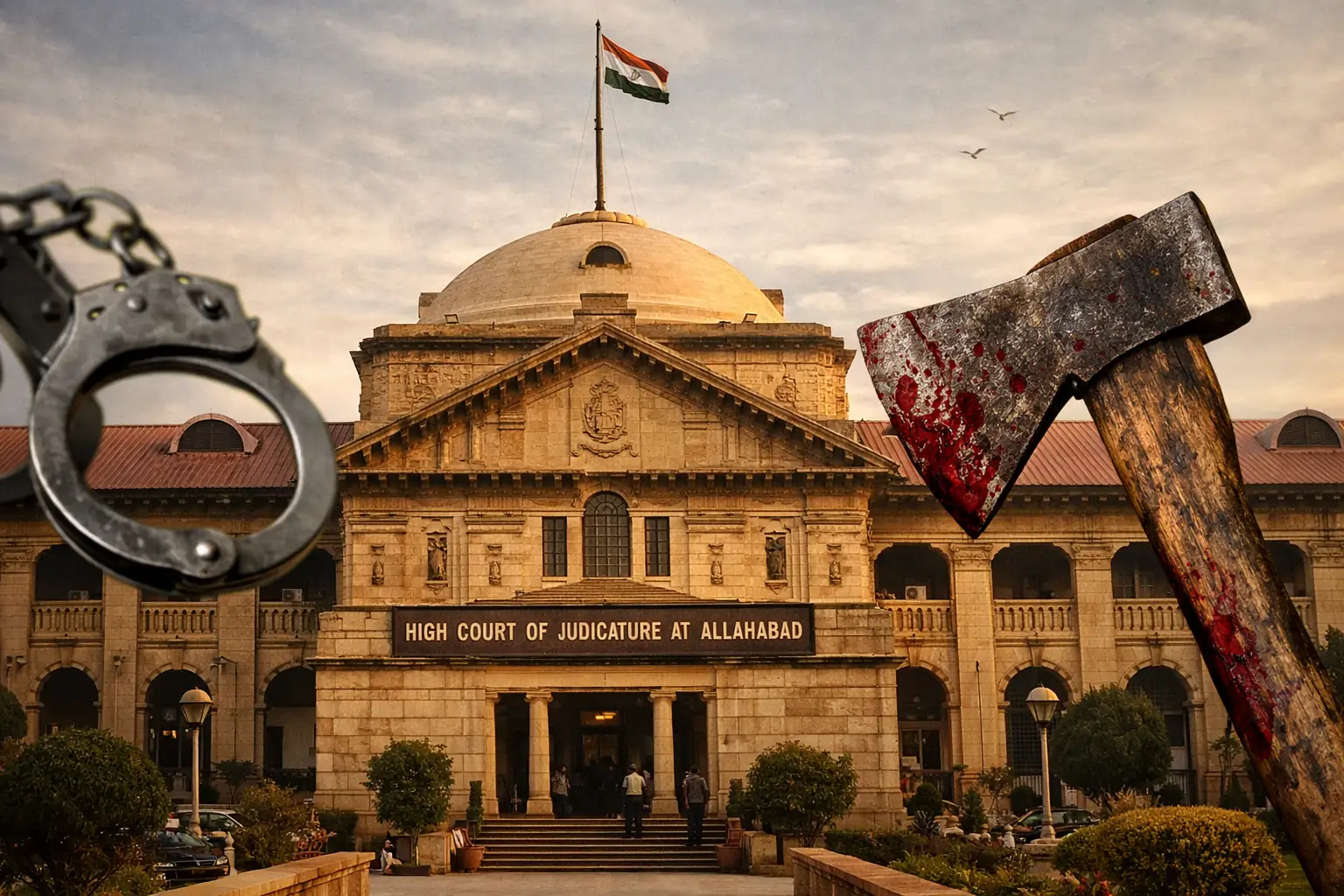
In a strong reminder to trial courts about strict adherence to procedural law, the Allahabad High Court has quashed criminal proceedings against two accused after finding that cognizance was taken well beyond the legally permitted time limit. The Court held that ignoring statutory limitation periods strikes at the very foundation of criminal justice and violates the right to a fair trial.
Background of the Case
The case arose from an FIR registered in April 2019 at Firozabad North Police Station for theft of a motorcycle. The FIR was initially lodged against unknown persons under Sections 379 and 411 of the Indian Penal Code.
During investigation, five accused were charge-sheeted in June 2019 and cognizance was taken within time. However, two more persons -Avneesh Kumar and Suraj Thakur - were later named based on a co-accused’s statement. A supplementary charge-sheet against them was prepared on 26 June 2021, but shockingly, it was kept pending in the police office for over three years.
The charge-sheet was finally placed before the court only in November 2024, after which the Chief Judicial Magistrate took cognizance on 27 November 2024.
This delay became the core issue before the High Court.
What the Court Examined
The High Court examined whether the trial court could legally take cognizance after expiry of the limitation period prescribed under:
• Section 468 CrPC – bar on taking cognizance after limitation
• Section 469 CrPC – commencement of limitation period
Since offences under Sections 379 and 411 IPC carry a maximum punishment of three years, the limitation period was three years from the date of offence.
Read also:-Andhra Pradesh HC Quashes APSRTC Tender, Slams Monopoly in Bus Station Shop Allotments
The Court noted that:
• The incident occurred in April 2019
• The supplementary charge-sheet was prepared in June 2021
• Cognizance was taken only in November 2024
This clearly crossed the permissible limit.
Court’s Observations
Justice Praveen Kumar Giri took serious note of the delay and the manner in which the charge-sheet was handled.
“The court cannot take cognizance after expiry of the limitation period. Such an act is contrary to law and amounts to abuse of process,” the Bench observed.
The Court also expressed concern over the explanation offered by the then Chief Judicial Magistrate, who stated that magistrates generally do not examine limitation at the stage of cognizance.
Rejecting this justification, the Court remarked that:
“Practice cannot override the law. Cognizance is the foundation of a criminal case and must strictly follow statutory provisions.”
The High Court further noted that failure to follow limitation law directly violates Article 21 of the Constitution, which guarantees personal liberty and due process.
Accountability of Officials
The Court took a serious view of the role played by police officials and judicial officers:
• The Circle Officer admitted that the charge-sheet remained pending in office for years.
• Departmental proceedings were initiated against the concerned Head Constable.
• The former Chief Judicial Magistrate was cautioned for casual handling of judicial responsibility.
• The Registrar General was directed to inform the Judicial Training Institute to sensitize magistrates about limitation laws.
Final Decision of the Court
The Allahabad High Court ultimately held:
• The entire proceedings against Avneesh Kumar and Suraj Thakur stand quashed
• The charge-sheet dated 26 June 2021 and cognizance order dated 27 November 2024 were set aside
• Proceedings against the other five accused, whose cases were filed within time, will continue
The Court concluded that once limitation expires, no court has the authority to revive the case.
Case Title: Avneesh Kumar v. State of Uttar Pradesh & Anr.
Case Number: Application U/S 528 BNSS No. 7072 of 2025
Decision Date: 19 January 2026


