

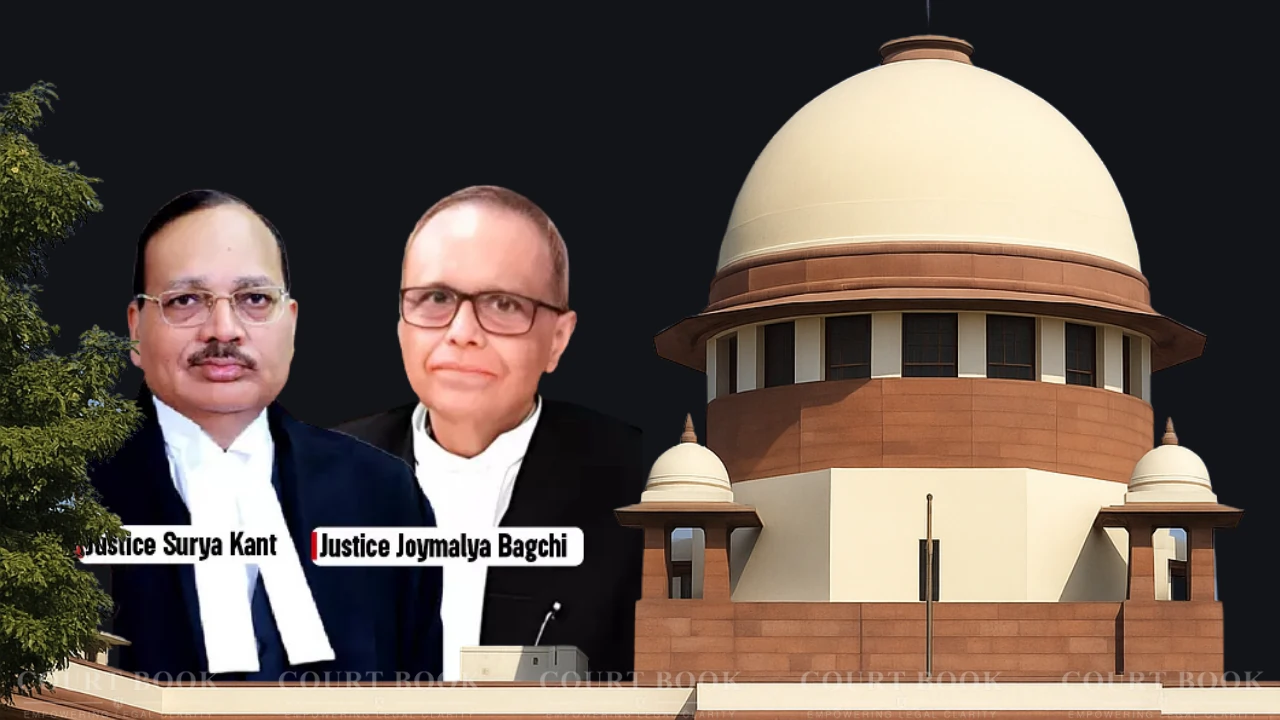
The Supreme Court on Friday (January 23, 2026) took serious note of allegations involving large-scale financial irregularities during an ongoing corporate insolvency process and issued notices to the Central Bureau of Investigation (CBI), Enforcement Directorate (ED), and Serious Fraud Investigation Office (SFIO). The case concerns alleged illegal transactions worth nearly ₹150 crore carried out when the company was legally under a moratorium.
The matter was heard by a Bench led by Chief Justice of India Surya Kant along with Justice Joymalya Bagchi.
Read Also:-Supreme Court Seeks CBI, ED Status Reports in Alleged ₹1.5 Lakh Crore Bank Fraud Linked to Anil
Background of the Case
The petition was filed by a Director of Bengal Cold Rollers Private Limited, an operational creditor of M/s KLSR Infratech Limited. The plea challenges what it describes as a complete breakdown of the insolvency process under the Insolvency and Bankruptcy Code, 2016 (IBC).
KLSR Infratech was admitted into the Corporate Insolvency Resolution Process (CIRP) by the National Company Law Tribunal (NCLT), Hyderabad on July 14, 2023. Following the admission, a statutory moratorium under Section 14 of the IBC came into effect, and the company’s Board of Directors stood suspended under Section 17. An Interim Resolution Professional (IRP) was also appointed to take charge of the company.
However, just four days later, the National Company Law Appellate Tribunal (NCLAT), Chennai, passed an interim order staying further proceedings.
Alleged Misuse of Interim Stay
The petitioner argued that the NCLAT’s stay order did not cancel the CIRP admission nor restore the company’s management to the suspended directors. Citing the Supreme Court’s ruling in Shree Chamundi Mopeds Ltd. v. Church of South India Trust Association (1992), it was contended that a stay of proceedings does not undo the legal consequences of the original order.
Despite this, the suspended directors allegedly resumed control of the company by misrepresenting facts before statutory authorities. The company’s status was shown as “Active” on the Ministry of Corporate Affairs portal, even though the moratorium was still in force.
During this period, the petitioner alleged that multiple loans were raised and charges were created, involving transactions of nearly ₹148–150 crore - all without the consent or knowledge of the IRP.
Court’s Observations
The Supreme Court took note of the allegation that these financial dealings took place in clear violation of Sections 14, 17, and 23 of the IBC, which prohibit such actions during a moratorium.
“The bench observed that the allegations raise serious concerns regarding the sanctity of the insolvency process and the functioning of statutory authorities,” a courtroom source said.
Read Also:-Bombay High Court Dismisses Plea Against PSU Banks’ Right to Reject Candidates for Past Misconduct
The petition also pointed out that the IRP had informed the NCLAT that the suspended directors never handed over control and continued to run the company during the moratorium period.
Delay in Insolvency Proceedings
A major issue raised before the court was the prolonged delay in the appellate proceedings. The appeal before the NCLAT has remained pending for over 30 months, far exceeding the 330-day outer limit prescribed under the IBC.
Relying on the Supreme Court’s ruling in Committee of Creditors of Essar Steel India Ltd. v. Satish Kumar Gupta (2020), the petitioner argued that such delays defeat the very purpose of time-bound insolvency resolution and lead to erosion of the corporate debtor’s value.
Serious Allegations of Judicial Impropriety
The matter took a more serious turn when the petitioner referred to events of August 13, 2025. On that day, a Member of the NCLAT reportedly recused himself in open court after disclosing that he had been approached by a sitting Chief Justice of a High Court seeking a favourable order for the suspended directors.
Read Also:-Supreme Court Faults Bail-for-Deposit Practice, Directs Delhi HC to Decide Rakesh Jain’s Bail
According to the plea, the Member stated that he possessed call records and messages to support his statement. However, the subsequent written order did not clarify the identity of the person who made the approach. The petitioner’s request for access to video recordings and court records was also rejected by the registry.
What the Petitioner Sought
The petitioner has sought:
• A court-monitored investigation by the CBI and SFIO
• ED probe into alleged money laundering
• Restoration of control of the company to the IRP
• Preservation and supply of court records
• Expedited hearing of the pending NCLAT appeal
Court’s Decision
After hearing the submissions, the Supreme Court issued notice to the CBI, Enforcement Directorate, and SFIO, seeking their response to the allegations raised in the petition.
The matter will now be examined further after the investigative agencies file their replies.
Case Title: Saurabh Agarwal v. Union of India & Ors.
Case Type: Writ Petition (Civil)
Decision Date: January 23, 2026


