

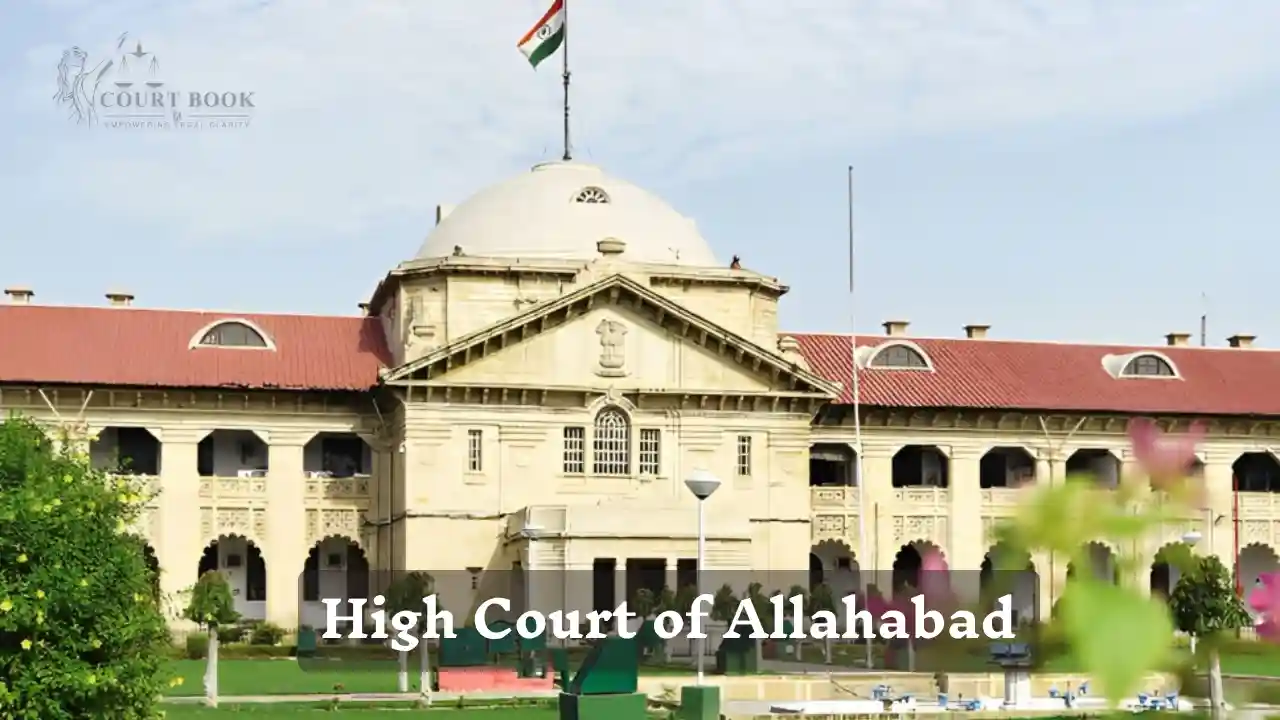
In a significant order, the High Court of Judicature at Allahabad has quashed criminal proceedings against two students accused of violating administrative directions while offering Namaz at a restricted location in Sant Kabir Nagar district.
Justice Saurabh Srivastava passed the order while hearing an application filed under Section 528 of the Bharatiya Nagarik Suraksha Sanhita (BNSS). The court made it clear that while citizens are free to practice their faith, administrative directions aimed at maintaining public order must also be respected.
Read also:-Bombay High Court Allows Single Mother to Change Daughter’s Name, Caste in School Records
Background of the Case
The case arose from Case Crime No. 1055 of 2017 registered at Khalilabad Police Station in Sant Kabir Nagar district. The applicants, Azeem Ahmad Khan (also known as Abeem Ahmad) and another individual, were booked under Sections 143 (unlawful assembly) and 188 (disobedience to order promulgated by a public servant) of the Indian Penal Code.
According to the prosecution, the local administration had temporarily restricted the offering of Namaz at a particular location to maintain law and order. Despite the restriction, the two applicants allegedly insisted on performing Namaz at the same site, leading to the registration of the FIR along with other co-accused persons.
After investigation, a charge sheet was filed on August 29, 2017. The Judicial Magistrate took cognizance and issued a summoning order on May 27, 2019.
Challenging the charge sheet and summoning order, the applicants approached the High Court seeking quashing of the entire proceedings.
Read also:-Rajasthan High Court Refuses Relief to New Nursing Colleges, Says Counselling Cannot Be Reopened
Arguments Before the Court
Senior Counsel appearing for the applicants argued that both were students with no criminal history. It was submitted that they were implicated only because they performed Namaz despite the administrative advisory.
The counsel emphasized that the offences alleged were minor in nature. He further submitted that continuation of the trial would adversely affect the future prospects of applicant no. 1, who is preparing for higher competitive examinations.
On the other hand, the State’s counsel informed the court that the restrictions were imposed only to maintain peace and harmony in the area. It was argued that the applicants had knowingly violated the administrative directions, which led to the FIR.
Read also:-Jharkhand HC Seeks Answers on 437 Custodial Deaths, Orders Home Secretary to Clarify Judicial
Court’s Observations
Justice Srivastava carefully limited the consideration to the two applicants before the court and not the other co-accused.
The court noted that the State had confirmed there was “hardly any criminal history” against the applicants. It also observed that their implication was solely based on their insistence on offering Namaz at a place temporarily restricted by the administration.
In a key observation, the bench remarked, “In the democratic set up of this country, which is secular in nature as per the Preamble of the Constitution, citizens of every faith are guaranteed the right to follow their rituals.”
However, the judge added that in a diverse society, administrative directions issued for maintaining public order and harmony must also be respected.
The court found that continuing the criminal proceedings against the two applicants, especially considering their clean record and student status, would be unjustified. Azeem Ahmad Khan Alias Abeem Ah…
Read also:-Karnataka High Court Cuts Jail Term in ATM Cloning Case, Enhances Fine to ₹2 Lakh Each
The Decision
Allowing the application, the High Court quashed the entire criminal proceedings, including the charge sheet dated August 29, 2017, and the summoning order dated May 27, 2019 - but only in respect of the two applicants.
At the same time, the court issued a clear warning. It directed both applicants to strictly follow any future instructions or restrictions imposed by the local administration in the interest of maintaining peace and social harmony.
With these directions, the application under Section 528 BNSS was allowed, and the proceedings against the two applicants stood set aside.
Case Title: Azeem Ahmad Khan @ Abeem Ahmad & Another vs State of U.P.
Case No.: Application U/S 528 BNSS No. 46108 of 2025
Decision Date: February 17, 2026


