

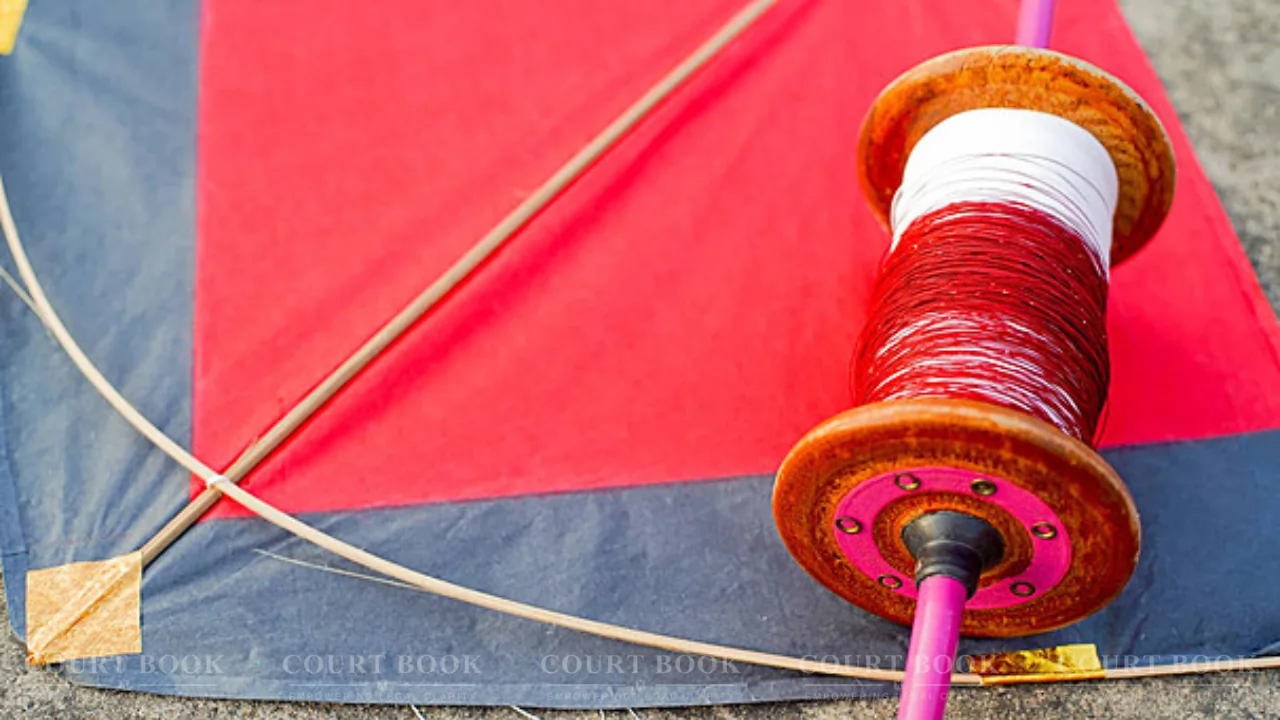
The Allahabad High Court on February 11, 2026, came down heavily on the Uttar Pradesh government over continued deaths and injuries caused by so-called “Chinese manjha” - a dangerous synthetic kite string coated with metal or glass.
Hearing a batch of public interest litigations, a Division Bench of Justice Rajan Roy and Justice Abdhesh Kumar Chaudhary said mere government orders were not enough. What was needed, the court stressed, was a permanent and effective enforcement system.
Read also:-Bombay High Court Allows Single Mother to Change Daughter’s Name, Caste in School Records
Background of the Case
The matter began in 2018 when petitioner Moti Lal Yadav approached the court seeking a ban on the import, sale and use of Chinese manjha in Uttar Pradesh. The petition asked for strict action against the manufacture and sale of the hazardous string, which has caused fatal injuries to people and birds.
Over the years, the State informed the court that several government orders had been issued prohibiting the manufacture, storage, sale and use of synthetic or nylon-coated kite strings. These included orders passed under environmental laws and directions following earlier court rulings.
The State’s affidavit claimed that action had been taken at district levels and that authorities were implementing the ban.
Read also:-Rajasthan High Court Refuses Relief to New Nursing Colleges, Says Counselling Cannot Be Reopened
But the petitioners pointed to repeated newspaper reports showing that incidents were continuing. In court, Moti Lal Yadav placed fresh reports from February 2026 detailing at least ten injuries and deaths allegedly caused by the sharp kite strings.
Court’s Observations
The Bench made it clear that paperwork alone would not solve the problem.
“As emphasized earlier, mere issuance of Government Orders will not suffice,” the court observed, noting that effective action must happen at the district and local levels.
The Chief Standing Counsel for the State argued that the term “Chinese manjha” was misleading, explaining that the string was not necessarily imported from China but referred to synthetic or lead-coated nylon string manufactured locally.
The judges, however, focused on the larger issue - enforcement. They remarked that repeated orders had already been passed in earlier public interest cases directing a statewide prohibition and awareness drives.
Referring to a 2015 order in a similar case, the Bench recalled that the problem was not limited to one city and required coordinated state-level action. The earlier ruling had directed authorities to prohibit manufacture and sale and to conduct sustained public awareness campaigns, especially around festivals like Makar Sankranti when kite flying peaks.
Read also:-Jharkhand HC Seeks Answers on 437 Custodial Deaths, Orders Home Secretary to Clarify Judicial
The judges noted with concern that action often intensified only after tragic incidents made headlines.
“It appears that only when such injuries/deaths take place and these incidents hog the headlines, State functionaries wake up,” the court said in open court, stressing the need for a “regular and continuous exercise” to prevent violations.
The Bench also raised the issue of accountability. It questioned what steps were in place not only to punish those manufacturing and selling the string but also to fix responsibility on officials who fail to enforce the ban.
Read also:-Karnataka High Court Cuts Jail Term in ATM Cloning Case, Enhances Fine to ₹2 Lakh Each
Demand for Stronger Mechanism
The court directed the State to file a fresh counter affidavit detailing concrete measures.
It asked whether suitable legal provisions already exist, and if not, what amendments or new rules the government proposes to introduce to curb the practice effectively.
Importantly, the judges said the mechanism must ensure accountability at two levels:
1. Against those manufacturing, selling or using the banned string; and
2. Against officials who fail in their duty to prevent such activities.
The court also emphasized the importance of awareness campaigns, especially targeting parents and young kite flyers.
The Bench reminded the State that enforcement must be consistent, not seasonal or reactive.
Warning on Compensation
In a sharp warning, the court observed that if the sale and use of the dangerous string continued despite directions, it may consider ordering compensation to victims.
“If, even after the aforesaid, such sale and use continues, then we may be compelled to consider ordering payment of compensation by the State to victims,” the Bench noted.
The judges clarified that compensation could be in addition to medical expenses and other costs.
Read also:-MP High Court Dismisses Plea of Compulsorily Retired Head Constable, Says Mercy Order Cannot
Decision
The court directed the State authorities to file a detailed fresh affidavit outlining proposed legal and administrative measures, including a robust accountability framework.
The matter has been listed for further hearing on March 11, 2026.
Case Title: Moti Lal Yadav vs. Prime Minister Office & Others
Case No.: PIL No. 13864 of 2018 (Connected with PIL No. 499 of 2025)
Decision Date: 11 February 2026


