

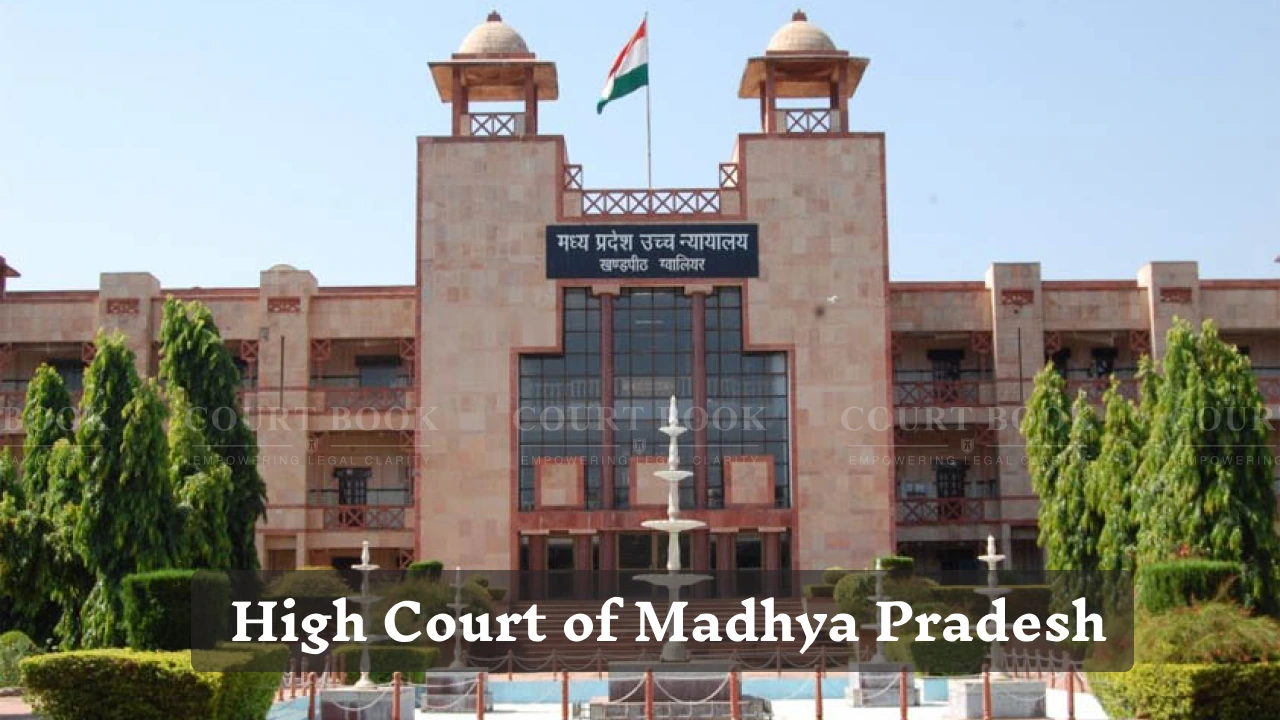
The High Court of Madhya Pradesh has dismissed a long-pending writ petition filed by a former Head Constable who sought reinstatement after his dismissal was later reduced to compulsory retirement on a mercy plea.
Hearing the matter at the Gwalior Bench, Justice Anand Singh Bahrawat held that once the State Government grants relief in a mercy petition, the employee cannot treat it as a legal right and challenge it in court.
The order was passed in Writ Petition No. 1336 of 2008 on February 13, 2026.
Read also:-Bombay High Court Allows Single Mother to Change Daughter’s Name, Caste in School Records
Background of the Case
Petitioner Babulal Deewan was appointed as a Constable in 1981. After clearing a departmental examination, he was promoted to Head Constable in 1987. At the time relevant to the case, he was posted at Police Station Anandpur in Vidisha district.
A complaint was made against him, following which a preliminary inquiry was conducted. A formal charge sheet was issued. An inquiry officer examined witnesses and eventually found the charges proved.
Based on the inquiry report, the Superintendent of Police passed an order dismissing him from service on February 28, 2002. His departmental appeal before the Inspector General of Police was rejected on October 24, 2002 .
Left with no other departmental remedy, Deewan filed a mercy petition before the State Government. In September 2007, the government partially allowed it. The punishment of dismissal was converted into compulsory retirement.
Read also:-Rajasthan High Court Refuses Relief to New Nursing Colleges, Says Counselling Cannot Be Reopened
Petitioner’s Arguments
Challenging all three orders - dismissal, rejection of appeal, and the mercy order - the petitioner approached the High Court under Article 226 of the Constitution.
His counsel argued that the Superintendent of Police was not the appointing authority and therefore had no power to impose the major punishment of dismissal. According to him, the appointing authority was the Deputy Inspector General (DIG), who had issued the promotion order.
He also relied on earlier judgments to argue that the High Court could exercise judicial review if the punishment was shocking or unreasonable.
State’s Stand
The State opposed the petition. It argued that under the M.P. Civil Services (Classification, Control and Appeal) Rules, 1966, the Superintendent of Police is competent to act as appointing authority up to the rank of Head Constable.
Read also:-Jharkhand HC Seeks Answers on 437 Custodial Deaths, Orders Home Secretary to Clarify Judicial
The government further pointed out that the dismissal had already been softened into compulsory retirement on humanitarian grounds. The petitioner was now receiving pension under the modified order.
Court’s Observations
The court first examined whether there was any legal provision granting a right to file a mercy petition. Justice Bahrawat posed a direct question to the petitioner’s counsel during the hearing.
“There is no statutory right to file a mercy petition,” the bench noted after the counsel failed to show any rule permitting such a remedy .
The court explained that mercy is not a matter of legal entitlement. It is an act of grace by the executive authority.
Quoting earlier precedent, the bench observed, “Mercy is not the subject of legal rights. It begins where legal rights end.”
The judge further said that once the petitioner himself sought mercy and accepted the benefit of a lesser punishment, he could not later turn around and challenge the same order.
The court also referred to earlier rulings, including H.S. Bhargava v. State Industrial Court of M.P., where it was held that orders passed in mercy petitions are generally not open to judicial review .
On the argument regarding judicial review of punishment, the court clarified that it does not substitute its own judgment for that of the disciplinary authority unless the punishment shocks the conscience of the court. In this case, no such ground was made out.
Read also:-Karnataka High Court Cuts Jail Term in ATM Cloning Case, Enhances Fine to ₹2 Lakh Each
Decision
After considering the entire record, the High Court held that the petitioner had no fundamental or statutory right to challenge the mercy order, especially when it had granted him a lesser punishment.
The bench concluded that since the State Government had already shown leniency by converting dismissal into compulsory retirement, the petition lacked merit.
Accordingly, the writ petition was dismissed .
Case Title: Babulal Deewan v. State of M.P. and Others
Case No.: W.P. No. 1336 of 2008
Decision Date: 13 February 2026


