

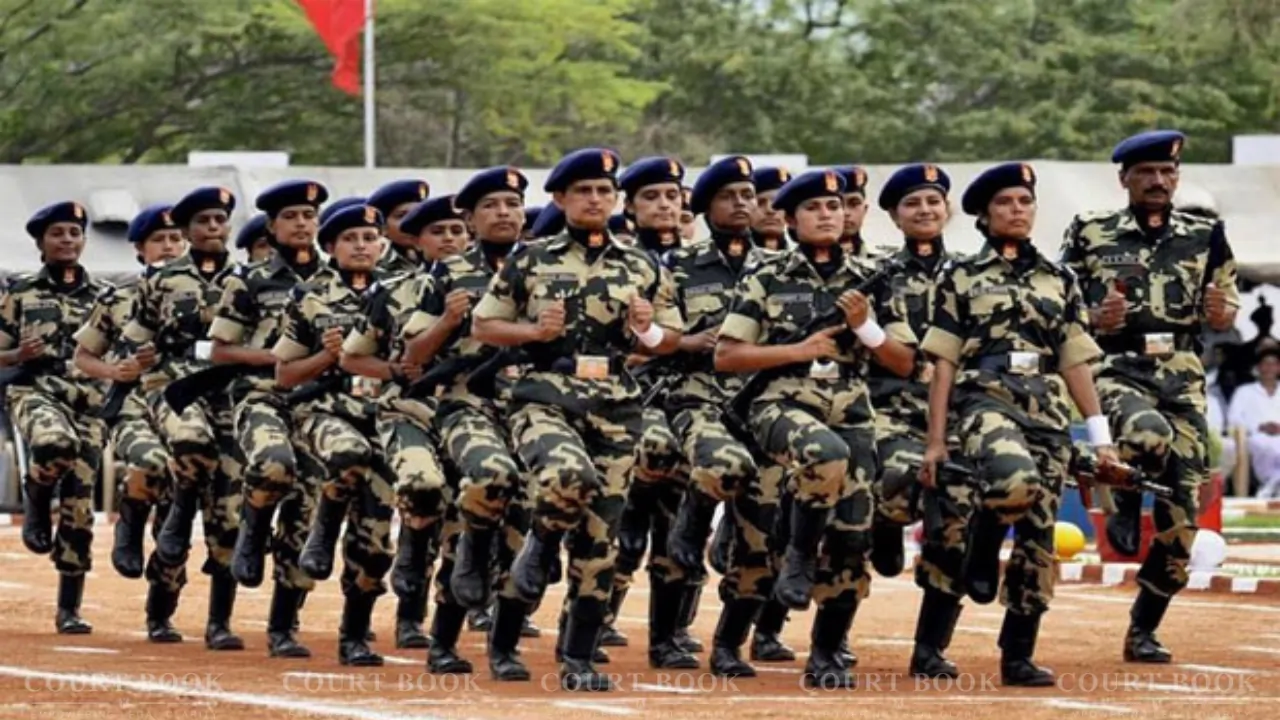
In a significant ruling for candidates aspiring to join the Central Armed Police Forces, the High Court of Jammu & Kashmir and Ladakh has declined to order a fresh medical examination for a Constable (GD) candidate who was declared medically unfit due to a suspected squint condition.
Justice Sanjay Dhar, while dismissing the petition, made it clear that courts cannot lightly interfere with the opinion of a duly constituted Review Medical Board unless there is proof of procedural lapses or bad faith.
Read also:-Gujarat HC Clears Way for Police Recruit, Says Minor, Quashed FIR Can’t Block Appointment
The ruling came in WP(C) No. 2820/2024, titled Younis Ali v. Union of India & Others, pronounced on February 13, 2026 .
Background of the Case
The petitioner, Younis Ali, had applied for the post of Constable (General Duty) in the Central Armed Police Forces (CAPFs), SSF, and Rifleman (GD) in Assam Rifles following a recruitment notification issued in November 2023.
After successfully clearing the Physical Test (PTS), Physical Efficiency Test (PET), and document verification, he underwent a Detailed Medical Examination (DME) on October 29, 2024.
He was declared unfit on three grounds:
• Myopia (short-sightedness),
• Squint in the right eye, and
• Knock knee.
Ali then opted for a Review Medical Examination. In the second medical test conducted on November 5, 2024, he was cleared of myopia and knock knee. However, the Review Medical Board still found him unfit due to the presence of squint in his right eye.
Challenging this finding, Ali approached the High Court. He produced an Out Patient Card from the Ophthalmology Department of Government Medical College Hospital, Jammu, stating that no squint was detected in his eye. He argued that the earlier medical assessments were casual and arbitrary.
Arguments Before the Court
Counsel for the petitioner contended that the Review Medical Board’s opinion was incorrect and sought a direction for a fresh medical examination by an independent board.
On the other hand, the Union of India opposed the plea. Government counsel submitted that:
• The petitioner had already been examined by specialist doctors.
• As per the Ministry of Home Affairs guidelines dated August 24, 2005, there is no provision for a third medical examination.
• The rules clearly state that the decision of the Review Medical Board is final.
The respondents emphasized that physical fitness is a core requirement in uniformed forces, and medical standards cannot be diluted.
Court’s Observations
Justice Dhar examined whether a medical opinion from a government hospital could override the findings of the Review Medical Board constituted under the recruitment rules.
Referring to judgments of the Allahabad High Court, the Court noted that the scope of judicial interference in medical fitness assessments is extremely limited.
The Court observed that, “Medical fitness is a subject best left for determination by experts and should not be lightly interfered with.”
It further highlighted that the petitioner had not alleged any mala fides (bad faith) or procedural irregularity in the conduct of either the initial or review medical examination.
The bench made it clear that merely producing a subsequent medical opinion cannot automatically discredit the findings of a statutory medical board comprising three specialist doctors.
“The opinion of the Medical Board once formed in accordance with the prescribed procedure is conclusive and cannot be lightly interfered with,” the Court held.
Read also:-Supreme Court Clears Siddhartha Reddy in Actress Pratyusha Death Case, Says No Proof of Abetment
Legal Position on Medical Board Findings
The Court reiterated that recruitment rules governing CAPFs give finality to the decision of the Review Medical Board. The Ministry of Home Affairs has also clarified that no appeal lies against its decision.
Allowing repeated medical examinations based on private or external medical reports, the Court said, would derail the recruitment process and undermine the prescribed rules.
Justice Dhar noted that the petitioner’s challenge was based solely on a contrary medical opinion from a government hospital, without any evidence of procedural violation or bias.
In such circumstances, the Court found no grounds to interfere.
Read also:-Karnataka High Court Cuts Jail Term in ATM Cloning Case, Enhances Fine to ₹2 Lakh Each
Decision
Finding no merit in the plea, the High Court dismissed the writ petition.
With that, the Court upheld the decision of the Review Medical Board declaring the petitioner medically unfit for appointment as Constable (GD) in the Central Armed Police Forces.
Case Title: Younis Ali v. Union of India & Others
Case No.: WP(C) No. 2820/2024
Decision Date: 13 February 2026
Download Judgment

