

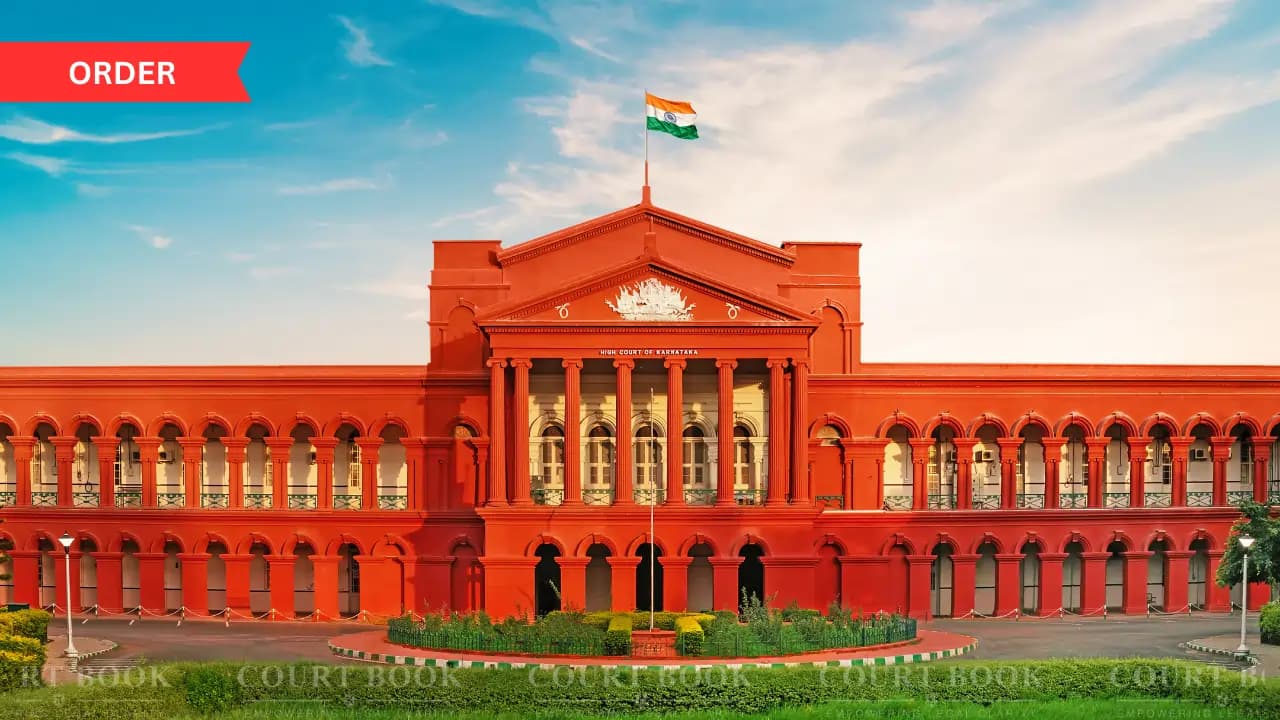
In a significant ruling on cybercrime and sentencing, the Karnataka High Court at Dharwad has upheld the conviction of two men for ATM card cloning and theft but reduced their prison term, replacing the remaining sentence with a hefty fine of ₹2 lakh each.
The order was passed by Justice V. Srishananda on January 23, 2026, in a criminal revision petition challenging concurrent findings of the trial and appellate courts.
Read also:-Gujarat HC Clears Way for Police Recruit, Says Minor, Quashed FIR Can’t Block Appointment
Background of the Case
The petitioners, Sahadevaprasad alias Prasad and Jayabhadhakumar, were earlier convicted in 2013 by a trial court in Dharwad. They were found guilty under Section 66(c) of the Information Technology Act, 2008 (identity theft involving misuse of electronic credentials) and Section 380 read with Section 34 of the Indian Penal Code (theft committed with common intention).


According to the prosecution, the accused had duplicated ATM cards belonging to three individuals and withdrew money from their bank accounts by stealing their passwords. The trial court sentenced them to three years’ and two years’ simple imprisonment respectively, along with fines.
The appellate court later confirmed both the conviction and the sentence.
Unhappy with the outcome, the accused approached the High Court, arguing that there was no proper identification parade, no bank statements proving unauthorized withdrawals, and that key recovery witnesses had turned hostile.
Arguments Before the Court
Counsel for the petitioners argued that there was no direct proof that the accused had cloned the ATM cards or withdrawn money. He stressed that the complainants identified the accused only during court proceedings and before the police, which, he claimed, was not legally sufficient.
He also sought leniency, pointing out that the accused were first-time offenders and that the incident was isolated.
On the other side, the State strongly opposed any relief. The government counsel submitted that the accused had “misused technology to defraud innocent cardholders” and had acted with planning and intelligence. According to the State, the nature of the offence did not deserve sympathy.
Read also:-Supreme Court Clears Siddhartha Reddy in Actress Pratyusha Death Case, Says No Proof of Abetment
Court’s Observations
After examining the record, the High Court found no reason to disturb the conviction.
“The material evidence is sufficient enough to maintain the conviction,” the bench observed. It noted that the investigation had gathered adequate proof showing that the petitioners duplicated ATM cards and withdrew money from the victims’ accounts.
The Court also referred to the findings of the appellate court, which had re-examined the evidence and reached the same conclusion.
However, the judge took a broader view while considering the sentence.
The trial court had earlier considered granting the benefit of the Probation of Offenders Act but declined, citing the nature of the offence and the manner in which technology was used.
At the revision stage, the High Court noted that the petitioners had already spent 41 days in custody in 2011. It also recorded that they were now residing in Bihar and earning their livelihood through employment.
In a telling remark, the Court said, “Every sinner has a future and the criminal justice system should hate the crime and not the criminal.”
Read also:-Supreme Court Clears Siddhartha Reddy in Actress Pratyusha Death Case, Says No Proof of Abetment
The Decision
While maintaining the conviction under the Information Technology Act and the Indian Penal Code, the High Court modified the sentence.
The period already spent in custody-from March 1, 2011, to April 12, 2011-was treated as the substantive imprisonment.
Instead of directing the accused to undergo the remaining jail term, the Court enhanced the fine to ₹2,00,000 each. The amount must be paid before February 20, 2026, failing which they will have to surrender and serve the remaining sentence as originally ordered.
Out of the fine recovered, ₹50,000 each will be paid as compensation to two of the victims, and ₹25,000 to the third victim. The remaining amount will go to the State towards expenses.
With these modifications, the criminal revision petition was partly allowed, and the conviction stood affirmed.
Case Title: Sahadevaprasad @ Prasad & Anr. v. State of Karnataka
Case No.: Criminal Revision Petition No. 100019 of 2025
Decision Date: 23 January 2026



