

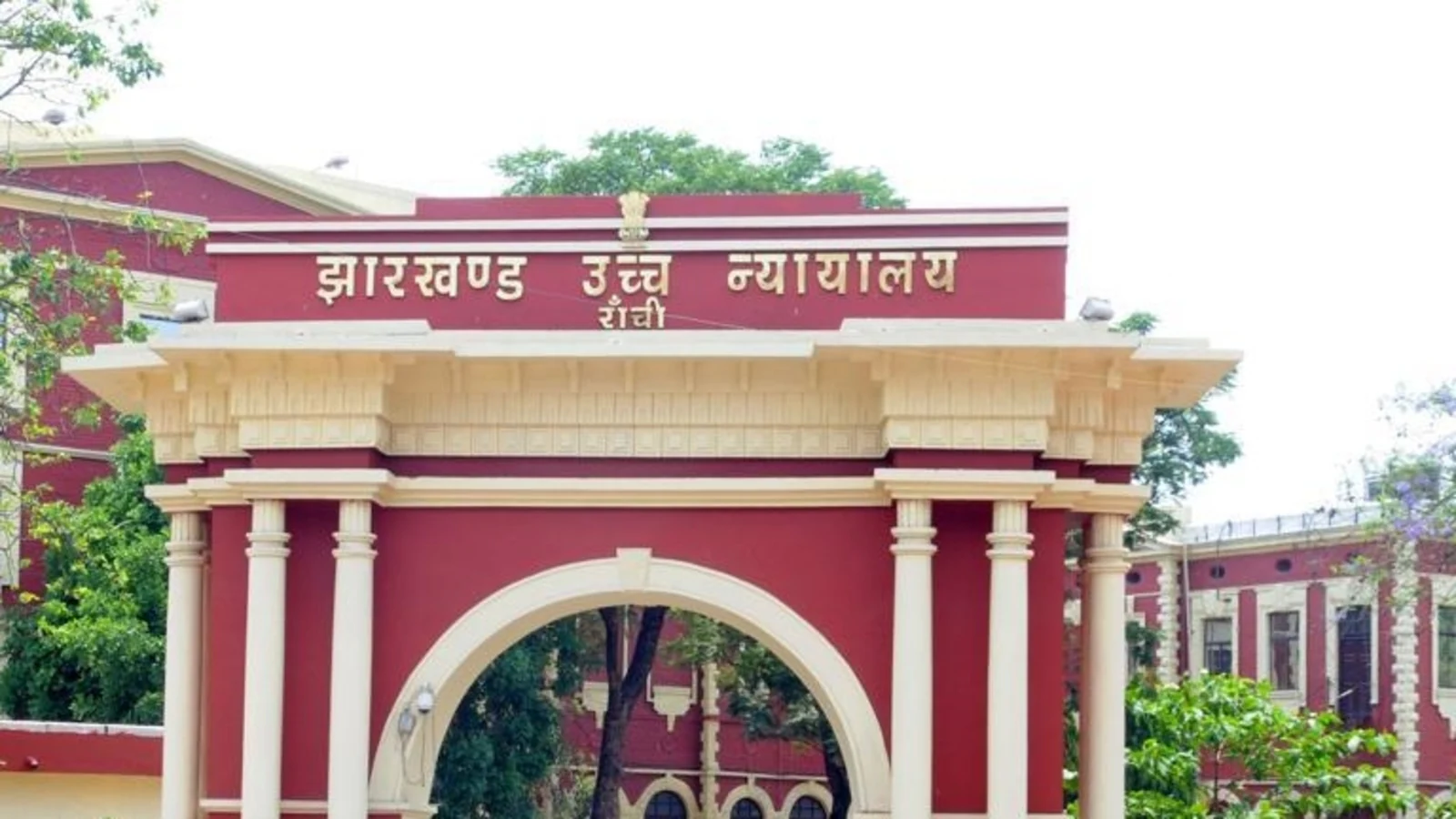
In a dramatic post-lunch hearing on Wednesday, the Jharkhand High Court stepped in to halt police action in two criminal cases arising from a road accident in Ranchi. Justice Sanjay Kumar Dwivedi ordered a stay on further proceedings and directed that no coercive steps be taken against advocate Manoj Tandon until the next hearing.
The matter was mentioned urgently at 1:30 p.m., with the petitioner alleging police harassment and violation of arrest guidelines.
Read also:-Bombay High Court Allows Single Mother to Change Daughter’s Name, Caste in School Records
Background of the Case
The case relates to an incident on February 17, 2026. According to the petitioner, he was driving to the High Court when a motorcycle allegedly came in front of his car, resulting in a minor collision. An altercation followed.
Two FIRs were registered at Doranda Police Station - Case No. 51 of 2026 and Case No. 52 of 2026 - under various provisions of the Bharatiya Nyaya Sanhita, 2023 (BNS).
The petitioner claimed he was kept at the police station from 10 a.m. to 5 p.m. and that his vehicle was taken into custody without a proper seizure memo at that time. He also alleged that the two cross-cases were assigned to different investigating officers.
Appearing for the petitioner, senior counsel argued that the situation had taken a “very alarming” turn. It was submitted that the motorcycle rider’s social media profile contained references to a banned organization and that the matter required investigation by a central agency.
Read also:-Rajasthan High Court Refuses Relief to New Nursing Colleges, Says Counselling Cannot Be Reopened
The counsel further alleged that the petitioner’s residence and the police station were surrounded by a large crowd and that there was apprehension of arrest without compliance with statutory safeguards.
Arguments on Arrest Guidelines
The court examined whether police action complied with established safeguards against arbitrary arrest.
Referring to the Supreme Court’s ruling in Arnesh Kumar v. State of Bihar, the bench noted that arrests cannot be made mechanically and must follow statutory conditions. The guidelines, now reflected in Section 35(3) of the BNSS, require police to justify the necessity of arrest.
The court also cited D.K. Basu v. State of West Bengal, which laid down procedural safeguards during arrest and detention.
Further reliance was placed on Md. Asfak Alam v. State of Jharkhand, where the Supreme Court reiterated that police must issue notice of appearance and record reasons before arresting an accused in appropriate cases.
Justice Dwivedi observed in court that when two cases arise from the same incident, “both are required to be investigated by one investigating officer.”
Read also:-Jharkhand HC Seeks Answers on 437 Custodial Deaths, Orders Home Secretary to Clarify Judicial
Court’s Observations
The judge made it clear that courts ordinarily do not interfere in policy matters and that investigation at the initial stage should not be routinely stalled. He referred to the Supreme Court’s decision in Neeharika Infrastructure Pvt. Ltd. v. State of Maharashtra, which cautions against staying investigations at the FIR stage except in rare cases.
At the same time, the court remarked that the federal structure of the Constitution must be preserved and that the High Court has a duty to intervene when serious concerns are brought before it.
“The High Court is required to rise to the occasion,” the bench observed during the hearing.
Counsel for the Union of India and the CBI submitted that giving the matter a different colour could create wider problems in the city. They stated that if directed by the court, the agencies would act accordingly.
The State sought four weeks’ time to file a counter affidavit.
Read also:-Karnataka High Court Cuts Jail Term in ATM Cloning Case, Enhances Fine to ₹2 Lakh Each
The Decision
After hearing all sides, the High Court passed interim directions:
• Further proceedings, including investigation, in Doranda P.S. Case Nos. 51 and 52 of 2026 are stayed.
• No coercive step shall be taken against the petitioner in Case No. 51 of 2026 pending before the Judicial Magistrate First Class-XIII, Ranchi.
• The Senior Superintendent of Police, Ranchi, has been directed to assess the situation and ensure that no harm comes to the petitioner.
The court also disposed of an interlocutory application seeking exemption from filing a certified copy of the FIR, granting liberty to file it later as a supplementary affidavit.
The matter will next be heard on March 24, 2026.
Case Title: Manoj Tandon v. State of Jharkhand & Ors.
Case No.: W.P.(Cr.) Filing No. 4238 of 2026
Decision Date: 19 February 2026


