

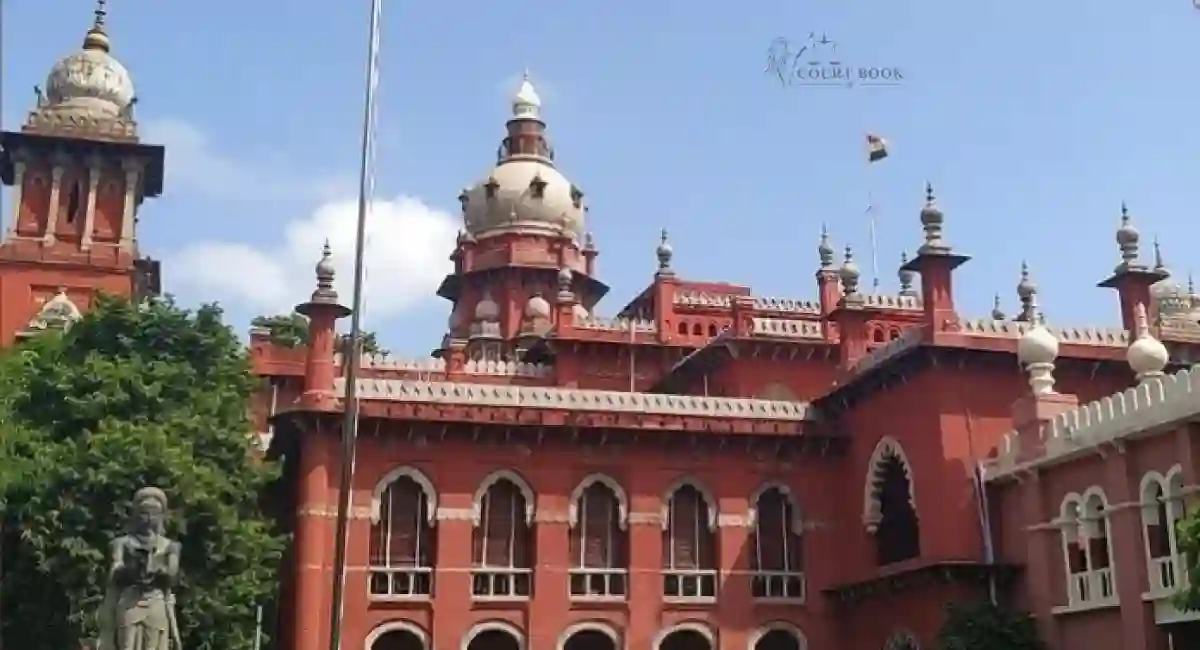
The Madras High Court has stepped into a bitter land dispute in Erode district, ruling that a decades-old burial ground cannot be disturbed or treated as a mere cart track simply because revenue records say so.
In a detailed order delivered on February 11, 2026, Justice V. Lakshminarayanan directed authorities to fence and protect the burial site in Karumandisellipalayam Town Panchayat, while dismissing two petitions that sought to stop cremations and burials there.
Read also:-Bombay High Court Allows Single Mother to Change Daughter’s Name, Caste in School Records
Background of the Case
The dispute revolved around land in Survey Nos. 621/3 and 628/8 in Thiruvengadampalayam village, under Karumandisellipalayam (Special Grade) Town Panchayat in Erode district.
One group of petitioners claimed the land was officially classified as a “cart track” in revenue records and was being wrongly used for burials. They argued that:
• The burial activity blocked access to their properties.
• A modern crematorium was available within 1.5 km.
• The land should not be reclassified as a burial ground.
• A recent burial during the pendency of the case violated court directions.
In contrast, local residents and another petitioner asserted that the land had been used as a burial and cremation ground for over 70 years. They alleged that:
• Graves and memorial stones were recently destroyed using machinery.
• Trees were uprooted and the ground was levelled.
• Skeletal remains had been disturbed.
• The burial ground was used by multiple communities, including members of the Scheduled Caste Arunthathiyar community.
The District Collector’s report confirmed that while the land was recorded as a cart track, substantial portions had long been used as a burial ground. It also noted that graves had been disturbed and penalties imposed for illegal tree cutting.
Read also:-Rajasthan High Court Refuses Relief to New Nursing Colleges, Says Counselling Cannot Be Reopened
Court’s Key Observations
Justice Lakshminarayanan made it clear that the case could not be decided merely by looking at revenue labels.
“The dead are also entitled to dignity,” the court observed, stressing that the right to life under Article 21 of the Constitution extends to a dignified burial.
The judge examined past Town Panchayat resolutions, including one from 2000 that referred to laying a “Cemetery Road” to provide access to the burial ground. This, along with official records and photographs, convinced the court that the land had indeed been functioning as a burial site for at least 25 years - if not longer.
Importantly, the court clarified that Karumandisellipalayam is a Special Grade Town Panchayat governed by urban local body laws, not the Tamil Nadu Panchayats Act as argued by many lawyers during the hearing.
Under the Tamil Nadu Urban Local Bodies Act, burial or cremation can take place only in registered or licensed places. However, the court noted that the Town Panchayat has a constitutional duty to provide and maintain burial grounds.
Read also:-Jharkhand HC Seeks Answers on 437 Custodial Deaths, Orders Home Secretary to Clarify Judicial
“If a modern crematorium is available, it is for the council to issue a notification banning cremations elsewhere,” the bench said. “Until such notification is issued, the plea to prohibit burials cannot be accepted.”
The court was particularly disturbed by the levelling of graves.
“On account of rivalry between siblings, the dead have not been left at peace,” the judge remarked, adding that such acts strike at the “temporal sanctity of a grave.”
The order also pointed out that denying access to burial grounds for Scheduled Caste communities could amount to a violation under the SC/ST (Prevention of Atrocities) Act.
Read also:-Karnataka High Court Cuts Jail Term in ATM Cloning Case, Enhances Fine to ₹2 Lakh Each
The Final Decision
The court disposed of the petition seeking protection and reclassification of the burial ground with specific directions:
1. The District Collector must ensure the burial and cremation areas in Survey Nos. 621/3 and 628/8 are properly segregated and fenced.
2. The Town Panchayat must keep the area free from encroachment and garbage dumping.
3. Revenue authorities must act on the Town Panchayat’s resolution dated October 14, 2025, and exclude the burial portions from the “cart track” classification.
4. The Collector must initiate action against those responsible for levelling the graves.
At the same time, the court dismissed the two other writ petitions that sought to prevent burials and demanded exhumation of a recently buried body.
With that, the High Court brought an end - for now - to a dispute that had pitted landowners against grieving families and raised uncomfortable questions about dignity, tradition, and local governance.
Case Title: K.S. Balakrishnan vs District Collector, Erode & Others (Connected Cases)
Case No.: W.P. Nos. 36402, 37501 & 44377 of 2025
Decision Date: 11 February 2026


