

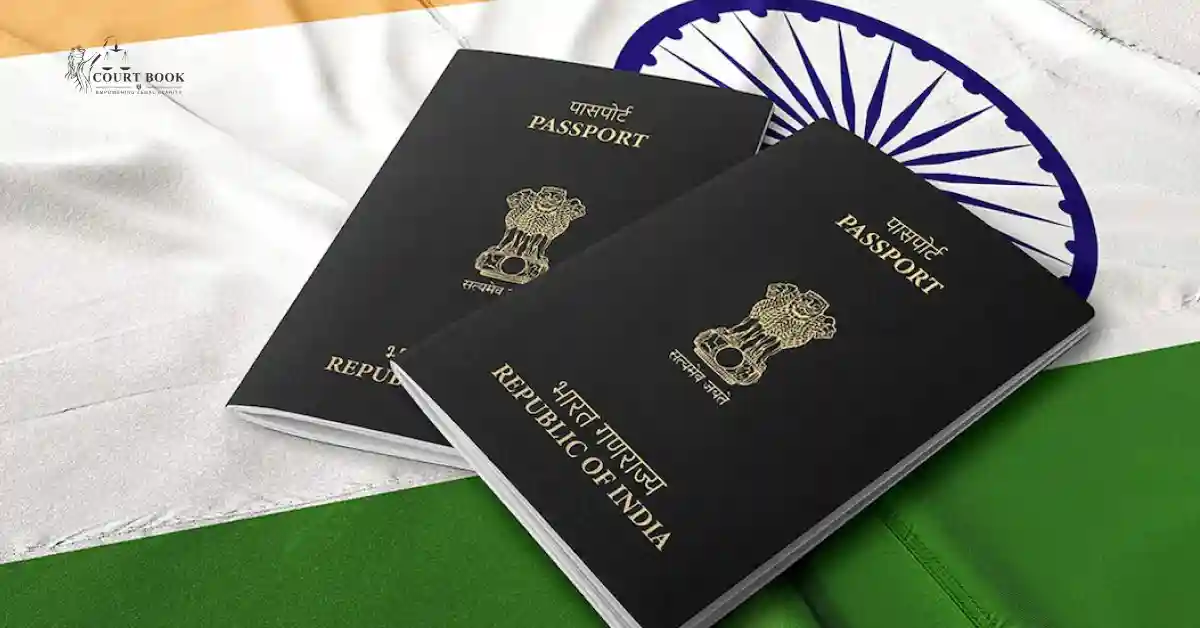
In a significant ruling on passport renewals, the Madras High Court has clarified that reissuing or renewing a passport is not a mere formality. If a criminal case is pending against an applicant, prior permission from the trial court is mandatory - just as in the case of a fresh passport application.
A three-judge bench settled conflicting views expressed earlier by different Division Benches of the court.
Read also:-Bombay HC Disposes Unmarried Woman’s Abortion Plea, Cites Supreme Court Ruling on MTP Rights
Background of the Case
The case was filed by Jawahar Rajan, a businessman whose passport is valid until March 3, 2026. In August 2025, he applied under the Tatkaal scheme for reissue of his passport.
However, the Regional Passport Office in Coimbatore issued a show cause notice on September 11, 2025, citing an adverse Police Verification Report. The report revealed that a criminal case - Crime No. 26 of 2021 - was pending against him before the Judicial Magistrate No. I, Madurai.
The charges included conspiracy and cheating under the Indian Penal Code. The case had already been taken on file as C.C. No. 1730 of 2022.
Rajan argued that the complaint was false and that he had no intention of evading trial. He told the court that since the trial had not yet begun, it could not be treated as “criminal proceedings pending before a court.” He sought a direction to quash the passport office’s communication and to reissue his passport.
Read also:-Calcutta High Court Refuses to Quash Forgery Case Linked to 1963 Land Deed, Orders Police Prob
Why the Case Went to a Larger Bench
A Single Judge referred the matter to a larger bench after noting conflicting judgments on the issue.
In one earlier case, the court had directed passport authorities to process renewal without insisting on court permission. In another, a different bench held that prior approval from the criminal court was mandatory.
To resolve this confusion, the larger bench framed a key question:
Should passport renewal be treated the same as a fresh passport application?Court’s Observations
Delivering the judgment, Justice G. Jayachandran explained that the Passports Act does not distinguish between fresh issuance and renewal when it comes to legal restrictions.
“The restrictions contained in Section 6(2)(f) apply not only for fresh applications but also to reissue or renewal,” the bench observed .
Section 6(2)(f) of the Passports Act allows authorities to refuse a passport if criminal proceedings are pending before a court in India.
The bench also referred to a 1993 government notification (GSR 570(E)), which offers limited relief. Under this notification, a passport may be issued if the applicant obtains permission from the court where the case is pending.
Read also:-Bombay High Court Flags Flawed Tree-Felling Notices, Closes Pune Coconut Trees Case
“The persons facing criminal proceedings are not absolutely disentitled to a passport,” the court clarified. “However, they must comply with the statutory requirements.”
Importantly, the judges interpreted the phrase “criminal proceedings pending” broadly.
“The expression ‘criminal proceedings pending’ means the stage from taking cognizance of the crime by the criminal court till the case attains finality,” the bench said .
This means that once a court has taken cognizance - even if trial has not started - the case is considered pending for the purpose of passport restrictions.
On Right to Travel
The court acknowledged that the right to travel abroad has constitutional protection, referring to the Supreme Court’s earlier ruling in Satwant Singh Sawhney v. Union of India.
But it emphasized that this right is not absolute.
“A passport is a civil document that enables its holder to cross international borders,” the bench noted. “The right to leave the country is subject to the permission of the criminal court, which can impose conditions or refuse leave altogether.”
The judges also clarified that the exemption notification must be “strictly applied” and does not dilute the statutory bar unless court permission is produced.
Read also:-Karnataka High Court Quashes Cheque Bounce Conviction After Finding Serious Gaps in Trial
Decision in Rajan’s Case
Applying the law to the facts, the bench noted that on the date Rajan applied under the Tatkaal scheme, a criminal case had already been taken cognizance of and was pending trial before the Judicial Magistrate.
Therefore, he was required to obtain prior permission from the concerned court and submit it along with his passport application.
“In fine, the question of reference is answered affirmatively that reissue / renewal of a passport has to be treated in the same manner as issuance of a fresh passport,” the bench held .
The writ petition was disposed of without costs.
Case Title: Jawahar Rajan v. Regional Passport Officer & Anr.
Case No.: W.P.(MD) No. 26547 of 2025
Decision Date: 09 February 2026


