

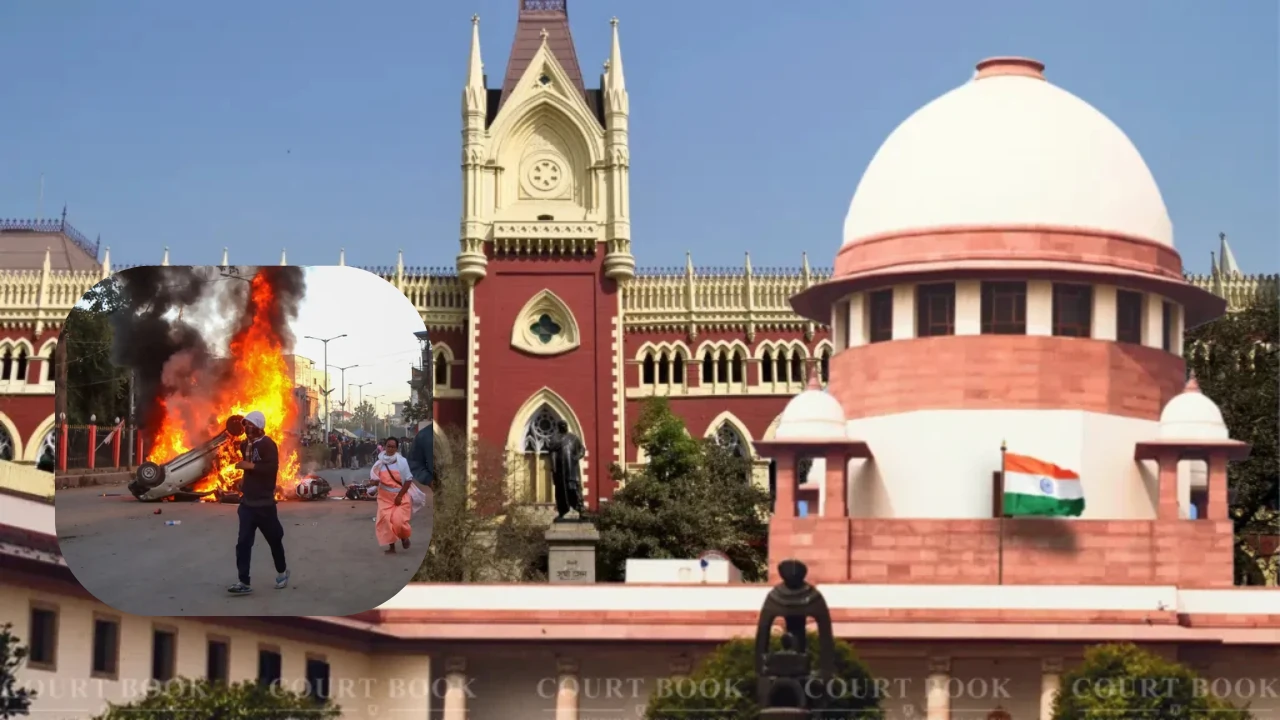
In a sharp exchange inside Court No. 1 on Wednesday, the Supreme Court of India questioned the National Investigation Agency’s decision to invoke anti-terror provisions in connection with the recent violence in Beldanga, West Bengal.
Hearing petitions filed by the State government, the Bench made it clear that branding a local flare-up as a threat to “economic security” requires solid material-not assumptions.
Read also:-Bombay HC Disposes Unmarried Woman’s Abortion Plea, Cites Supreme Court Ruling on MTP Rights
“Every emotional outburst cannot be packaged as a threat to economic security,” Justice Joymalya Bagchi remarked during the hearing, as the courtroom fell silent.
Background of the Case
The violence broke out in January in Beldanga, Murshidabad district, after the body of 30-year-old Alauddin Sheikh was brought from Jharkhand to his native village. Allegations of murder triggered protests that soon escalated. Roads were blocked, public property damaged, and a journalist was reportedly attacked.
Police registered four FIRs and arrested over 30 persons.
On January 20, the Calcutta High Court, hearing public interest petitions filed by BJP leader Suvendu Adhikari and another resident, allowed deployment of Central Armed Police Forces in the area. The High Court also observed that it would be open to the Centre to consider an NIA probe.
Subsequently, the Union Home Ministry directed the National Investigation Agency to investigate the matter. The agency invoked provisions of the Unlawful Activities (Prevention) Act, 1967 (UAPA), particularly Section 15, which defines a “terrorist act.”
Challenging both the High Court’s observations and the Centre’s direction, the West Bengal government approached the Supreme Court.
Read also:-Calcutta High Court Refuses to Quash Forgery Case Linked to 1963 Land Deed, Orders Police Prob
Court’s Sharp Questions on UAPA Invocation
The Bench, led by Chief Justice of India Surya Kant and Justice Joymalya Bagchi, expressed concern over how the NIA concluded that the violence affected India’s “economic security,” a requirement under Section 15 of UAPA.
Justice Bagchi pointed out that the State had not yet handed over the case diary to the NIA when it invoked the law.
“Without looking into documents, you have said Section 15 UAPA is justified. The case diary was not placed before you… this is a pre-decisional conclusion,” he observed.
The Court noted that similar violence had taken place in April 2025. At that time too, the High Court had left it open for the NIA to examine the matter, yet the agency had not immediately stepped in.
“In April 2025, we saw this kind of violence… High Court division bench asked NIA to see if probe can be conducted. But then NIA slept over it!” Justice Bagchi remarked.
The judges indicated that invoking anti-terror law is not a routine step and must be backed by material showing intent to threaten the nation’s economic stability.
Read also:-Bombay High Court Flags Flawed Tree-Felling Notices, Closes Pune Coconut Trees Case
Arguments from Both Sides
Senior Advocate Kalyan Banerjee, appearing for the West Bengal government, argued that the case did not involve explosives or any intent to destabilise the economy.
“You can say there was no use of explosives and that there was no intention to affect economic security,” Justice Bagchi told the State’s counsel, suggesting the issue could be reconsidered by the High Court.
On the other side, Additional Solicitor General S.V. Raju, representing the NIA, defended the probe. He said the region’s proximity to the Bangladesh border and the alleged use of deadly weapons justified an independent investigation.
“This is a porous border near Bangladesh. There was violence and deadly weapons were used… We are doing independent investigation… they are not handing over probe papers to us,” he submitted, urging the Court to direct the State to cooperate.
Banerjee responded sharply, alleging selective action by the agency. “Only in West Bengal, the NIA is active!” he said.
ASG Raju rebutted the claim, saying the agency acts where circumstances demand.
Read also:-Karnataka High Court Quashes Cheque Bounce Conviction After Finding Serious Gaps in Trial
Supreme Court’s Decision
After hearing both sides, the Supreme Court refrained from expressing any view on the merits of the case. Instead, it directed that the matter be reconsidered by the Calcutta High Court.
The NIA has been asked to submit a status report in a sealed cover before the High Court, clarifying whether there is a prima facie case-meaning at first glance-for continuing the investigation under UAPA.
“Go back to the High Court and make a plea for reconsideration,” Justice Bagchi said.
CJI Surya Kant added, “Whether UAPA should be invoked or not… We will ask NIA to submit a report on this in sealed cover.”
The Bench clarified that it had not made any observations on the merits and directed that the case be heard by a Division Bench headed by the Chief Justice of the Calcutta High Court, before whom a related plea is already pending.
With that, the Supreme Court disposed of the petitions, leaving the final word-for now-to the High Court.
Case Title: State of West Bengal vs Union of India & Anr.
Case No.: (Petitions challenging HC order & MHA direction, 2026)
Decision Date: February 11, 2026


