

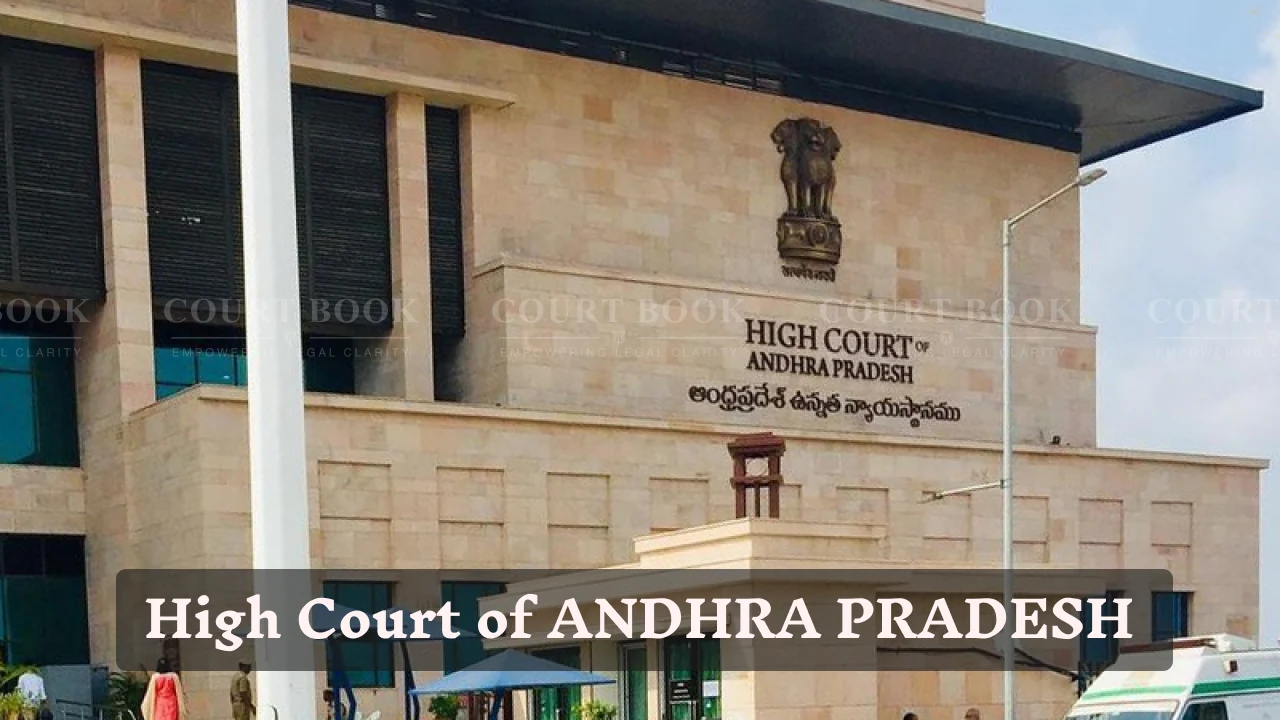
In a significant order affecting a long-pending family dispute, the Andhra Pradesh High Court has restored a 2009 partition suit that had been dismissed as abated by a trial court in Prakasam district.
Justice Justice Harinath.N allowed three Civil Revision Petitions and held that the trial court took an overly technical view while refusing to condone a delay of 2294 days in bringing legal heirs on record.
The common order was pronounced on January 21, 2026.
Read also:-Bombay HC Disposes Unmarried Woman’s Abortion Plea, Cites Supreme Court Ruling on MTP Rights
Background of the Case
The dispute traces back to O.S. No. 58 of 2009, a suit for partition filed before the Senior Civil Judge at Darsi. The suit was originally instituted by the petitioners’ father seeking division of family property, with his own father arrayed as the sole defendant.
During the pendency of the case, the original plaintiff passed away. However, his legal heirs did not immediately step in to continue the proceedings. As a result, the suit stood “abated” - a legal term meaning it automatically lapsed because required steps were not taken within the prescribed time.
Nearly six years later, the legal heirs filed three applications:
• To condone the delay of 2294 days,
• To set aside the abatement,
• To bring themselves on record as legal representatives.
On July 17, 2022, the trial court dismissed all three applications. The court reasoned that the petitioners failed to explain the delay “day-to-day,” which is usually required when seeking condonation of delay.
Aggrieved, the family approached the High Court under Article 227 of the Constitution.
Read also:-Calcutta High Court Refuses to Quash Forgery Case Linked to 1963 Land Deed, Orders Police Prob
Petitioners’ Stand Before the High Court
Appearing for the petitioners, counsel argued that the heirs were unaware of the very existence of the partition suit. They claimed they came to know about it only after their father’s death in March 2013, when they found a copy of the plaint at home.
They then made inquiries and took steps to pursue the case as legal heirs. By that time, however, the suit had already abated.
The petitioners contended that in a partition suit - which concerns family property and substantial rights - courts should adopt a liberal approach. Technicalities, they argued, should not defeat substantive justice.
They relied on Supreme Court judgments including Bhagwan Swaroop v. Mool Chand (AIR 1983 SC 355), Ram Sumiran v. D.D.C. (AIR 1985 SC 606), and Collector, Land Acquisition v. Mst. Katiji (AIR 1987 SC 1353), which emphasize a justice-oriented approach in delay matters.
Court’s Observations
Justice Harinath closely examined whether the trial court passed a “reasoned order” while rejecting the applications.
The High Court noted that the respondents did not even file counters opposing the delay applications. Still, the trial court dismissed them solely for failure to explain the delay day-by-day.
Read also:-Bombay High Court Flags Flawed Tree-Felling Notices, Closes Pune Coconut Trees Case
Referring to the Supreme Court rulings, the bench observed that courts must adopt a pragmatic approach. Quoting from precedent, the judge noted that “there is no presumption that delay is occasioned deliberately.”
The Court found the explanation given by the petitioners - that they discovered the plaint after their father’s death - to be believable.
“The explanation offered by the petitioners regarding their discovery of the plaint is believable and ought to have been accepted by the trial Court,” the bench observed.
The High Court also held that the dismissal of an earlier Civil Revision Petition in 2012 had no bearing on the present case, since that earlier matter had become infructuous after the suit itself had abated.
Importantly, the Court emphasized that in partition matters, it is in the interest of all parties that the dispute be decided on merits rather than shut out on procedural grounds.
The bench remarked that the concept of explaining “day-to-day delay” evolved to prevent abuse of process, not to defeat genuine claims in family property disputes.
Read also:-Karnataka High Court Quashes Cheque Bounce Conviction After Finding Serious Gaps in Trial
The Decision
Setting aside the trial court’s order, the High Court allowed all three Civil Revision Petitions.
The suit in O.S. No. 58 of 2009 has now been restored to the file of the trial court. The petitioners have been permitted to take steps to bring the legal heirs of the deceased defendant on record.
No costs were imposed. All pending miscellaneous applications were closed.
The order effectively reopens a 17-year-old family partition dispute for adjudication on merits.
Case Title: Gogulapalli Khadar Mohiddin (Died) & Ors. v. Gogulapalli Khadar (Died) & Ors.
Case No.: Civil Revision Petition Nos. 2075, 2076 & 2077 of 2022
Decision Date: 21 January 2026


